Both Ruling and Opposition Parties Classify About 50 Key Battlegrounds
Both Parties Fight to Boost Supporters' Voter Turnout
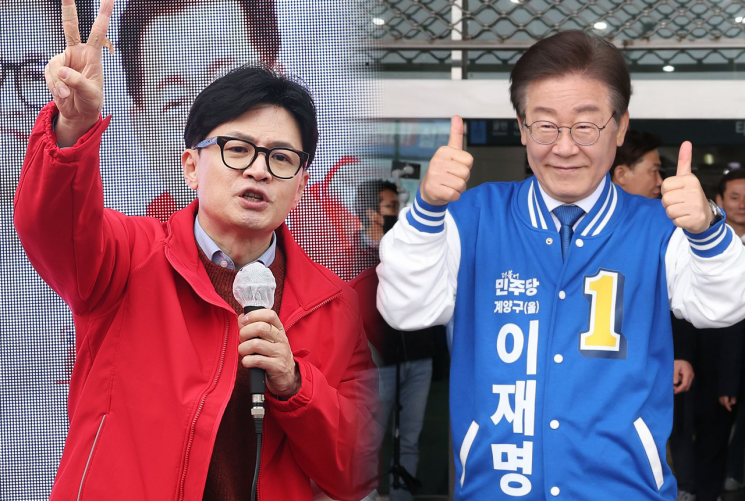 Handonghun, Emergency Response Committee Chairman of the People Power Party (left), and Lee Jaemyung, Leader of the Democratic Party of Korea (right)
Early voting for the 22nd National Assembly general election began on the 5th. Out of a total of 254 constituencies, about 50 are identified as competitive districts. With the election outcome difficult to predict, Han Dong-hoon, Emergency Response Committee Chairman of the People Power Party, and Lee Jae-myung, Leader of the Democratic Party of Korea, have launched all-out efforts to increase voter turnout. As many ultra-close battleground areas with razor-thin support rates emerge, a tense atmosphere that cannot be relaxed until the end is being sensed in various places.
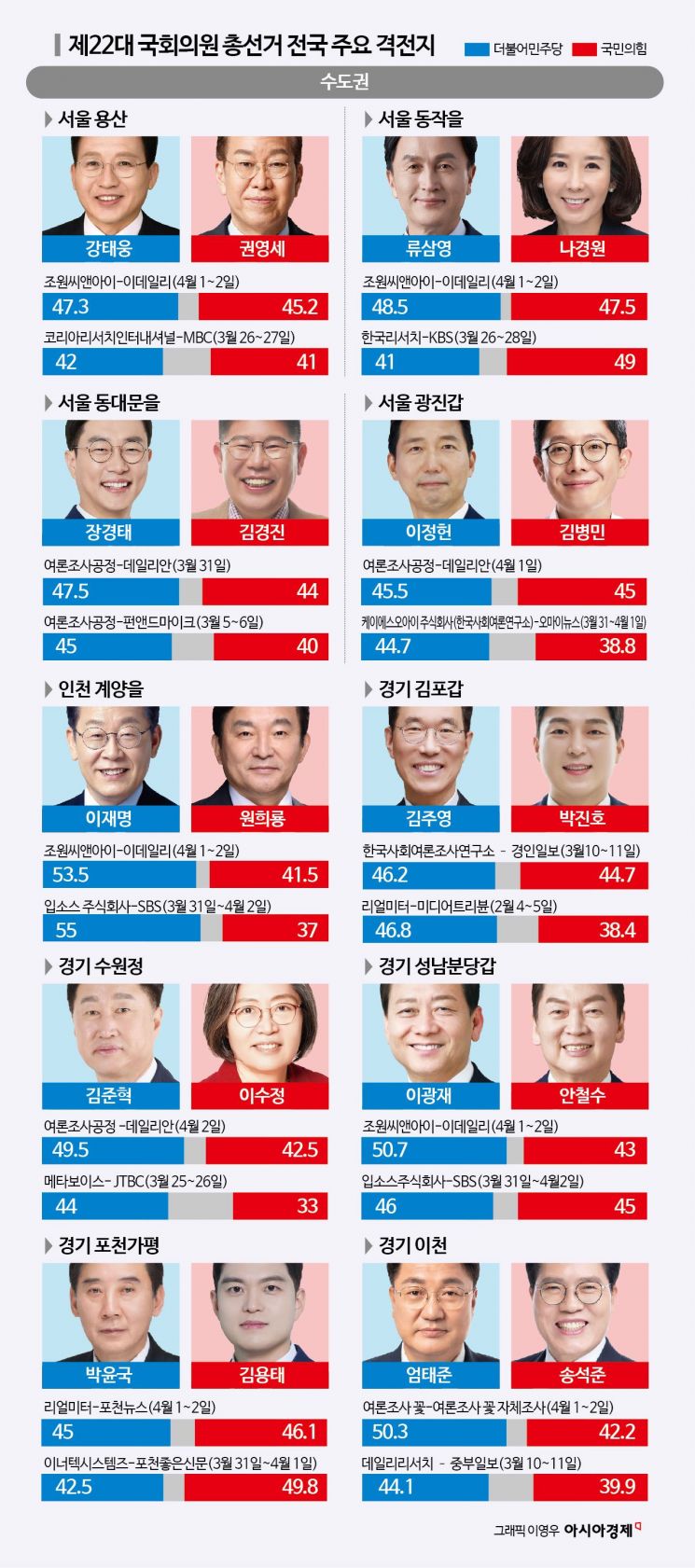
◆ Unpredictable back-and-forth in the metropolitan area = Incumbent People Power Party candidates in the metropolitan area are struggling fiercely. Yongsan, dubbed the "new political hotspot" due to the presidential office relocation, is a representative example. In a rematch after four years, the vote difference between Kwon Young-se, the People Power Party candidate who won the last general election, and Kang Tae-woong, the Democratic Party candidate, was 890 votes. This time, the outcome is also hard to predict. According to a public opinion poll conducted by Jowon C&I commissioned by Edaily on April 1-2 among 501 Yongsan-gu residents using wireless ARS (sampling error 95%, confidence level ±4.4 percentage points, response rate 7.1%), Kang received 47.3% support, while Kwon had 45.2%.
In Seoul's Gwangjin-gap and Dongdaemun-eul, traditionally Democratic Party strongholds, ruling party candidates are narrowing the support gap and performing well. According to a poll conducted by Polling Integrity commissioned by Dailyan on March 31 among 500 Dongdaemun-eul residents (sampling error 95%, confidence level ±4.4 percentage points, response rate 4%), Democratic candidate Jang Kyung-tae received 47.5%, and People Power Party candidate Kim Kyung-jin 44%, indicating a close race within the margin of error. Gwangjin-gap candidates Lee Jeong-heon (Democratic) and Kim Byung-min (People Power) are also in a neck-and-neck contest. A poll conducted on April 1 among 504 respondents (sampling error 95%, confidence level ±4.4 percentage points, response rate 4.4%) showed a 0.5 percentage point difference between the two. In Seoul Dongjak-eul, where Lee Jae-myung has visited six times for campaign support, the support rates between Ryu Sam-young and Na Kyung-won are extremely close.
Some candidates have been hampered by controversies. Kim Jun-hyuk of the Democratic Party, embroiled in controversy over his remarks about "female Ewha University students and U.S. military sexual bribery," has seen his support gap with People Power Party candidate Lee Soo-jung narrow significantly. In a poll conducted by Metavoice commissioned by JTBC on March 25-26 among 504 local residents (sampling error 95%, confidence level ±4.4 percentage points, response rate 10%), the two were outside the margin of error, but in a poll released on April 2 by Polling Integrity (504 respondents, wired and wireless ARS, sampling error 95%, confidence level ±4.4 percentage points, response rate 5.2%), the difference was within the margin of error.
In Seongnam Bundang, Democratic candidate Lee Kwang-jae and People Power Party candidate Ahn Cheol-soo are locked in an unpredictable race with a 1 percentage point difference. According to a wireless telephone interview poll conducted by Ipsos commissioned by SBS from March 31 to April 2 among 502 Bundang residents (sampling error 95%, confidence level ±4.4 percentage points, response rate 13.8%), Lee received 46% support, and Ahn 45%.
◆ Shaken Busan public sentiment amid 'regime judgment theory' = In Busan and Gyeongnam (PK), where 34 seats are at stake, the number of competitive districts is increasing unexpectedly due to the rise of the regime judgment theory.
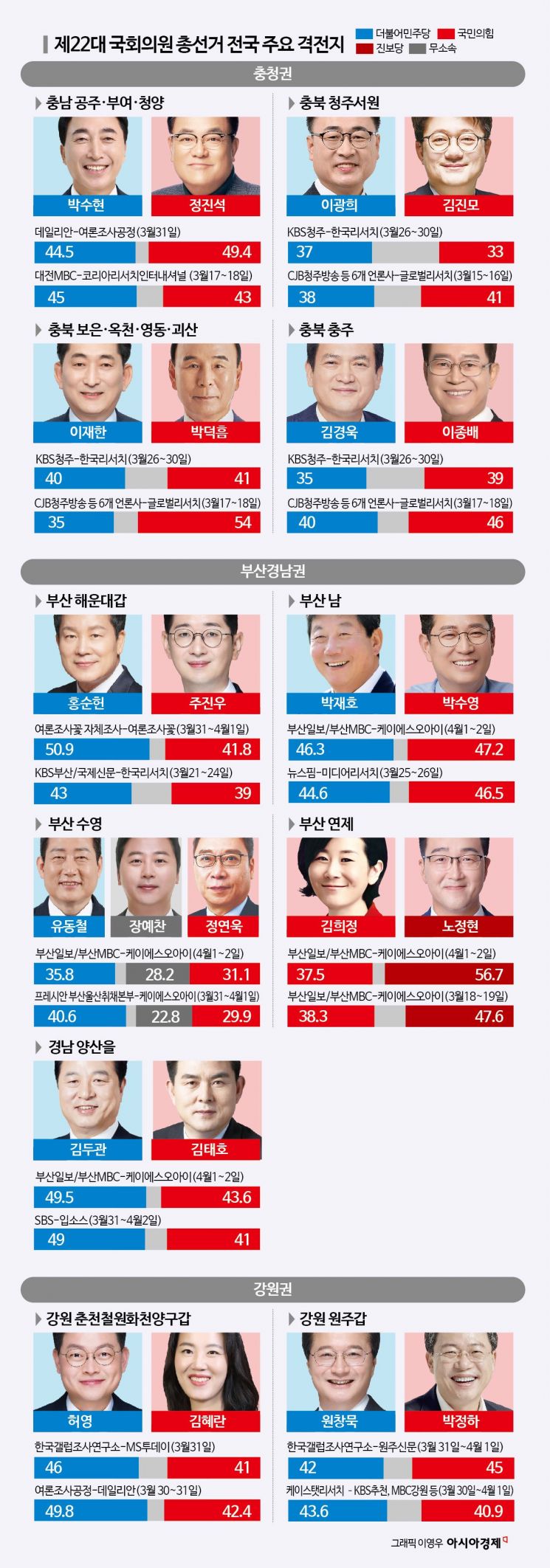
In Busan Nam, incumbent Park Soo-young of the People Power Party and Park Jae-ho of the Democratic Party are in an ultra-close contest. According to a poll conducted by KSOI commissioned by Busan Ilbo and Busan MBC on April 1-2 (501 respondents in Busan Nam, wireless ARS, virtual wireless phone numbers, sampling error 95%, confidence level ±4.4 percentage points, response rate 9%), Park Soo-young leads Park Jae-ho by 0.9 percentage points with 47.2% to 46.3%.
Haeundae-gap, a region with strong conservative sentiment, shows large fluctuations in support gaps between candidates across different polls. According to a poll conducted by Polling Flower on March 31-April 1 (501 respondents in Haeundae-gap, wired and wireless ARS, virtual wired and wireless phone numbers, wired phone number RDD, sampling error 95%, confidence level ±4.4 percentage points, response rate 9.5%), Democratic candidate Hong Soon-heon led People Power Party candidate Joo Jin-woo with 50.9% to 41.8%. However, in a poll conducted by Busan Ilbo and Busan MBC on March 8-9 (505 respondents in Haeundae-gap, wireless ARS, virtual wireless phone numbers, sampling error 95%, confidence level ±4.4 percentage points, response rate 6.5%), Joo led Hong with 51.3% to 41.9%.
Yangsan-eul, considered the biggest match with a former Gyeongnam governor showdown, remains competitive. According to a poll conducted by KSOI commissioned by Busan Ilbo and Busan MBC on April 1-2 (502 respondents in Yangsan-eul, wireless ARS, virtual wireless phone numbers, sampling error 95%, confidence level ±4.4 percentage points, response rate 10.5%), Democratic candidate Kim Doo-kwan received 49.5%, and People Power Party candidate Kim Tae-ho 43.6%.
◆ Undecided voter sentiment in Chungcheong = In the Chungcheong region, out of 28 total constituencies, the People Power Party leads in 9, and the Democratic Party in 11. Traditionally regarded as a casting voter region, five constituencies had the closest races with a 3 percentage point difference in the 21st general election, the highest nationwide.
Gongju, Buyeo, and Cheongyang in Chungnam are considered the biggest battlegrounds in the area. The recent support gap between People Power Party candidate Jeong Jin-seok and Democratic candidate Park Soo-hyun is 4.9 percentage points. According to a poll conducted by Polling Integrity commissioned by Dailyan on March 31 (500 respondents in Gongju, Buyeo, Cheongyang, wired and wireless ARS, response rate 12.1%), Jeong received 49.4%, and Park 44.5%. This election marks their third face-off. In the previous 20th and 21st general elections, Jeong won by margins of 3.17 and 2.22 percentage points, respectively. However, Jeong should not be complacent. In a poll conducted by Korea Research International commissioned by Daejeon MBC on March 17-18 (501 respondents in Gongju, Buyeo, Cheongyang, 100% wireless telephone interviews, response rate 21.7%), Park led Jeong by 2 percentage points with 45% to 43%.
Looking at support gaps, Boeun, Okcheon, Yeongdong, and Goesan in Chungbuk are even more competitive. According to a poll conducted by Hankook Research commissioned by KBS Cheongju on March 26-30 (501 respondents, 100% wireless telephone interviews, response rate 18.9%), People Power Party candidate Park Deok-heum received 41%, and Democratic candidate Lee Jae-han 40%, a 1 percentage point difference.
Chungju in Chungbuk, where Democratic candidate Kim Kyung-wook's four-year-old cash envelope controversy has escalated into a 'negative controversy,' is also a close race within the margin of error. According to a poll conducted by Hankook Research commissioned by KBS Cheongju on March 26-30 (502 respondents, 100% wireless telephone interviews, response rate 15%), People Power Party candidate Lee Jong-bae received 39%, and Kim 35%, showing a close race within the margin of error. Meanwhile, all Chungcheong region polls have a sampling error of ±4.4 percentage points at a 95% confidence level.
◆ Narrowing margins in Gangwon = The Gangwon region's election outlook has also become difficult to predict. A representative case is Wonju-gap in Gangwon, where the atmosphere is ultra-close. According to a poll conducted by Gallup Korea commissioned by Wonju Newspaper from March 31 to April 1 among 502 respondents (sampling error 95%, confidence level ±4.4 percentage points, response rate 14.3%), Democratic candidate Won Chang-mook received 42%, and People Power Party candidate Park Jeong-ha 45%. For detailed information on the polls mentioned in this article, please refer to the Central Election Poll Deliberation Commission website.
© The Asia Business Daily(www.asiae.co.kr). All rights reserved.
![Clutching a Stolen Dior Bag, Saying "I Hate Being Poor but Real"... The Grotesque Con of a "Human Knockoff" [Slate]](https://cwcontent.asiae.co.kr/asiaresize/183/2026021902243444107_1771435474.jpg)


















