Second Expert On-Site Discussion on Set Location Retention and Demolition Held
Structural Expert: "Vulnerable to Earthquakes... Overall Reinforcement Needed When Utilized"
Also Opinions That "More Costly Than New Construction with Seismic Design"
Experts have raised safety concerns, including vulnerability to earthquakes, regarding the Goguryeo Palace set at Naju Video Theme Park, which is now at a crossroads between preservation and demolition.
They also pointed out that the set has no value for use as a drama set anymore, and if repurposed for other uses, the overall repair and reinforcement costs, such as seismic design, would be much higher than rebuilding anew.
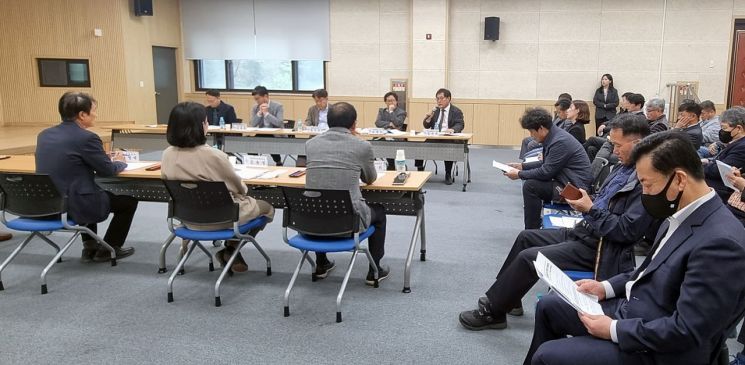
According to Naju City on the 4th, an expert on-site discussion regarding the preservation or demolition of the Goguryeo Palace set was held on the 2nd at the auditorium of the Youth Hostel in the Naju Video Theme Park Youth Culture Center, organized by the Naju Citizens' Rights Committee (Chairman Choi Young-tae).
The discussion was arranged to decide on a policy recommendation from the Citizens' Rights Committee concerning the preservation or demolition of the Goguryeo Palace set, which is located on the site of the second phase of the Namdo Militia History Park development project.
The Citizens' Rights Committee had previously held a forum on March 14 in the city hall's main conference room to gather expert opinions and public sentiment regarding the preservation or demolition of the Goguryeo Palace set.
After the forum, Chairman Choi Young-tae mentioned that another expert on-site discussion, recommended by both sides of the demolition debate, would be held and that a policy recommendation would be decided by mid-April.
At the discussion, participants included Kim In-su, CEO of Samhan A-Tech Co., Ltd. (Master of Architectural Engineering), recommended by the civic group opposing demolition; Cho Cheol-hee, CEO of the Korea Structural Safety Institute (Ph.D. in Structural Engineering), recommended by Naju City; Noh Sung-yeol, Executive Director of Korea Construction Co., Ltd. (Ph.D. in Structural Engineering); and professors Cheon Deuk-yeom, Emeritus Professor of Architecture at Chonnam National University, and Cho Chang-geun, Professor of Architectural Engineering at Chosun University, recommended by Chairman Choi.
Additionally, the vice-chairman, subcommittee chairpersons, committee members, and about 20 citizens attended the discussion as observers and later engaged in a Q&A session with the experts.
Before the main discussion, the experts conducted an on-site inspection of the Goguryeo Palace set, checking the upper wooden structures and the lower concrete structures of the set.
Chairman Choi presented key discussion points including the "structural safety of the Goguryeo Palace built as a set," "cost and economic feasibility of remodeling the Goguryeo Palace building," and "utilization plans if the existing building is preserved or the site is used after demolition."
Experts recommended by Naju City agreed that the Goguryeo Palace set at Naju Video Theme Park was constructed as a facility for drama filming, and to use it as a museum or other exhibition or assembly facility, comprehensive improvements including seismic reinforcement according to current structural design standards would be necessary.
They particularly pointed out that the set building is structured with an upper wooden structure placed on a lower steel frame, and no seismic load considerations were made in the design, making it highly vulnerable to earthquakes.
CEO Cho Cheol-hee explained, "South Korea is no longer a seismic safe zone, so how the different upper and lower structural types are anchored at strong joints is key to structural safety in the event of an earthquake."
He added, "While the Goguryeo Palace set may have been appropriately built for drama filming purposes, if it is to be used as a museum or for other purposes, seismic loads must be considered. However, this set was not designed with seismic loads in mind at all."
Professor Cho Chang-geun, recommended by the chairman, shared similar views on the importance of seismic loads and the safety of the upper and lower structures.
Professor Cho said, "Although good wood was used for the wooden structures, the connections between the main beams and columns are simple. Considering earthquakes, there are doubts about safety. It could be very vulnerable to seismic activity."
He emphasized again, "The structure is built by placing the upper structure on the lower one without strong joint connections, so there is a high risk of danger from vibrations," and suggested, "It is necessary to verify safety through a detailed inspection."
Professor Cho also noted, "There are surprisingly serious issues with the lower structure. The overall construction quality is poor, and the concrete curing and compaction work cannot be considered thorough."
He continued, "The concrete strength is currently measured at 18 to 21 MPa (megapascals), which is a severe level of deterioration for a structural member. While reinforcement is not impossible, it would require significant costs, and whether rebuilding or reinforcing is more appropriate should be concluded through a detailed safety diagnosis."
Executive Director Noh Sung-yeol of Korea Construction said, "Repair costs are higher than rebuilding, especially seismic reinforcement costs are enormous. On the other hand, rebuilding is somewhat easier and less costly than reinforcement."
Conversely, Kim In-su, CEO recommended by the civic group, argued, "The steel structure under the wooden columns is aligned in a row, so there is no problem with load-bearing. The set's wood has fire resistance certification, and traditional Korean houses (Hanok) are built to be strong against earthquakes."
In response, CEO Cho Cheol-hee rebutted, "Fire resistance is important in case of fire but is not much related to structural safety. The arrangement of the upper wooden structure and lower steel columns means the static load is sufficient, but that does not mean it is safe against earthquakes."
He emphasized, "At the time, since the building was a set, there was no need to secure seismic performance, and there were no standards. But if it is to be used as a museum or auxiliary facility, seismic performance must definitely be secured."
Regarding the utilization plan if preserved as a drama set, CEO Kim In-su said, "There might have been utilization plans before the demolition of Buyeo Palace and the marketplace, but in the current state, it can be considered to have almost no value as a drama filming site."
Professor Cheon Deuk-yeom expressed the view, "Considering the local residents' memories and affection for the building remains that have lasted over 20 years, it would be good for the administration to consider turning part or a cross-section of the set into a tourism resource."
The Citizens' Rights Committee plans to decide on the final policy recommendation regarding the preservation or demolition of the Goguryeo Palace set at its regular meeting on the 16th and submit it to the city.
Although the policy recommendation is not binding, since the main role of the Citizens' Rights Committee is to propose practical solutions to the administration by addressing the majority of residents' long-standing issues, conflict management projects, and difficulties, this policy recommendation is expected to be an important reference for Naju City in deciding the fate of the Goguryeo Palace set.
With the groundbreaking ceremony for the Namdo Militia History Museum scheduled for April 30, local public opinion and calls for Naju City's prompt decision are growing, urging that the issue of demolishing the Goguryeo Palace set be resolved without further delay to ensure smooth project progress.
Naju = Asia Economy Honam Reporting Headquarters, Reporter Kim Yuk-bong baekok@asiae.co.kr
© The Asia Business Daily(www.asiae.co.kr). All rights reserved.

















