KOSDAQ Also Closes Lower
On the 3rd, the KOSPI index fell to the 2700 level due to fading expectations of a US interest rate cut and weakness in semiconductor stocks.
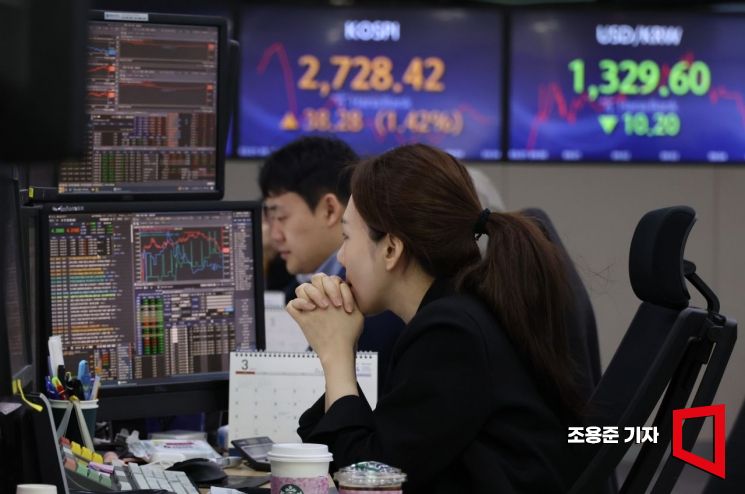 On the 21st, the KOSPI opened at 2,731.18, up 41.04 points (1.53%) from the previous trading day (2,690.14), as employees were working in the dealing room of Hana Bank in Jung-gu, Seoul. On the same day, the KOSDAQ index started at 900.46, rising 9.01 points (1.01%) from the previous trading day (891.45), and the won-dollar exchange rate opened at 1,329.5 won, down 10.3 won from the previous trading day (1,339.8 won). Photo by Jo Yongjun jun21@
On that day, the KOSPI closed at 2706.97, down 46.19 points (1.68%) from the previous trading day. The index opened at 2730.68, widened its decline, and barely held the 2700 level. In the securities market, foreign investors and institutions sold a net 272 billion KRW and 674.7 billion KRW respectively, while individuals bought 923.7 billion KRW. It was the first time in seven trading days since the 25th of last month that foreign investors turned to net selling.
The decline in the domestic stock market on that day is attributed to the retreat of expectations for a US interest rate cut. According to the US Institute for Supply Management (ISM), the manufacturing Purchasing Managers' Index (PMI) for March recorded 50.3, surpassing both the previous month (47.8) and experts' forecast (48.5). Generally, a PMI above 50 indicates economic expansion, while below 50 indicates contraction. This rebound in US manufacturing activity could exert inflationary pressure, leading the market to speculate that the Federal Reserve's timing for rate cuts may be delayed.
Among the top market capitalization stocks, semiconductor shares such as Samsung Electronics (-1.06%) and SK Hynix (-3.81%) showed weakness. LG Energy Solution (-4.33%), Hyundai Motor (-1.82%), Kia (-2.77%), and Celltrion (-1.80%) also closed lower. NAVER (0.73%) and Krafton (0.60%) rose.
The KOSDAQ index closed at 879.96, down 11.63 points (1.30%) from the previous trading day.
In the KOSDAQ market, foreign investors and institutions sold a net 45.9 billion KRW and 156.3 billion KRW respectively, while individuals showed a net buying preference of 219.9 billion KRW.
Among the top market capitalization stocks, secondary battery stocks such as Ecopro BM (-6.12%) and Ecopro (-7.21%) fell sharply due to Tesla's steep decline. Biotech stocks including HLB (-3.58%), Celltrion Pharm (-2.49%), and Samchundang Pharm (-5.28%) also declined.
On the other hand, Enchem surged more than 20%, rising 20.53%.
Ji-won Kim, a researcher at KB Securities, analyzed, "Tesla's first-quarter vehicle delivery performance fell significantly short of expectations, and former President Trump’s remarks on abolishing electric vehicle subsidies have expanded the decline in domestic secondary battery-related stocks. Foreign investors have increased supply-side pressure by net selling spot shares for the first time in seven trading days and selling nearly 14,000 futures contracts."
© The Asia Business Daily(www.asiae.co.kr). All rights reserved.
![Clutching a Stolen Dior Bag, Saying "I Hate Being Poor but Real"... The Grotesque Con of a "Human Knockoff" [Slate]](https://cwcontent.asiae.co.kr/asiaresize/183/2026021902243444107_1771435474.jpg)











