JCS "Hypersonic Missile Flight Range and Trajectory Changes Exaggerated"
"Some Technological Advances at Development Stage... Time Required for Deployment"
North Korea's newly launched medium-to-long-range solid-fuel hypersonic ballistic missile (IRBM) on the 2nd appears to have improved performance, but assessments suggest that North Korea's announcement was somewhat exaggerated.
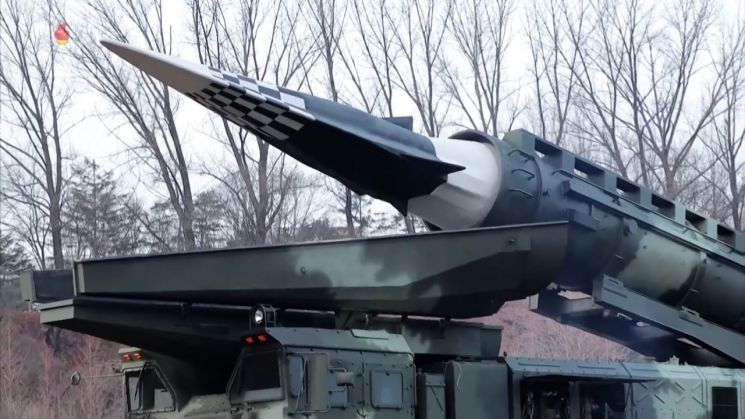
The Joint Chiefs of Staff (JCS) stated on the 3rd, "North Korea exaggerated the flight distance and trajectory changes of the medium-to-long-range hypersonic missile it test-fired the previous day."
According to the 'Reference Material on North Korea's Hypersonic Missile' distributed by the military, the flight distance claimed by North Korea (1000 km) differs from the analysis by our military. The JCS tracked the North Korean missile until it fell into the East Sea and refuted North Korea's claim as a falsification of the range. North Korea announced through the state-run media, Korean Central News Agency, that for safety reasons, the range was limited to 1000 km and that an irregular flight trajectory was realized to evade ballistic missile interception systems. In contrast, South Korea, the U.S., and Japan assessed the flight distance to be around 600 km.
The JCS also stated that North Korea's claim of intentionally delaying the ignition of the second-stage engine and changing the flight direction during the second-stage engine burn "differs from our military's analysis and is considered exaggerated."
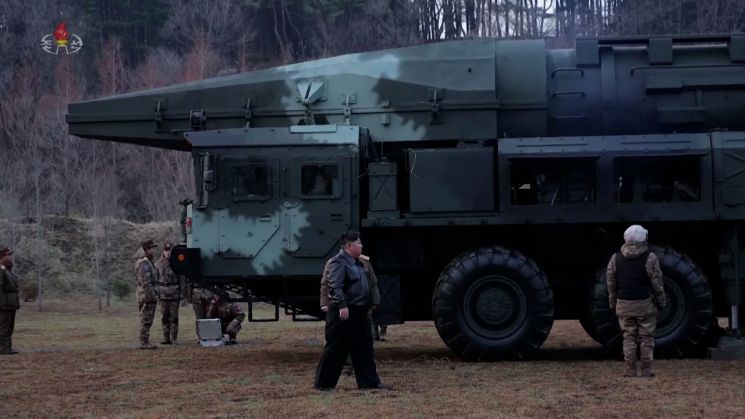
Regarding North Korea's claim that the missile performed an abnormal flight by descending after reaching the first apex (101.1 km) and then ascending again to reach a second apex (72.3 km), a JCS official pointed out, "The trajectory was one of reaching the apex, maneuvering horizontally, and then descending," adding, "There was no second apex or pull-up maneuver (ascending after descending) as North Korea claimed." The official explained, "Hypersonic missiles typically reach speeds up to 10 times the speed of sound and glide down at speeds exceeding five times the speed of sound over distances greater than 100 km. The missile North Korea launched this time reached speeds up to 10 times the speed of sound but did not maintain speeds of five times the speed of sound while descending."
However, the JCS assessed North Korea's launch the previous day as "the first test launch of a new solid-fuel hypersonic missile, focusing on flight performance testing at the early development stage," and concluded that "some technological progress can be recognized."
This likely refers to the performance of the propulsion system (engine). The propulsion system of the existing Hwasong-8 is a liquid first stage. In contrast, the current propulsion system uses a solid two-stage propulsion system, lengthening the missile and launcher. This implies an increased range. If North Korea successfully launches the IRBM, the range is predicted to be approximately 3000 to 5500 km. Locations such as Okinawa, Japan, about 1400 km from Pyongyang, and Guam, about 3500 km away, would fall within striking distance.
Technologically, it has also changed. The missile's front part is not the conventional conical shape but a glider type. It can ascend and descend during flight and perform gliding maneuvers. During the gliding phase, it flies at altitudes between 30 and 70 km while maintaining speeds above Mach 5. This makes it difficult for major air defense systems of South Korea and the U.S., such as the Patriot PAC-3 interceptor missile, to detect and intercept.
The JCS further stated, "Hypersonic missiles are weapon systems requiring advanced technology, currently being developed by leading countries in missile technology such as the U.S., China, and Russia," and added, "It is difficult to predict the timing of North Korea's operational deployment, but it will likely take a considerable amount of time."
Regarding North Korea's solid-fuel ballistic missiles under development, the JCS evaluated, "Short-range solid-fuel ballistic missiles are in the final stages of development, but solid-fuel hypersonic missiles and intercontinental ballistic missile (ICBM)-class missiles will require verification of warhead thermal protection and re-entry capabilities."
Since unveiling the hypersonic missile 'Hwasong-8' in September 2021, North Korea has continuously improved its performance. It is expected to continue test launches in the future. Some analysts believe North Korea is developing toward the level of China's hypersonic missile Dongfeng-27, which has a range of 5000 to 8500 km.
© The Asia Business Daily(www.asiae.co.kr). All rights reserved.


















