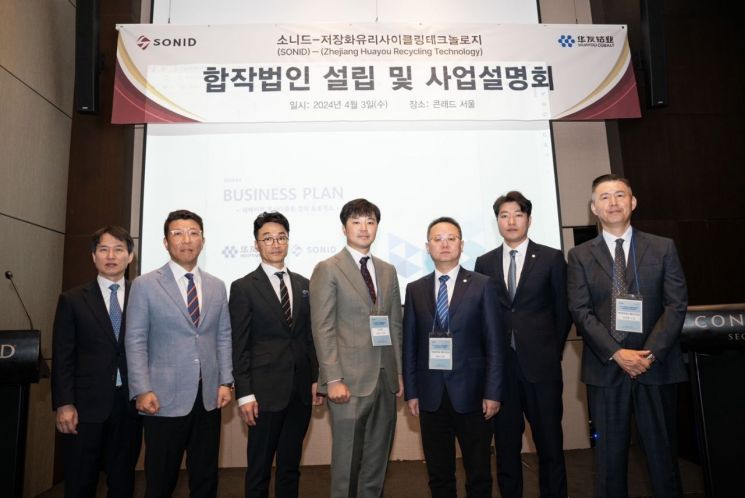
 Sonyde CEO Oh Jung-geon (fourth from the left) and Huayuri Cycle CEO Bao Wei (third from the right), along with officials from both companies, are taking a commemorative photo. / Photo by Sonyde
Sonid announced on the 3rd that it has signed a main contract for a joint venture in battery recycling with Zhejiang Huayou Recycling Technology, a battery recycling business subsidiary of Huayou Cobalt.
On the same day, Sonid held a joint business briefing at Conrad Seoul in Yeouido, Seoul, attended by executives from both companies, including Bao Wei, CEO of Huayou Recycling, and Oh Jung-geon, CEO of Sonid.
The establishment of the joint venture will be completed this month after direct investment by Huayou Recycling. After establishment, Huayou Recycling will directly participate in management and integrate its battery recycling technology, factory blueprints and contractor lists, as well as sales and operational know-how into the joint venture. The joint venture plans to complete a battery pre-processing plant within the year and expand its business scope and overseas presence in the future.
The joint venture established through this contract will be incorporated into Huayou Recycling’s global battery network and serve as a "hub for overseas battery pre-processing," handling battery pre-processing in Asia and other overseas regions. Therefore, it is expected to secure supply of used batteries and sales channels for black powder through Huayou Recycling’s global battery infrastructure.
The black powder extracted in Korea will be supplied to Huayou Recycling’s post-processing plant to extract battery raw materials such as lithium, cobalt, and nickel.
Huayou Cobalt operates joint ventures with LG Chem, POSCO, and others. Huayou Cobalt is the world’s leading supplier of secondary battery materials and cobalt. Huayou Recycling is a 100% subsidiary of Huayou Cobalt, established in March 2017.
Huayou Cobalt has established a recycling structure that reuses used batteries and refines them back into minerals through a vertically integrated cluster from mineral resource smelting and refining to precursors, cathode materials, and recycling.
CEO Bao Wei stated, "Based on the know-how accumulated in the battery pre-processing business in China, we have been promoting overseas expansion, and this joint venture establishment is the first case. We will do our best to ensure that overseas business gets on track through the success of this project."
The two companies signed an MOU in December last year and have been conducting various confidential discussions, including site review and technology exchange. Since 2022, Sonid has built a battery recycling business value chain consisting of used battery collection, performance inspection, and pre- and post-processing. It has also secured essential permits for designated waste comprehensive recycling, as well as sites for pre- and post-processing plants and smelting facilities.
Through its subsidiary SonidOn, Sonid has secured technologies for electric vehicle battery collection, disassembly, storage, discharge, and residual value evaluation, and has experience securing key clients such as leading battery cell manufacturers and automobile companies.
SonidOn CEO Kim Jin-seop has collected data on all existing and pre-release electric vehicles since 2012 and holds the record of recovering and disassembling 20,000 recalled vehicles and about 20,000 energy storage system (ESS) batteries, the first in Korea.
They also have know-how in operating used battery hub centers and resource recovery centers that collect and store electric vehicle batteries nationwide. They have established electric vehicle disassembly manuals to develop safe processes and secured ESS fire prevention systems. In particular, they have registered and applied for patents on used battery collection vehicle systems, used battery disassembly methods, cell balancing devices, and high-power hybrid BMS battery pack systems.
CEO Oh Jung-geon said, "Most domestic used battery pre-processing companies are still in the market entry stage, but in China, where the electric vehicle market has been active for over 10 years, there is abundant know-how in used battery recycling technology and plant operation. This is why the joint venture can emerge as a domestic used battery recycling company."
According to market research firm SNE Research, the global number of electric vehicle scrappages is expected to increase from 4.11 million in 2030 to 42.27 million in 2050. The market size for used batteries is predicted to grow from about 70 trillion won in 2030 to about 600 trillion won in 2050.
© The Asia Business Daily(www.asiae.co.kr). All rights reserved.

















