Ministry of Agriculture, Food and Rural Affairs to Promote 'Hanwoo Short-Term Fattening Model Development' by Year-End
The government has decided to develop a short-term breeding model by the end of this year that reduces the current Hanwoo breeding period from 30 months to a maximum of 24 months, aiming to ease the management burden on farms and allow consumers to purchase at lower prices.
The Ministry of Agriculture, Food and Rural Affairs announced on the 3rd that it plans to develop an optimal short-term cattle breeding model by December this year in collaboration with NongHyup, Kangwon National University, and Chonnam National University to shorten the breeding period.
Since the end of 2022, Hanwoo wholesale prices have been weak due to oversupply caused by excessive breeding and decreased demand resulting from interest rate hikes. On the other hand, feed prices, which account for about 60% of production costs (excluding calf prices), have risen due to the increase in international grain prices since 2022, significantly reducing farm income and exacerbating difficulties. Additionally, as more consumers become interested in climate change and carbon neutrality, there is growing attention to food that places less burden on the environment and emits less carbon. According to Professor Byung-ki Park’s team at Kangwon National University, which is conducting research on shortening the Hanwoo breeding period, feed costs are reduced by about 32% and greenhouse gas emissions decrease by about 25% when breeding for 24 months compared to the current 30 months.
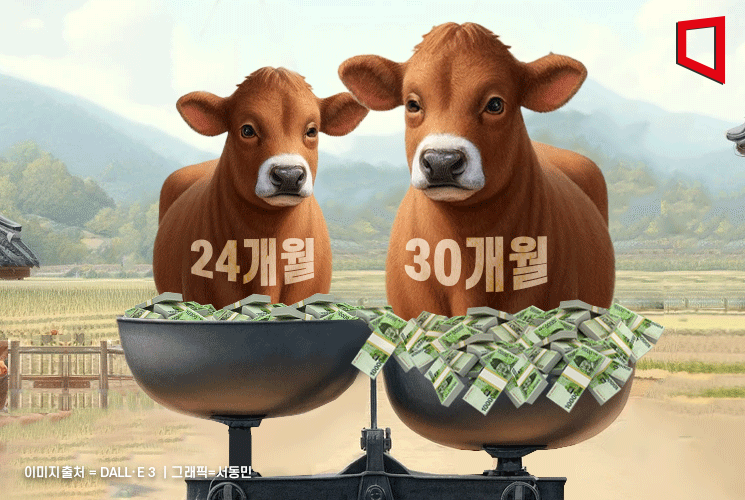
The Ministry of Agriculture, Food and Rural Affairs expects that shortening the Hanwoo breeding period will benefit farms, the environment, and consumers. For example, at Jungwoo Farm in Gochang, which breeds about 600 Hanwoo cattle, the average shipping age is 24 months, 6 months shorter than the national average of 30 months, yet the rate of 1++ beef grade appearance is 49%, surpassing the national average of 35%. This allows the farm to reduce production costs by about 1.5 million KRW per head while producing high-quality beef.
Accordingly, the Ministry purchased 600 calves in 2022 and is applying feeding test programs based on genetic traits, breeding periods, and nutritional levels to analyze the economics and evaluate taste (quality) at 24, 26, and 28 months of age. Additionally, through genetic trait analysis of calves, they are developing a model where individuals with a high likelihood of achieving higher grades are bred for 26 to 28 months, while those with lower potential are bred for up to 24 months. Based on these results, the Ministry plans to create five short-term Hanwoo breeding model programs and support the establishment of a separate Hanwoo market with strong price competitiveness.
The reason for breeding Hanwoo for 30 months is to evenly distribute intramuscular fat fibers (marbling) throughout the meat to enhance flavor. In advanced livestock countries such as the United States and Australia, the breeding period is 18 months, one year shorter than Hanwoo. Professor Hyung-sang Kim’s team at Hankyong National University, which conducted taste evaluation research on short-term bred Hanwoo, assessed that if a certain level of intramuscular fat is maintained, shipping at 25 months results in only minimal taste differences perceived by consumers.
Jung-wook Kim, Director of Livestock Policy at the Ministry of Agriculture, Food and Rural Affairs, said, "Hanwoo is a uniquely Korean breed and is recognized for its superior taste and flavor compared to imported beef. Going forward, to stabilize farm management and secure the price competitiveness of Hanwoo, we will expand the dissemination of the short-term Hanwoo breeding model to reduce production costs for farms and lessen the purchasing burden on consumers."
© The Asia Business Daily(www.asiae.co.kr). All rights reserved.

















