KCCI Analyzes On-Site Data from 1,278 Companies
Difficulties in Measuring Renewable Energy and More
Small and medium-sized enterprises (SMEs) and mid-sized companies face the greatest challenges in the environmental sector when practicing Environmental, Social, and Governance (ESG) management.
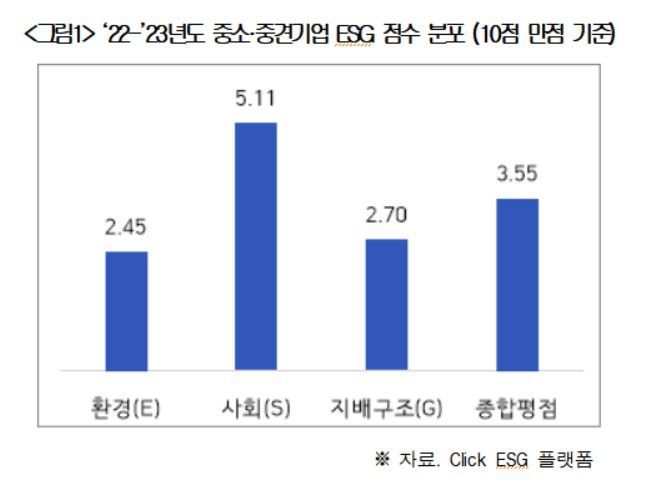 ESG Score Distribution of Small and Medium Enterprises and Mid-sized Companies from 2022 to 2023. Graph provided by the Korea Chamber of Commerce and Industry
The Korea Chamber of Commerce and Industry announced on the 3rd that this was confirmed through an analysis of ESG due diligence data from 1,278 SMEs and mid-sized companies within the domestic supply chain for the years 2022 to 2023.
When ESG management levels were scored on a 10-point scale, the environmental (E) category scored 2.45 points, social (S) 5.11 points, and governance (G) 2.70 points. The overall composite score was 3.55 points.
The lowest scoring item in the environmental sector was the measurement of renewable energy usage, which averaged only 0.32 points. This reflects the difficult conditions faced by companies that still lack sufficient renewable energy supply and are inadequately prepared for reducing air pollutants such as greenhouse gas emissions.
Efforts to conserve biodiversity were also insufficient, scoring 0.33 points. The Chamber analyzed that this was due to a lack of information and awareness regarding biodiversity conservation. Additionally, scores were low for eco-friendly product and service management (0.55 points), measurement of recycled raw material usage (0.61 points), and monitoring of substances contained in products (0.65 points).
By company size, the overall ESG composite scores were 4.84 points for listed companies, 3.96 points for companies subject to external audit laws, and 2.85 points for companies not subject to external audit laws, indicating that larger companies have higher levels of ESG management.
ESG field inspectors reported that many companies have not established dedicated ESG management organizations or systematic implementation strategies and monitoring systems due to manpower shortages and cost burdens.
Cho Young-jun, Director of the Sustainable Management Institute at the Korea Chamber of Commerce and Industry, stated, "Companies are facing significant difficulties due to European Union (EU) environmental regulations and mandatory disclosures," adding, "It is time for the government and companies to join forces to build a national-level data platform to alleviate overlapping burdens on companies and enhance information reliability."
© The Asia Business Daily(www.asiae.co.kr). All rights reserved.
![Clutching a Stolen Dior Bag, Saying "I Hate Being Poor but Real"... The Grotesque Con of a "Human Knockoff" [Slate]](https://cwcontent.asiae.co.kr/asiaresize/183/2026021902243444107_1771435474.jpg)
















