A Living Witness to 25 Years of Korea's Capital Market History
ACGA Secretary-General Exclusive Interview with Asia Economy
First Visit to Korea During This Year's Shareholders' Meeting Season
Jamie Allen, Secretary General of the Asian Corporate Governance Association (ACGA), has a special connection with the Korean capital market. Since his visit to Korea shortly after the 1998 Asian financial crisis, he has witnessed the development of Korea's capital market for 25 years. Having experienced and observed the Korean capital market from the Kim Dae-jung administration to the Yoon Seok-yeol administration, he testified, "Korea was in a rather gloomy state when I visited after the financial crisis, but now it has transformed into a more open and vibrant market compared to back then."
ACGA, led by Secretary General Allen, is a non-profit organization established in Hong Kong in 1999 in response to the Asian financial crisis. It conducts research and educational activities to improve corporate governance in Asia and represents its member companies. It has 101 members, including pension funds, sovereign wealth funds, asset management firms, global investment banks (IBs), and listed companies from 18 markets worldwide. Allen, who has served as ACGA's Secretary General for 25 years and is approaching retirement, was exclusively interviewed by Asia Economy on the 27th of last month at the Glad Hotel in Yeouido, Seoul.
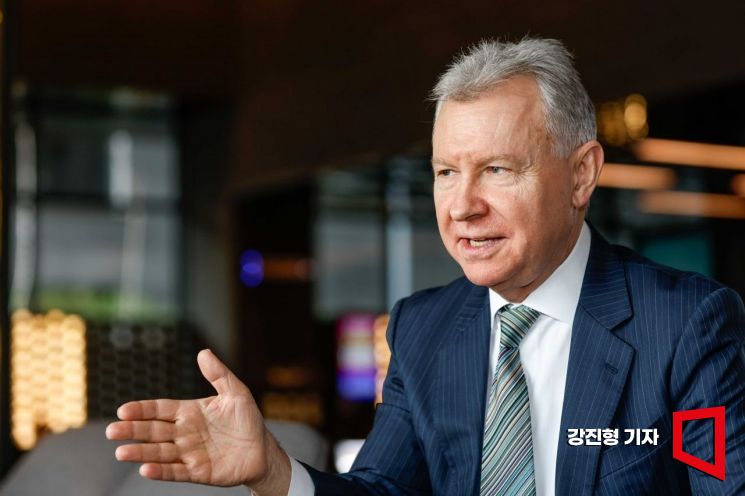 Jamie Allen, Secretary General of the Asian Corporate Governance Association, is being interviewed on March 27 at the Glad Hotel in Yeouido, Seoul. Photo by Jinhyung Kang aymsdream@
Large Corporations Should Be Obliged to Implement Value-Up Like Japan... Foreign Investors Should Be Included in the Value-Up Advisory Group
Secretary General Allen said, "From 2016 to 2019, I visited Korea annually, but mostly at the end of the year when the annual conference was held. This is the first time I visited during the regular Annual General Meeting (AGM) season. In the morning, I attended the regular AGM, and in the afternoon, I met with regulatory agencies such as the Financial Services Commission."
The ACGA delegation and foreign investors visited Korea from the 25th to the 28th of last month, holding meetings with domestic government and research institutions such as the Korea Exchange, National Pension Service, Financial Services Commission, and Capital Market Research Institute, engaging in a busy schedule. Accompanying the ACGA Secretariat were U.S.-based hedge fund Elliott Management, U.K.-based Palisade Capital and Federated Hermes, Hong Kong-based activist fund Oasis, the Norwegian Pension Fund, Dutch pension asset manager APG, Goldman Sachs Asset Management, and JP Morgan Asset Management. ACGA has traditionally visited Korea annually at the end of the year to coincide with the Asia regional conference, but this year was the first visit during the regular AGM season. This timing is explained by the fact that the Korean capital market is at a turning point due to the government's introduction of the 'Corporate Value-Up Program.'
He evaluated the Korean government's promotion of the Value-Up Program as a very positive attempt. Secretary General Allen said, "ACGA has been discussing Korea's discount problem for almost 25 years, and there have been past attempts to resolve it. As you can see, Korea's average Price-to-Book Ratio (PBR) over the past 10 years is much lower compared to other markets."
He pointed out that indicators such as PBR, Return on Equity (ROE), and dividend payout ratio show the current state of the Korea discount. Allen said, "These indicators are the Korea discount itself, and it is clearly due to corporate governance issues. It is very positive that the government is raising this issue." He also highly praised the emphasis on the role of outside directors and the government's plan to provide consulting and value-up related education to companies.
While positively evaluating the government's attempt to resolve the Korea discount problem, he regretted that the program's introduction process was rushed. He said, "Although the program introduction and overall direction were announced at the end of February, the detailed guidelines are to be released in May, which feels rushed. It would have been better if the government had presented the guidelines early on so that companies clearly understand what is required of them."
He advised that for the Value-Up Program to take root, large corporations should be obligated to implement value-up. The government's announced value-up is not mandatory but expects voluntary participation from companies, so the program's success depends on companies' voluntary actions. Regarding this, Allen said, "Leaving aside small listed companies, large corporations should be required to disclose their corporate plans. The government says companies should participate voluntarily, but that alone is not enough."
He cited Japan as a benchmark for Korea's Value-Up Program. Allen said, "The content of Japan's Value-Up Program is effectively mandatory for companies with a PBR below 1, and Japanese companies face significant pressure to comply. Since Korean companies may not be cooperative, the Korean government needs a stronger approach."
To encourage corporate participation, he suggested a 'naming and shaming' strategy that publicly discloses the list of companies. The Tokyo Stock Exchange, a pioneer in value-up, has been publishing the list of companies that comply with the exchange's guidelines since January this year. He explained, "It's not direct shaming but an indirect way to clearly show which companies comply with value-up, which serves as a significant motivator for Japanese companies."
He also urged the mandatory disclosure of English-language public announcements. This was also pointed out by Nam Woo Lee, Chairman of the Korea Corporate Governance Forum, during the release of the value-up draft in February. Allen said, "To be recognized as a global market, Korea needs to strengthen English disclosures. Above all, since the Value-Up Program was introduced to attract more investment in Korea, English disclosure should be mandatory for large corporations, not just recommended."
He also recommended including foreign investors in the Value-Up Program advisory group. He said, "It would be really good to include major foreign institutional investors such as asset managers in the advisory group. This would help facilitate communication with the government and regulatory agencies."
He mentioned that amendments to the Commercial Act are also necessary to establish shareholder-centered governance. Despite strong opposition from the business community, governance should shift from the current owner or management-centered system to shareholder-centered governance. Allen said, "Amendments to the Commercial Act related to directors' fiduciary duties are important. Investors want the Commercial Act to be revised to clearly state that the board of directors has duties to both the company and shareholders."
After hitting bottom early this year, the Korean stock market is enjoying a rare boom in conjunction with the introduction of the Value-Up Program. Foreigners' net purchases of domestic stocks exceeded 16 trillion won early this year, raising expectations for the KOSPI to surpass the 2800 mark this month. He analyzed, "Due to political environment and growth slowdown, global investors' perception of investment in China has become very negative, resulting in large-scale capital outflows from China recently. Foreign investors are interested in Korea because there are many successful companies and many undervalued companies, so they believe there will be opportunities to make money if value improves."
 Jamie Allen, Secretary General of the Asian Corporate Governance Association, is being interviewed on March 27 at the Glad Hotel in Yeouido, Seoul. Photo by Jinhyung Kang aymsdream@
The Notice Period for Convening AGMs Should Be Extended from 14 Days to 21 or 28 Days Before the Meeting
According to Korean Commercial Act, a listed company must notify shareholders of the AGM at least two weeks before the meeting date. Besides the recurring problem of AGM scheduling congestion caused by last-minute disclosures, the short notice period means that foreign investors and individual minority shareholders have insufficient time to consider agenda items before exercising voting rights. In major advanced countries such as Australia and the UK, the notice period for AGMs is longer, around 21 days before the meeting.
Secretary General Allen recommended, "Most other markets require the AGM notice to be published 21 or 28 days before the meeting, but Korea's period is shorter, so foreign investors do not have enough time to vote and make decisions. Korea should extend the notice period by up to 14 days, notifying shareholders at least 21 or 28 days before the AGM."
This is because foreign investors find it difficult to secure enough time to make decisions due to procedural reasons related to voting. According to his explanation, foreign investors must vote according to deadlines set by global custodian banks, which then send the votes to local custodian banks, which in turn deliver the results to the company.
He also pointed out, "Some ACGA members planned to visit Korea in the first week of March to decide which regular AGM to attend, but at that time, they could not know the AGM schedule because many companies did not announce their AGM plans until two weeks before."
Complicated procedures also make it difficult for foreign investors to exercise voting rights. He lamented, "When our members applied to attend regular AGMs, some companies made the process quite difficult. They had to bring all kinds of documents and proxies to attend, and there was no interpretation service. If our members wanted to bring an interpreter, the interpreter also had to be a shareholder." He then criticized, "Although the Korean capital market has undergone many changes, the AGM culture has not changed much."
Introducing Poison Pill and Dual-Class Voting Rights Would Weaken Value-Up
He expressed concerns about attempts to introduce management defense measures such as poison pills (rights plans) and dual-class voting rights. Since the Korean capital market opened, companies have consistently argued for various defense mechanisms against external attacks. The representative defense measures companies advocate are poison pills and dual-class voting rights. Allen clearly opposed, saying, "We earnestly hope the government will not introduce defense measures like poison pills or dual-class voting rights along with the Value-Up Program. These would have very negative effects on the Korean market, undermine market value, and weaken the value of the Value-Up Program."
He stated, "Management defense measures are designed to protect executives and controlling shareholders, who do not want to take responsibility and want to do as they please. As a result, shareholders do not buy the company's stock, causing the stock price to fall. It's a very simple logic."
Allen explained that while technology companies like Facebook have dual-class voting rights, companies like Microsoft (MS), Apple, and Amazon do not. He said, "Dual-class voting rights can protect management but do not determine company success or stock price. The purpose of defense measures is to fend off hostile takeovers, but hostile takeovers are rare in Korea, and none of our members expect hostile takeovers. Who would try to take over Samsung?"
He also noted that Japan introduced poison pills early but the number of companies withdrawing them is increasing. He said, "About 15 years ago, 560 listed companies in Japan adopted poison pills, but now the number has decreased to 200-250. Part of Japan's Value-Up Program involves corporate restructuring, meaning companies pay more dividends and build sustainable business models. Japanese shareholders do not want poison pills."
 Jamie Allen, Secretary General of the Asian Corporate Governance Association, is being interviewed on March 27 at the Glad Hotel in Yeouido, Seoul. Photo by Jinhyung Kang aymsdream@
Disclosure of Director Compensation Is Limited... Need to Establish Board Education Institutions
ACGA publishes a report analyzing corporate governance in Asian countries every two years. It ranks 12 Asian countries, with Korea lingering in the lower ranks for over 20 years. In the December 2023 report, Korea was ranked 8th. Japan jumped three places from 5th to 2nd, and countries ranked lower than Korea include Thailand, China, the Philippines, and Indonesia. Allen said about Korea's governance, "Scores improved in most of the seven categories, but the government sector's score declined, and the listed companies sector basically showed no change. The decline in the government sector score is due to the lack of a clear strategy for governance improvement despite a significant increase in individual shareholders due to the influx of retail investors."
The stagnation in the listed companies sector score is because "most companies provided insufficient information in many areas when analyzing governance practices and disclosures," especially noting the very limited information on director compensation.
He also proposed establishing board education institutions, emphasizing that this is directly linked to the success of the Value-Up Program. He said, "For the Value-Up Program to succeed, board members need education on financial matters such as financial management and profitability. All participants in the board, including senior executives and internal and external directors, should receive education." Most Asian countries, including Hong Kong, Singapore, Malaysia, Thailand, and Japan, operate associations called 'Institutes of Directors.'
He also shared his reflections after observing the Korean capital market for 25 years. He recalled 2016 as a time when signs of change were evident. Allen said, "In the early days of ACGA activities, Korean companies did not want to talk with us, but from 2015, companies' attitudes gradually became more open. That was a turning point for us." He added, "Compared to Singapore, Japan, and Taiwan, Korean companies are surprisingly open in board interviews. The revision of the Corporate Governance Codes in 2016 and the introduction of the Stewardship Code (guidelines for institutional investors' voting rights) are examples of positive changes," reflecting on the achievements of the Korean capital market.
Finally, he criticized the chronic practices of domestic chaebols. Pronouncing the word 'chaebol' directly, he said, "If they try to control the entire company and board through circular shareholding structures while holding only a small stake, that is a serious problem. In such cases, corporate transparency and stronger corporate governance are necessary." He emphasized that the role of outside directors is crucial to eradicating these malpractices. He said, "Many outside directors are academics, accountants, professors, or prosecutors, but what we want are outside directors with rich business experience. The board appointment process needs to be made open and normalized." This is because proper board appointment procedures and composition ensure shareholder-based decision-making and prevent management from dominating the board.
© The Asia Business Daily(www.asiae.co.kr). All rights reserved.
![Clutching a Stolen Dior Bag, Saying "I Hate Being Poor but Real"... The Grotesque Con of a "Human Knockoff" [Slate]](https://cwcontent.asiae.co.kr/asiaresize/183/2026021902243444107_1771435474.jpg)


















