The Constitutional Court has ruled that the current legal provision banning the online sale of contact lenses does not violate the Constitution.
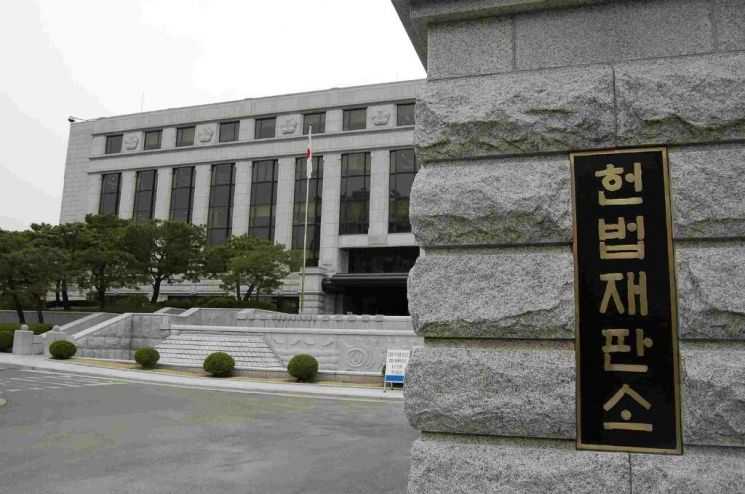
According to the legal community on the 2nd, the Constitutional Court made a constitutional ruling with an 8 (constitutional) to 1 (unconstitutional) decision in a case concerning the constitutional review of part of Article 12, Paragraph 5 of the Medical Technicians Act. Article 12, Paragraph 5 of the Medical Technicians Act stipulates that no one, including professional opticians, may sell glasses and contact lenses through e-commerce or telecommunication sales.
Optician A received a summary order for a fine of 2 million won after selling contact lenses worth approximately 360 million won online a total of 3,938 times from February to June 2018. Dissatisfied with this, A requested a formal trial.
Subsequently, A judged that Article 12, Paragraph 5 of the Medical Technicians Act might be unconstitutional and applied to the court for a constitutional review. The court accepted this and referred the constitutional review to the Constitutional Court in June 2020.
The Seoul Central District Court stated, "Banning all e-commerce sales of contact lenses, even in cases where only repeated purchases of standard pre-made contact lenses are needed, may excessively infringe on the seller's freedom of occupation and the customer's freedom of choice."
However, the Constitutional Court judged that the provision does not violate the freedom of occupation by violating the principle of proportionality. The Court pointed out, "A person's eyesight and eye health condition can change over time," and "If sold through e-commerce, there is a possibility of indiscriminate contact lens use without considering the wearer's eyesight and eye health condition."
Additionally, the Court stated, "Access to optical shops and opticians in Korea can be considered substantially guaranteed, making it easy for consumers to visit optical shops to purchase contact lenses," and "It is difficult to see the inconvenience to consumers caused by this provision as excessive."
The Constitutional Court judged, "The private interests restricted by this provision are limited to certain business disadvantages and some inconvenience to consumers," while "the public interest of improving national health, which this provision aims to achieve, is very significant."
However, Justice Lee Young-jin, who issued a dissenting opinion, stated, "Given the regional imbalance and the relatively small number of optical shops in rural, island, and mountainous areas, a complete ban on e-commerce sales imposes significant restrictions on consumer accessibility," and expressed opposition, saying, "Regulations on contact lenses, which have a low degree of potential harm, can be handled differently."
© The Asia Business Daily(www.asiae.co.kr). All rights reserved.

















