Agricultural Product Price Inflation Rate Month-on-Month: 5.7% in February → 1.3% in March
Strong Prices for Fruits Like Apples and Bae Until New Harvest Shipment
The government has projected that the prices of agricultural and livestock products will rapidly improve starting this month due to increased sunlight hours and a rise in the supply of alternative fruits such as chamoe and watermelon. However, prices for apples and pears, whose production has decreased by about 30%, are expected to remain strong until the new fruit harvest begins.
An official from the Ministry of Agriculture, Food and Rural Affairs stated on the 2nd, "Despite difficult weather conditions such as record-high rainfall last winter and reduced sunlight hours in February and March, consumer prices for vegetables, grains, and livestock products fell in March compared to the previous month. Prices for processed foods and dining out have also continued to show a slowdown in their rate of increase."
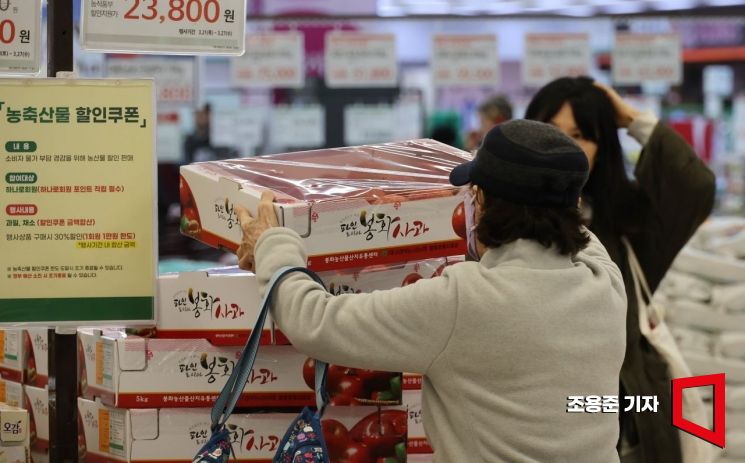 Citizens are shopping at Hanaro Mart Seongnam Branch in Seongnam, Gyeonggi-do. Photo by Jo Yongjun jun21@
According to the consumer price trends announced by Statistics Korea on the same day, the inflation rate in March rose by 3.1% year-on-year and 0.1% month-on-month. Agricultural products increased by 1.3% compared to the previous month, showing a smaller rise than in February (5.7%). Vegetables turned to a decline (February 6.8% → March -0.1%).
However, fruits such as apples and pears, whose production dropped by more than 30% due to last year’s weather disasters, are expected to maintain strong prices until the new fruit harvest. The fruit price inflation rates surged sharply, recording 28.1% in January, 40.6% in February, and 40.3% in March year-on-year.
The Ministry of Agriculture, Food and Rural Affairs forecasted that supply conditions for agricultural products will improve further from April. After the vernal equinox (March 22), the length of daylight gradually increases, boosting essential sunlight hours for the growth of facility-grown vegetables. Additionally, alternative fruits such as chamoe and watermelon will begin to be shipped in earnest, and the Korea Agro-Fisheries & Food Trade Corporation (aT) has expanded direct imports of imported fruits like bananas and oranges with discounts of up to 20%.
Along with this, the effects of emergency price stabilization funds (an additional 150 billion KRW) for support on delivery price reductions, discount support, and livestock product discount events, which have been in place since the 18th of last month, are expected to appear in full, leading to a rapid improvement in the perceived prices of agricultural and livestock products.
Park Soon-yeon, Director of Distribution and Consumption Policy at the Ministry of Agriculture, Food and Rural Affairs, said, "Government discount support is not reflected in the consumer price index survey due to its characteristics, so consumers encountered in the field are experiencing lower perceived prices. Also, the delivery price reduction support, which was mainly focused on large supermarkets, has been expanded to small and medium-sized marts and traditional markets since late March, allowing consumers to feel the effects of the measures over a wider range."
© The Asia Business Daily(www.asiae.co.kr). All rights reserved.

![Clutching a Stolen Dior Bag, Saying "I Hate Being Poor but Real"... The Grotesque Con of a "Human Knockoff" [Slate]](https://cwcontent.asiae.co.kr/asiaresize/183/2026021902243444107_1771435474.jpg)















