Core PCE Inflation Rises 2.8% in February 'In Line with Expectations'
US Labor Department's 'March Employment Report' on March 5 in Focus
The three major indices of the U.S. New York stock market showed mixed trends in the early trading session on the first day of the second quarter, April 1 (local time). Amid relief that the February Personal Consumption Expenditures (PCE) price index increase matched experts' expectations, market attention is focused on the U.S. Labor Department's March employment report to be released this week.
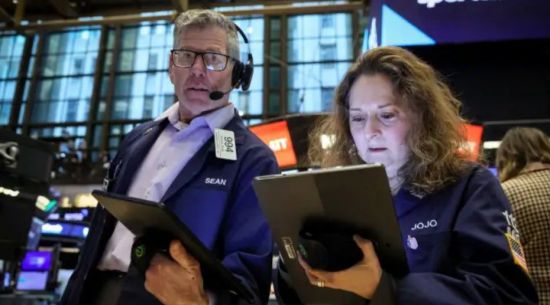
As of 10 a.m. at the New York Stock Exchange (NYSE) on the day, the Dow Jones Industrial Average was down 0.37% from the previous close, standing at 39,662.06. The S&P 500, centered on large-cap stocks, rose 0.08% to 5,258.79, and the Nasdaq, focused on technology stocks, increased 0.52% to 16,464.08.
By individual stocks, Nvidia was up 1.15%. U.S. telecommunications company AT&T fell 1.76% due to a customer information leak incident. UPS was down 0.63% despite news that it was selected as a major air cargo carrier by the U.S. Postal Service.
The February PCE price index, released on March 29, Good Friday when the market was closed, rose 2.5% year-on-year. It met expert forecasts and increased by 0.1 percentage points compared to the previous month's rise of 2.4%. The core PCE price index, which excludes volatile food and energy prices and shows the underlying inflation trend, rose 2.8% compared to a year ago. This also met market expectations but was 0.1 percentage points lower than the January increase of 2.9%.
The U.S. Federal Reserve (Fed) positively evaluated the February PCE inflation but maintained a cautious stance that additional evidence of sustained inflation slowdown is needed before lowering interest rates. Fed Chair Jerome Powell said on March 29 regarding the February PCE inflation, "It is a good thing that it came out as expected," but added, "There is no need to rush to cut rates."
With the core PCE price index, which the Fed closely monitors, meeting expert expectations, the market showed mixed trends on the first trading day after the indicator release, appearing largely undisturbed.
Giuseppe Sete, co-founder and president of Toggle AI, analyzed, "This shows that the pace of inflation progress is slow," and "It reminds us once again that unless the Fed expects inflation to slow down, it will keep interest rates consistently higher than inflation."
While the market predominantly expects the Fed to cut rates in June, some investors have begun to withdraw their bets on June. According to the Chicago Mercantile Exchange (CME) FedWatch, the federal funds futures market on the day reflected about a 64% chance that the Fed will cut rates by 0.25 percentage points at the June Federal Open Market Committee (FOMC) meeting, down from the 70% range a week ago.
With the February PCE inflation not deviating from expectations, the market is focusing on the employment data to be released this week. The key is the March employment report to be announced by the U.S. Labor Department on April 5. If solid employment continues amid inflation not significantly decreasing, the possibility of a rate cut becomes more distant. The market expects nonfarm payrolls to increase by 205,000 in March, significantly down from 275,000 in February. The March unemployment rate is expected to remain at 3.9%, the same as in February.
Earlier, on April 2, the U.S. Labor Department will release the February Job Openings and Labor Turnover Survey (JOLTS), and on April 3, the private employment data for March from ADP, a private employment information company, will be announced.
On April 3, Chair Powell's remarks will continue once again.
Government bond yields are on the rise. The U.S. 10-year Treasury yield, a global bond yield benchmark, rose 9 basis points (1 bp = 0.01 percentage points) from the previous trading day to 4.28%, and the U.S. 2-year Treasury yield, sensitive to monetary policy, moved up 3 basis points to around 4.65%.
International oil prices are moving sideways. West Texas Intermediate (WTI) crude oil rose $0.05 to $83.22 per barrel, while Brent crude fell $0.03 to $86.97 per barrel.
© The Asia Business Daily(www.asiae.co.kr). All rights reserved.
![Clutching a Stolen Dior Bag, Saying "I Hate Being Poor but Real"... The Grotesque Con of a "Human Knockoff" [Slate]](https://cwcontent.asiae.co.kr/asiaresize/183/2026021902243444107_1771435474.jpg)











