Supreme Court Overturns and Remands Lower Court Decision
Even if the tax authorities improperly imposed property tax without properly conducting a land status survey, the Supreme Court ruled that this cannot be considered a ‘serious and obvious defect’ and thus is a ground for cancellation rather than invalidation.
The Supreme Court Civil Division 3 (Presiding Justice Oh Seok-jun) overturned and remanded the lower court’s partial ruling in favor of the plaintiff in the unjust enrichment refund lawsuit (2021Da224408) filed by Hanwha Hotels & Resorts against Jeju Special Self-Governing Province and the state.
According to the ruling, Hanwha built a livestock barn and raised horses on ranch land located in Aewol-eup, Jeju City in 2013. Jeju City, without conducting a separate investigation, classified this land as subject to aggregated taxation and imposed property tax and local education tax amounting to about 70 million KRW on Hanwha from 2014 to 2018. Yeongdeungpo Tax Office also collected over 300 million KRW under the same tax category.
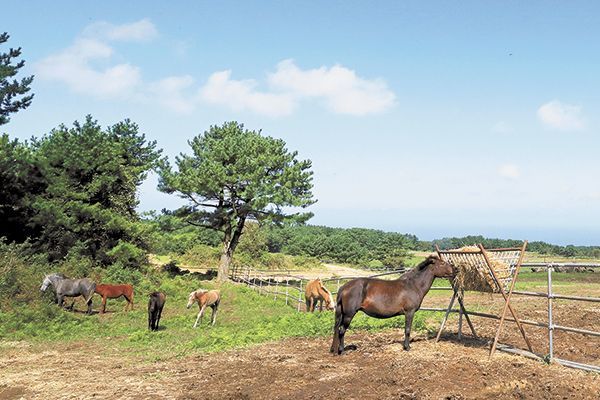 Horses are leisurely grazing on the grass at a ranch in Aewol-eup, Jeju-si. [Image source=Yonhap News]
Hanwha, which filed the lawsuit, argued, “Although the land has been actually used as a ranch since 2013 and qualifies for separate taxation, Jeju City classified it as subject to aggregated taxation and applied a higher tax rate,” and “Although land subject to separate taxation is not liable for comprehensive real estate tax and special rural tax, Yeongdeungpo Tax Office collected taxes, constituting a serious and obvious defect in the disposition.”
The first trial court acknowledged that the tax authorities had misclassified the tax items but ruled against the plaintiff, stating, “Even if the defect is serious, it cannot be considered obvious.”
However, the second trial court ruled partially in favor of the plaintiff, stating that “there is a serious and obvious defect in the tax authorities’ disposition, so the property tax imposition is naturally invalid.”
The second trial court stated, “Although the tax authority knew the land was ranch land and was actually used as such, it imposed tax based solely on previous years’ tax data without conducting any land status survey in the relevant year, classifying the land as subject to comprehensive and separate aggregated taxation,” and “there is a serious defect that violates essential parts of the taxation target and procedure.”
It further pointed out, “If Jeju City had investigated the status according to the law before imposing property tax and local education tax, it would have been easy to recognize that the land qualifies for separate taxation.”
The second trial court’s judgment was overturned by the Supreme Court.
The Supreme Court explained, “To qualify as ‘ranch land’ subject to separate property tax, it is not enough that there are livestock barns or other livestock-related buildings on the land and horses are raised there, allowing the land’s actual status to be seen as ranch land,” and “an accurate investigation of facts such as the number of livestock, the standard area of the land accordingly, the purpose of land use, and zoning is essential.”
It added, “If there are objective circumstances that could lead to a misunderstanding that the land is subject to taxation and whether it is subject to taxation can only be clarified through an accurate investigation of facts, even if the defect is serious, it cannot be considered obvious on its face,” and “in cases where there is illegality such as simple misidentification of the taxation target, incorrect choice of investigation method, or errors in tax amount calculation during the investigation and decision process, these constitute grounds for cancellation only.”
◆Separate Taxation Targets and Aggregated Taxation Targets
Land is classified into △separate taxation targets (farmland, ranch land, forest land, etc.) △separate aggregated taxation targets (land attached to factory or business buildings, etc.) △comprehensive aggregated taxation targets (vacant land, land attached to unauthorized buildings, etc.). Among these, the tax rate for separate taxation targets is the lowest.
◆Invalidity and Cancellation
Invalidity means that the legal act has no effect from the beginning, while cancellation means that after the legal act has been established and effects have occurred, the exercise of the right of cancellation causes it to lose effect retroactively.
Reporter Lee Soon-gyu, Legal Times
※This article is based on content supplied by Law Times.
© The Asia Business Daily(www.asiae.co.kr). All rights reserved.
![Clutching a Stolen Dior Bag, Saying "I Hate Being Poor but Real"... The Grotesque Con of a "Human Knockoff" [Slate]](https://cwcontent.asiae.co.kr/asiaresize/183/2026021902243444107_1771435474.jpg)
















