Continued Yen Weakness Despite End of Negative Interest Rates
Long-Term Perspective Needed Until Yen Strengthens
Focus on Export-Competitive Sectors Amid Yen Appreciation
The prolonged depreciation of the yen, which was expected to end with the Bank of Japan (BOJ)'s base rate hike, is deepening the sighs of investors who bet on yen appreciation. However, the securities industry forecasts that while the yen may continue to weaken in the short term, it is expected to strengthen in the medium to long term. They advised paying attention to the competitive landscape of export sectors between South Korea and Japan in the future environment of a strong yen.
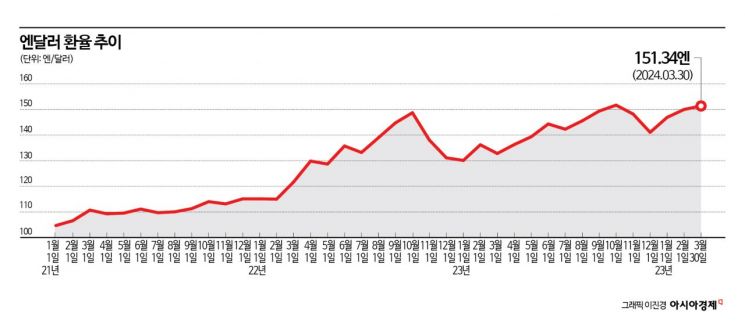
According to the foreign exchange market on the 2nd, the yen closed at 151.34 yen per dollar on the 30th of last month. This is more than a 7% increase compared to the beginning of the year, when it was at 141.55 yen. The won-yen exchange rate also remains in the high 800 won range per 100 yen. Although the Bank of Japan ended its negative interest rate policy of over eight years by raising the base rate at the monetary policy meeting on the 19th of last month, the yen continues to weaken.
Yen deposits surged amid the yen's historically low value. According to the Bank of Korea, as of the end of February, the balance of yen deposits held by residents in South Korea increased by 4.6% from the previous month to $9.86 billion (approximately 13.3 trillion won). This represents a 60.8% increase compared to the same month last year. Until May of last year, the yen deposit balance fluctuated around $6 billion but began to increase from July. The yen deposit balance approaching $10 billion is the first time since the related statistics began in June 2012.
Expectations that changes in Japan's monetary policy would lead to yen appreciation are also reflected in the popularity of related financial products. According to the Korea Exchange, the KBSTAR U.S. Treasury 30-Year Yen Exposure (Synthetic H) Exchange-Traded Fund (ETF) has seen continuous net purchases by individuals since its listing in December last year, except for one day, growing to a net asset size of 201.9 billion won as of the 1st. It is interpreted that as the U.S. interest rate cuts become more active in the second half of this year, buying momentum continues, aiming to enjoy capital gains from investing in 30-year U.S. Treasury bonds as well as foreign exchange gains from yen value fluctuations.
Gradual Yen Appreciation Expected; Focus on Export-Competitive Sectors Between South Korea and Japan When Yen Strengthens

However, contrary to investors' expectations, yen appreciation did not immediately follow the end of the BOJ's negative interest rate policy. This is because the BOJ maintained some accommodative measures such as government bond purchases, continuing to exert downward pressure on the yen's value. Choi Ye-chan, a researcher at Sangsangin Securities, said, "Considering Japan's domestic demand, inflation, and real wages, the possibility of an additional rate hike in the second quarter of this year is very low," adding, "There is also an incentive to tolerate some degree of yen depreciation to maintain export competitiveness and attract foreign tourists, so a passive response to control only the upper limit around 150 yen is expected." He continued, "However, the long-term direction of the yen's value is indeed appreciation," forecasting, "After the second quarter, when the U.S. Federal Reserve's rate cuts become concrete, the yen will gradually strengthen."
The securities industry advised that in the yen appreciation environment that will come after waiting, attention should be paid to export and import sectors that compete with Japan. Woo Ji-yeon, a researcher at IBK Investment & Securities, explained, "Since the export competition between South Korea and Japan is high in third-country markets, it is necessary to respond mainly to sectors such as electronics, home appliances, steel, shipbuilding, and automobiles, where export competitiveness is highlighted due to the strong yen phenomenon, as well as defensive sectors like banks and telecommunications stocks." However, he evaluated, "The rise in the won-yen exchange rate, KOSPI returns, and the monthly won-yen exchange rate returns all have an inverse correlation with the 20-day cumulative net purchases by foreigners, so the positive effect on the domestic stock market from yen appreciation will not be significant."
Han Ji-young, a researcher at Kiwoom Securities, analyzed, "Although the significance of evaluating export competition levels has somewhat diminished compared to before due to the improved competitiveness of Korean products giving them a comparative advantage over other countries, South Korea and Japan have similar manufacturing-centered industrial structures, so the structure of export competition targeting the global market has not changed." She added, "In the medium to long term, when the yen strengthens, attention can be paid to sectors with significant export competition with Japan that have seen a decline in export market share," noting, "Sectors such as petroleum, home appliances, automobiles, and shipbuilding can secure export price competitiveness compared to Japanese competitors and work on recovering their global market share."
© The Asia Business Daily(www.asiae.co.kr). All rights reserved.

![Clutching a Stolen Dior Bag, Saying "I Hate Being Poor but Real"... The Grotesque Con of a "Human Knockoff" [Slate]](https://cwcontent.asiae.co.kr/asiaresize/183/2026021902243444107_1771435474.jpg)
















