Promotion of Smart Care Using AI Speakers for the First Time Nationwide in 2019 to Prevent Crisis Situations like Solitary Deaths
Emotional Support, Health Checks, Emergency Reporting, 95% User Satisfaction, 100% Willingness to Continue Use
18,822 Welfare Checks, 218 Psychological Counseling Referrals, 312 Emergency SOS Services Provided
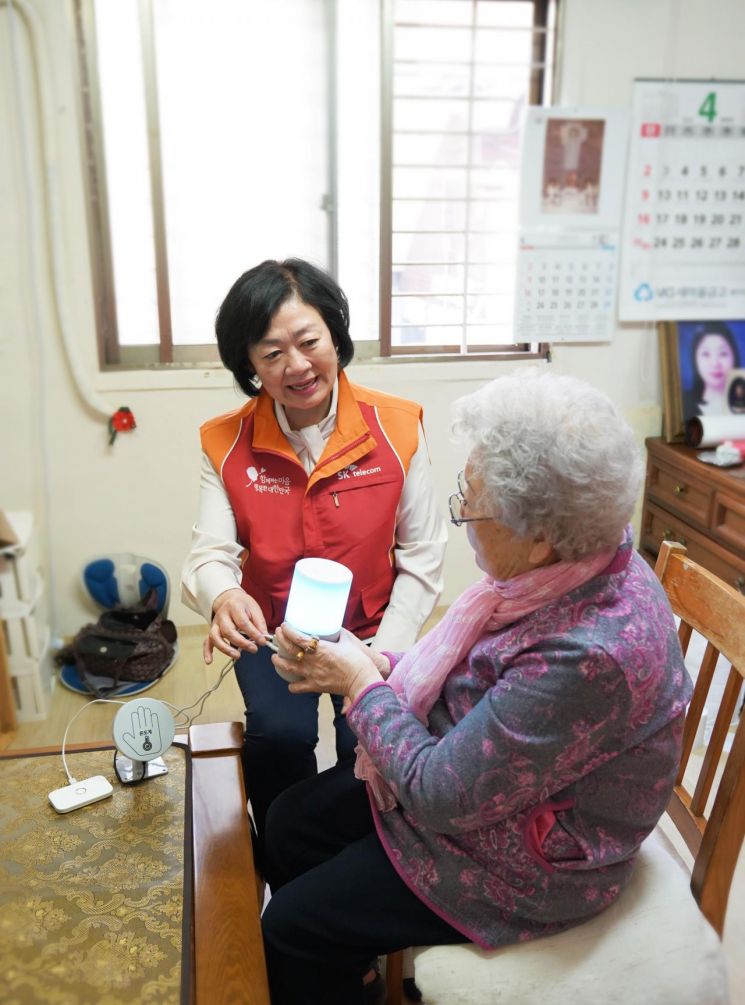
“Thanks to ‘Aria,’ I was able to get through a critical moment safely. The care manager who heard my voice asking for help reported it to 119, allowing me to be quickly transported to the hospital. I am truly grateful. (Lee OO, 58, Seongsu-dong)”
Seongdong-gu, Seoul (Mayor Jung Won-oh) announced that it is minimizing care gaps by promoting the smart care ‘Happy Community’ project, which provides care services such as welfare checks for elderly living alone and middle-aged single-person households using the artificial intelligence (AI) speaker ‘Aria.’
Seongdong-gu started the ‘Happy Community’ project in 2019, the first in the nation to use the AI speaker ‘Aria’ for care services. After installing the AI speaker (Aria), which functions as a conversational companion, in the homes of care recipients, the Integrated Control Center (Happy Community ICT Care Center) monitors for dangerous situations to prevent crises such as solitary deaths in advance. If an emergency is detected by analyzing the frequency of speaker use, care managers visit the recipient’s home to provide care services.
The project targets elderly living alone and middle-aged single-person households in the area, prioritizing those at risk of social isolation and solitary death. This year, a total of 400 households are being supported.
The AI speaker ‘Aria’ offers emotional support functions for single-person households living alone through features such as music listening, news, weather updates, and conversation. It also provides a function that connects users to 119 in emergencies when they say phrases like ‘Help me’ or ‘Save me.’
Additionally, the project offers a total of seven specialized services, including ▲ ‘Information Provision’ content (2 types) that delivers customized local news and health management information ▲ ‘Dementia Prevention’ content (3 types) for early dementia screening and cognitive training enhancement ▲ ‘Audio’ content (2 types) that plays touching stories and music to aid sleep. Last year, an average of 400 users accessed 81,188 pieces of content (cumulative). Among these, the ‘Dementia Prevention’ content had the highest usage with 10,075 accesses.
These AI care functions also greatly contribute to the emotional stability and improved quality of life of the recipients.
An analysis conducted one year after the project’s implementation in 2020 showed that happiness increased by 7% and loneliness decreased by 4% on average (after 30 days and 9 months), indicating higher life satisfaction among users.
Furthermore, users who engaged with the specialized ‘Dementia Prevention’ content for 60 days showed improvements of 16% in working memory, 15% in long-term memory, and 10% in verbal fluency compared to before use.
In last year’s user satisfaction survey, 95% of all users (379 households) responded that they were generally satisfied with the service, and all users expressed their intention to continue using it.
The Integrated Control Center (Happy Community ICT Care Center, located in Seongsu-dong) is staffed with six personnel, including crisis signal monitoring and professional psychological counselors, and operates a separate monitoring team during nights and holidays to provide 24-hour service.
In particular, the monitoring staff receive real-time data on Aria’s non-use periods and users’ abnormal speech to assess crisis situations. When checking on users’ well-being, if signs of depression are reported, they connect the user to a professional psychological counselor; if an emergency is suspected, they coordinate with the fire department (119) for immediate response. To date, 18,822 welfare checks, 218 psychological counseling referrals, and 312 emergency SOS services have been provided.
Analysis of the emergency SOS requests received shows that 36 cases were linked to 119 and on-site rescue, with 19 cases (52%) occurring during early morning or late night hours (9 AM to 6 PM), demonstrating that 24-hour operation plays a significant role in accident prevention.
User satisfaction with this service is also high. Those who experienced the emergency SOS service reported feeling psychological stability and using more diverse services for longer periods than before. Additionally, 92% responded that they would be able to receive help in the event of an actual emergency.
Moreover, Seongdong-gu provides customized care to more than 4,000 vulnerable households through various smart care projects such as ‘Let’s Check In Together,’ ‘Smart Plug,’ the Seoul Salpimi app, and the ‘Good Morning Call’ AI welfare check service.
Based on these achievements, in June last year, the project was selected as the ‘Best Institution’ in the 1st Government Innovation Evaluation jointly hosted by the Ministry of the Interior and Safety and the Korea Institute of Public Administration, recognized as a case of ‘Visiting and ICT-based Elderly Welfare Check Service.’
Jung Won-oh, Mayor of Seongdong-gu, stated, “The issues of social isolation and solitary death due to the rapid increase of single-person households were considered difficult challenges intertwined with the shortage of welfare personnel. However, through the ‘Happy Community’ project, it has become possible to reduce the burden on care workers while expanding the beneficiaries of the service. We will continue to lead welfare services based on advanced smart technology to realize smart inclusive welfare.”
© The Asia Business Daily(www.asiae.co.kr). All rights reserved.
![Clutching a Stolen Dior Bag, Saying "I Hate Being Poor but Real"... The Grotesque Con of a "Human Knockoff" [Slate]](https://cwcontent.asiae.co.kr/asiaresize/183/2026021902243444107_1771435474.jpg)
















