'2022 Disabled Enterprises Survey' Released
Scheduled for Annual Preparation and Publication Starting This Year
As of the end of 2022, the number of disabled-owned businesses was confirmed to be 164,660. This represents a 42.8% increase compared to 2020.
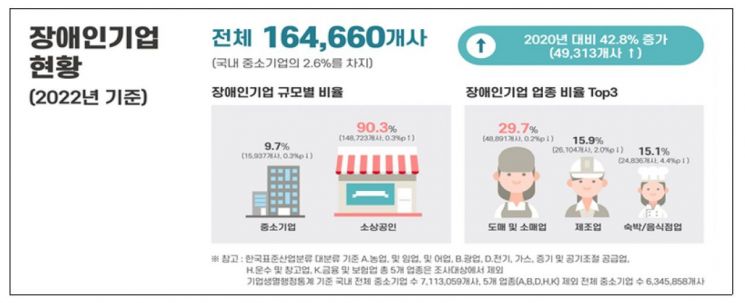
The Ministry of SMEs and Startups announced the "2022 Disabled-Owned Business Survey" containing these details on the 31st.
Among all disabled-owned businesses, 90.3%, or 148,723 companies, were identified as small business owners. By industry, wholesale and retail trade accounted for the largest share at 29.7% (48,891 companies), followed by manufacturing at 15.9% (26,104 companies), and accommodation and food services at 15.1% (24,836 companies).
Regarding the type of disability of the representatives, physical disabilities accounted for 66.8% (110,008 people), and those with mild disabilities classified as grades 4 to 6 made up 81.3% (133,833 people). The average age of representatives was 61.3 years, with those in their 60s comprising the largest proportion at 37.1% (61,071 people). By gender, males accounted for 78.3% (128,994 people) and females 21.7% (35,666 people).
Total sales amounted to 75.1368 trillion KRW, and operating profit was 7.6212 trillion KRW, increasing by 60.1% and 80% respectively compared to 2020. The average sales per company were 456.31 million KRW, and the average operating profit was 46.28 million KRW. Looking at average sales by company size, small business owners had 290 million KRW, and small and medium enterprises had 2.08 billion KRW. Compared to 2020, small business owners saw a 12% increase, while small and medium enterprises experienced a 10.5% decrease. By industry, manufacturing sales reached 22.2545 trillion KRW, accounting for 30% of total sales, followed by wholesale and retail trade at 21 trillion KRW, and construction at 14 trillion KRW.
The total number of employees was 544,840, of which 175,581 were disabled employees, accounting for 32.2% of all employees. The average number of employees per company was 3.3. By company size, disabled employees made up a larger proportion in small business owners at 86.5% (151,879 people) compared to 13.5% (23,701 people) in small and medium enterprises.
Factors affecting the management activities of disabled-owned businesses were surveyed as follows: financing (51.9%), securing sales channels and marketing (39.8%), and securing and managing personnel (28.7%). The area with the greatest financial difficulty was working capital (77.3%), followed by labor costs (12.8%) and facility funds (3.4%).
Awareness rates of support policies for disabled-owned business activities were highest for startup support at 89.1%, followed by public procurement promotion at 59.3%, technology commercialization support at 47.8%, and export capacity enhancement at 45.4%.
The most needed support for disabled-owned businesses in their management activities was financial support programs (74.7%), followed by tax support programs (49.0%) and sales channel support programs (24.4%).
The Disabled-Owned Business Survey has been conducted and published biennially until now, but due to amendments to the Act on the Promotion of Disabled-Owned Business Activities, it will be conducted and published annually starting this year. Lee Dae-geon, Director of Small Business Policy at the Ministry of SMEs and Startups, stated, "We will establish effective policies to foster disabled-owned businesses based on timely statistical data that reflect the changing business environment."
© The Asia Business Daily(www.asiae.co.kr). All rights reserved.
![Clutching a Stolen Dior Bag, Saying "I Hate Being Poor but Real"... The Grotesque Con of a "Human Knockoff" [Slate]](https://cwcontent.asiae.co.kr/asiaresize/183/2026021902243444107_1771435474.jpg)











