Illegal Arrest Without Following Proper Procedures Is a Problem
Judge "Struggling Between Individual and Judicial Conscience"
A man in his 50s who caused a fatal drunk driving accident 10 years ago and then drove under the influence again while refusing to take a breathalyzer test was acquitted. This was because the breathalyzer test was conducted after an arrest that did not follow proper legal procedures.
On the 30th, the Uijeongbu District Court Namyangju Branch Criminal Division 1 (Judge Choi Chi-bong) announced that on the 28th, it had acquitted Mr. A (53), who was indicted for refusing a breathalyzer test under the Road Traffic Act. Mr. A was caught by the police while driving home after drinking one bottle of soju and 500cc of beer at a pub in Namyangju, Gyeonggi Province, in the early morning of February 5 last year.
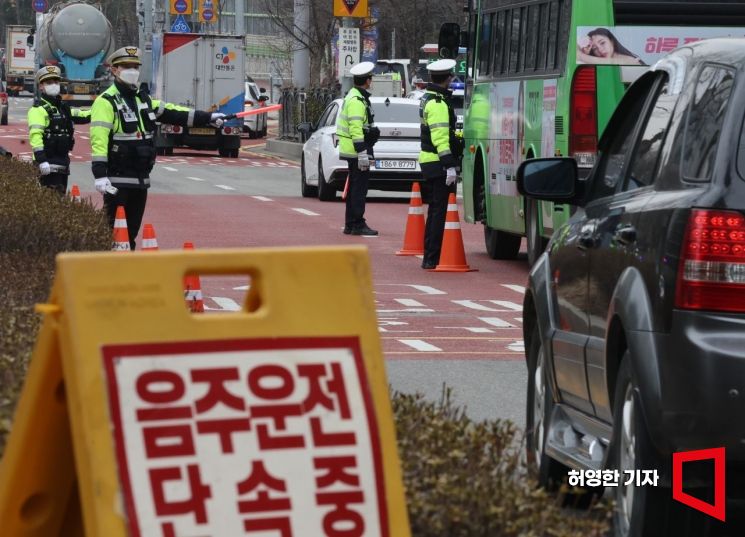 The photo is not related to the specific content of the article. On the afternoon of the 12th, police conducted a drunk driving crackdown near an elementary school in Sangam-dong, Seoul. Photo by Heo Younghan younghan@
At the time, the police who responded to a witness report attempted to conduct a breathalyzer test on the spot, but Mr. A did not comply with the police's request. Mr. A has a prior record of causing a fatal accident due to drunk driving about 10 years ago. On that day as well, after driving about 10 km to his home, he was caught by a group of witnesses who suspected drunk driving and followed him, but he continued to attempt to flee.
At around 1:10 a.m. on the same day, police officers who responded to the report separated the group of witnesses who were confronting Mr. A, took custody of Mr. A, and requested a breathalyzer test three times, all of which he refused, leading to his arrest as a suspect caught in the act. However, Mr. A's defense attorney argued in court that this was an "illegal arrest," and the court accepted this claim. The problem was that the police officers who arrested Mr. A did not notify him that he was being arrested on suspicion of drunk driving nor did they prepare an on-the-spot arrest receipt when taking custody of Mr. A from the group of witnesses.
The presiding judge expressed a complicated sentiment while acquitting Mr. A. Before the verdict, Judge Choi said, "Although the defendant caused a fatal accident due to drunk driving and drove under the influence again, the breathalyzer test was requested after an arrest that did not follow proper legal procedures, so I had no choice but to acquit him," adding, "Whenever such cases arise, I cannot help but struggle between my personal conscience and my conscience as a judge."
He continued, "As a judge, my conscience is to follow the principle of due process, and the principle of due process is something required in the civilized era," but also expressed skepticism by saying, "I do not know if following due process is appropriate in this barbaric era where the defendant lives and tries to survive." Then Judge Choi emphasized, "The defendant's crime warrants a sentence of at least three years, and acquitting him does not mean his guilt disappears," and added, "If we meet again in this courtroom due to the defendant's drunk driving, I will undoubtedly impose the maximum sentence allowed by law," before finally reading the verdict of not guilty.
© The Asia Business Daily(www.asiae.co.kr). All rights reserved.
![Clutching a Stolen Dior Bag, Saying "I Hate Being Poor but Real"... The Grotesque Con of a "Human Knockoff" [Slate]](https://cwcontent.asiae.co.kr/asiaresize/183/2026021902243444107_1771435474.jpg)
















