After Ministry of Foreign Affairs Report, Approval Given That Afternoon
Chairman Han Dong-hoon Actively Proposes Remedies
Hwang Sang-mu and Lee Jong-seop Finally Resign
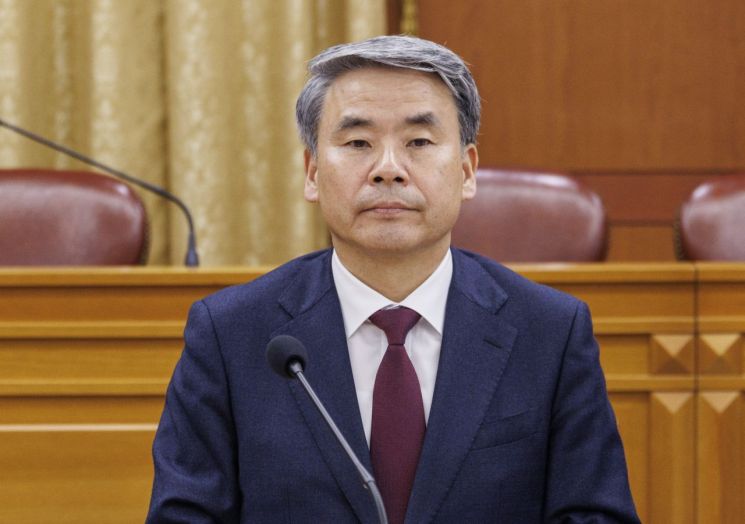 Ambassador Lee Jong-seop to Australia is entering the Major Defense Industry Cooperation Chiefs of Mission Meeting held at the Ministry of Foreign Affairs in Jongno-gu, Seoul on the morning of the 28th, listening to remarks by Foreign Minister Cho Tae-yeol.
 [Photo by Yonhap News]
President Yoon Suk-yeol approved the dismissal of Ambassador Lee Jong-seop to Australia, who had been under investigation by the High-ranking Officials' Crime Investigation Unit (PCC) over allegations of external pressure in the investigation of the death of Marine Sergeant Chae.
The presidential spokesperson's office announced, "This afternoon, the dismissal of Ambassador Lee Jong-seop to Australia, proposed by the Minister of Foreign Affairs, was approved." This comes 25 days after his appointment was announced on the 4th.
Lee's legal representative, Attorney Kim Jae-hoon, stated in a press release that morning that Lee had expressed his intention to Foreign Minister Cho Tae-yeol to be relieved of his post as Ambassador to Australia.
In the statement, Lee said, "I have continuously requested the PCC to expedite the investigation," but "the PCC has yet to set a date for the investigation." He added, "Even after the meeting of key defense cooperation embassy chiefs, I will remain in Seoul to strongly respond to all procedures until the end," and explained, "Therefore, today I expressed my intention to the Minister of Foreign Affairs to be relieved of my post as Ambassador to Australia and requested that it be duly accepted."
Subsequently, the Ministry of Foreign Affairs decided to accept Lee's resignation that morning, and President Yoon approved it in the afternoon after receiving the ministry's report.
Persistent Criticism Ahead of General Election... Ultimately Resignation
The presidential office had maintained that there was no legal issue with Lee's appointment. However, with mounting criticism ahead of the general election and Lee's request to accept his resignation, it is interpreted that President Yoon approved Lee's resignation.
Lee, who served as the first Minister of National Defense under the Yoon Suk-yeol administration, was reported to the PCC and under investigation for allegations of exerting pressure in the investigation of the death of Marine Sergeant Chae. Despite this, he was appointed Ambassador to Australia on the 4th. Following domestic controversy over his 'escape departure' and worsening public opinion, he returned to Korea on the 21st, 11 days after his departure, citing attendance at a meeting of key defense cooperation embassy chiefs as the reason.
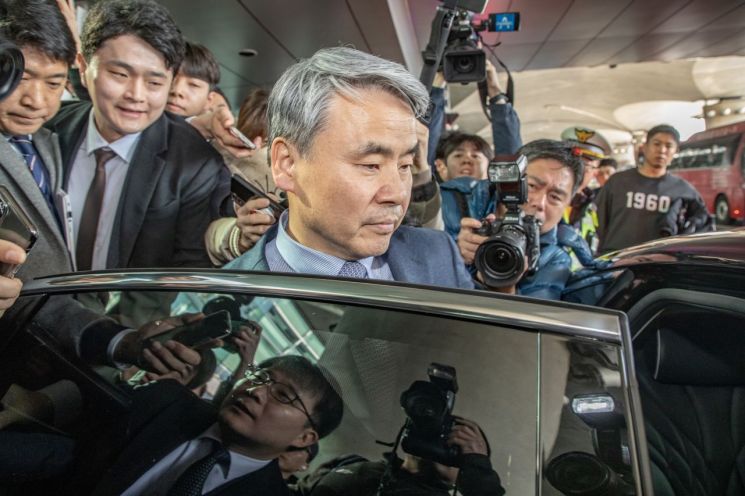 Sergeant Chae Mo of the Marine Corps, who died in the line of duty, and Lee Jong-seop, the Ambassador to Australia under investigation for allegations of external pressure related to the case, are returning to Korea through Incheon International Airport on Yeongjong Island, Incheon, on the 21st and boarding a vehicle.
 [Photo by Yonhap News]
At that time, Lee reiterated that the allegations against him were untrue and said, "I hope to have the opportunity to be investigated by the PCC during my stay." However, the PCC stated, "Due to investigative circumstances, it is difficult to summon Ambassador Lee for the time being," and time passed without a set date.
Meanwhile, some speculated that Lee's return was for 'election purposes.' It was explained that the government hastily brought Lee back to soothe worsening public opinion ahead of the general election and hastily arranged the defense cooperation embassy chiefs' meeting as justification.
Lee's sudden expression of intention to resign is interpreted as his wish not to further affect the Ministry of Foreign Affairs' work and the general election, and to focus solely on responding to the investigation. For the ruling party, it was a risk management move ahead of the general election to remove a negative factor, and attention is focused on how much this will affect public sentiment going forward.
Amid Deepening Ruling Party Crisis, Yoon Makes Decision Aligned with Public Expectations
Although Lee requested acceptance of his resignation and President Yoon accepted it as a voluntary resignation, it is known that President Yoon's decision played a role in the process. With only ten days left before the general election and the ruling party crisis deepening, with even talk of a '200-seat victory for the opposition,' President Yoon appears to have humbly accepted the critical public opinion and made a decision aligned with the public's expectations.
In particular, Han Dong-hoon, the Emergency Response Committee Chairman of the People Power Party, is reported to have actively conveyed the party's position to the presidential office and proposed measures to resolve the issue after the controversy surrounding Lee arose.
With the approval of the dismissal of Ambassador Lee Jong-seop to Australia, whose controversy had persisted, President Yoon once again accepted the ruling party's request. Previously, on the 20th, President Yoon accepted the resignation of Hwang Sang-moo, former Senior Secretary for Civil Society, who caused controversy with his 'kitchen knife terror' remarks during a meal with reporters covering the presidential office. At that time, Chairman Han pressured him to resign, saying, "It is a remark that does not meet the public's expectations, and he should decide his own position."
A ruling party official said, "With official election campaigning having started the day before, and seeing People Power Party candidates under pressure in key battleground areas such as the metropolitan area, President Yoon made a magnanimous decision."
© The Asia Business Daily(www.asiae.co.kr). All rights reserved.



















