"Anyone who is not worried about the dangers of artificial intelligence (AI) is someone who is not interested."
Former Secretary of State Hillary Clinton made this remark on the 28th (local time) while participating in a panel discussion held at Columbia University. At the event, held under the theme "The Impact of AI on the 2024 Global Elections," Clinton identified AI as the greatest threat to the upcoming November presidential election. U.S. election officials and IT company executives present also assessed that false information generated and spread by AI could negatively affect the election.
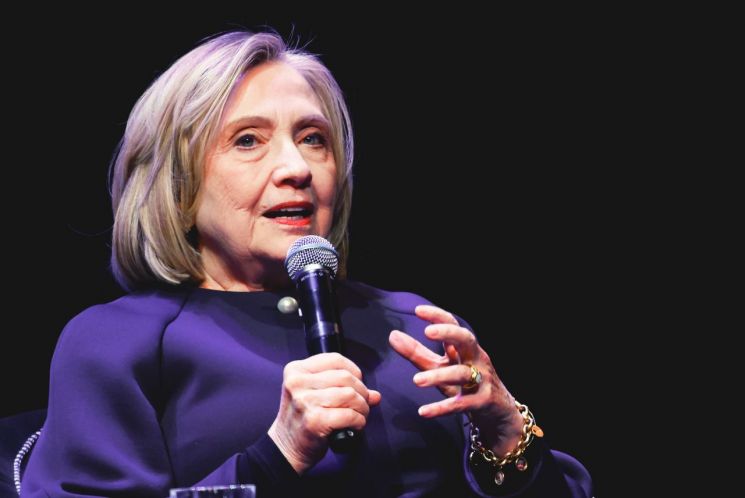
Recalling her experience of losing to former President Donald Trump in the 2016 election, Clinton said, "Before the election, the internet was flooded with all kinds of fake news, memes, and conspiracy theories about me." She added, "One piece of fake content casually created by someone can cause harm to everyone."
Clinton also warned about the possibility of Russian election interference using AI. She lamented, "Putin filled Facebook, Twitter, and Snapchat with fake news to discredit me during the 2016 election." In fact, the bipartisan foreign and military expert group 'Prop or Not' revealed in a report that as many as 200 sites were mobilized for Russian propaganda efforts during the 2016 election period.
Clinton continued, "What Russia did to me back then was primitive, but now we are talking about exponentially advanced technology," pointing out that not only false information mass-produced by AI but also more powerful threats such as deepfake videos have emerged. Michigan Secretary of State Jocelyn Benson also expressed concern, saying, "We are now facing an election cycle where these lies are amplified through AI."
The dangers of generative AI, including deepfakes, were notably confirmed during the New Hampshire primary in January. According to local media such as The Wall Street Journal (WSJ), robocalls imitating President Biden’s voice were randomly connected to voters, urging them not to participate in the vote.
As the impact of AI became visible, companies also began to respond. Twenty-four companies, including big tech firms such as Amazon, Google, Microsoft, and OpenAI, agreed last month at the Munich Security Conference (MSC) in Germany to cooperate in preventing the generation and spread of false information by detecting and labeling deepfakes that could influence voters.
Executives from technology companies attending the panel also pledged, "We will do our best to track and identify malicious risks using generative AI." Former Google CEO Eric Schmidt said, "The deepfake problem will worsen significantly over the next few years," and emphasized, "Relevant companies must collaborate to find solutions."
© The Asia Business Daily(www.asiae.co.kr). All rights reserved.
![User Who Sold Erroneously Deposited Bitcoins to Repay Debt and Fund Entertainment... What Did the Supreme Court Decide in 2021? [Legal Issue Check]](https://cwcontent.asiae.co.kr/asiaresize/183/2026020910431234020_1770601391.png)















