Early Voting on April 5-6 for Two Days... Participation Rate in the 40% Range
Opposition: "Risks from the Ruling Party Are High... Increased Centrist Participation Is Advantageous"
Ruling Party Focuses on Resolving Distrust... Confusion Over 'Whether to Encourage or Not'
The 'early voting' that will determine the outcome of the 22nd general election is just a week away. During the previous general and presidential elections, nearly half of the voters cast their ballots during the early voting period. Both ruling and opposition parties have started encouraging their supporters to participate according to their own calculations.
According to the National Election Commission on the 29th, early voting for the general election will take place over two days starting from the 5th of next month. During the 21st general election, 26.7% of the total votes (final turnout 66.2%) were cast during the early voting period. Among the voters who participated, 40.3% visited polling stations during early voting. This trend became stronger in the 20th presidential election. 36.9% (final turnout 77.1%) cast their ballots during early voting, accounting for 47.9% of the voters.
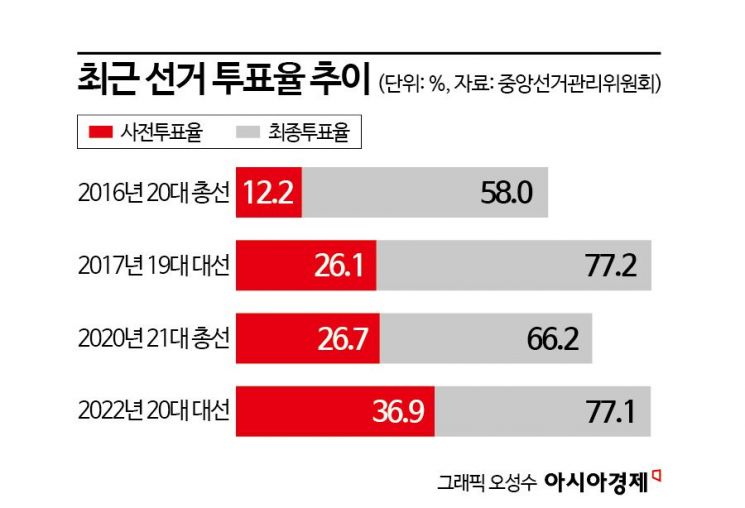
With nearly half of the voters participating in early voting, the calculations of both ruling and opposition parties have become more complicated. There has been a perception in the political sphere that higher voter turnout favors the progressive camp. The outcome is said to be influenced more by the participation of middle-aged or younger generations rather than the elderly, who have higher turnout rates.
The Democratic Party of Korea has a larger proportion of younger supporters compared to the ruling party. They believe that the victory or defeat in closely contested areas could depend on how many of these voters are brought to the polling stations during early voting. A Democratic Party campaign official said, "The more not only our party supporters but also the centrist voters participate in voting, the more favorable it will be for judgment."
The People Power Party has also encouraged early voting. However, conflicting statements from the campaign headquarters caused confusion. Hong Seok-jun, head of the comprehensive situation office, told reporters the day before, "Some supporters are raising issues about early voting, so we do not intend to encourage it." When controversy arose, Han Dong-hoon, emergency committee chairman, tried to calm the situation at a campaign event at Wangsimni Station in Seongdong-gu, Seoul, saying, "Whether early voting or the main vote, please go to the polling station unconditionally." Jang Dong-hyuk, secretary-general, also told reporters that morning, "We have made great efforts to improve the issues so far, so we ask for active participation."
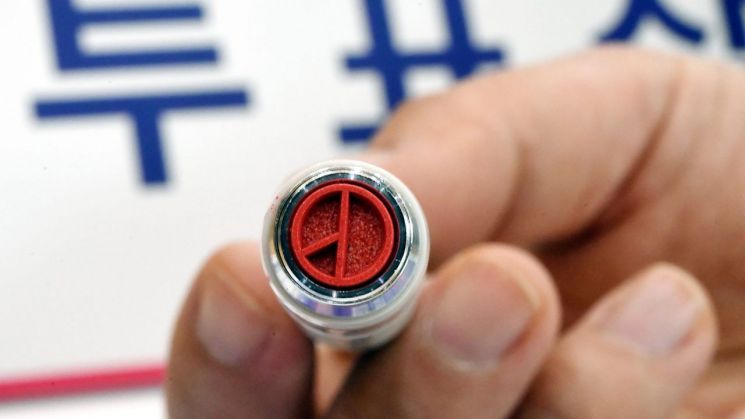
The National Election Commission introduced procedures such as manual counting of ballots to dispel suspicions of fraudulent voting like the 'basket voting' that occurred during the last general election. They also installed CCTV at early voting ballot box storage locations and plan to publicly display the footage 24 hours a day on large monitors set up at each city and provincial election commission office.
However, on the first official day of election campaigning yesterday, distrust flared up again as suspicious objects believed to be illegal cameras were repeatedly found at early voting stations nationwide. In the Incheon area, cameras of unknown origin were detected at three locations in Gyeyang-gu and two in Namdong-gu, and in Yangsan, Gyeongnam, four out of thirteen early voting stations were found to have such devices. The problematic cameras were reportedly installed near water dispensers and other locations inside the polling stations to capture the interior.
© The Asia Business Daily(www.asiae.co.kr). All rights reserved.


















