2023 Student Health Examination Sample Statistics
56% of Elementary, Middle, and High School Students Have 'Vision Problems'
More than half of elementary, middle, and high school students in South Korea have been found to have 'vision problems,' signaling a red alert for eye health.
On the 28th, the Ministry of Education and the Korea Disease Control and Prevention Agency announced the analysis data from last year's health examinations of elementary, middle, and high school students: the '2023 Student Health Examination Sample Statistics' (surveying 1,009 schools and 87,182 students) and the 'Youth Health Behavior Survey Results' (surveying 800 schools and about 60,000 students). The results showed that the rate of 'vision problems' among first graders in elementary school was 29.6%. Vision problems refer to cases where students wear glasses due to poor eyesight or have vision of 0.8 or less in either the left or right eye. The rate of vision problems jumped significantly as students advanced to higher grades. The rate was 68% for first-year middle school students and 75.3% for first-year high school students. These results are based on health examinations conducted on first and fourth graders in elementary school, first-year middle school, and first-year high school. When considering these students as a whole, 56.0% had vision problems, exceeding half. This is an increase of 0.8 percentage points compared to the previous year.
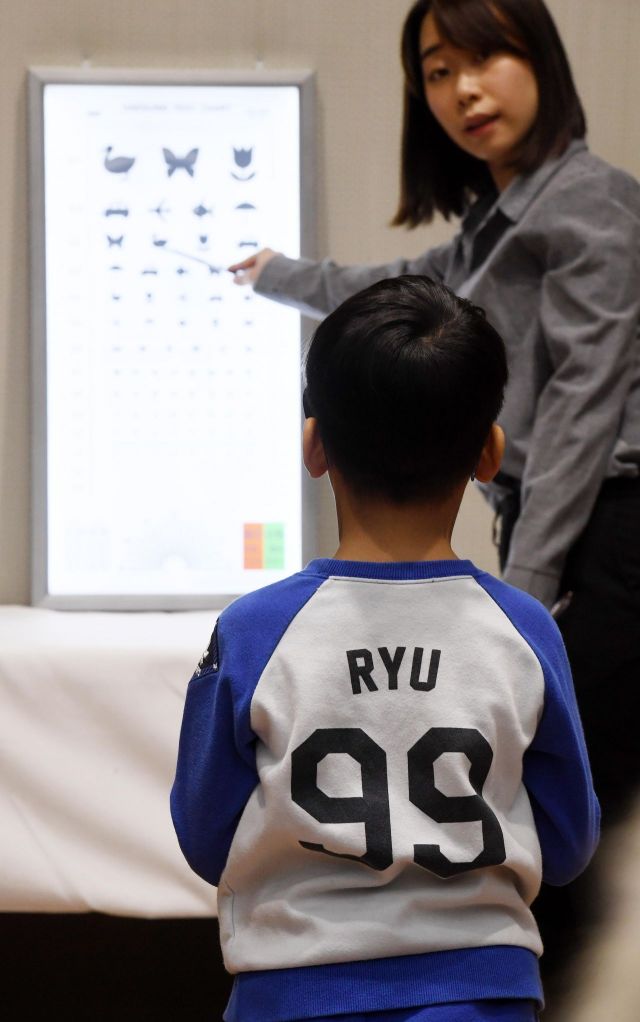 The photo is not related to the specific content of the article. A child is undergoing an eye examination. Photo by Hyunmin Kim kimhyun81@
The smartphone overdependence experience rate, surveyed every three years, also increased compared to the previous survey. Last year, the smartphone overdependence experience rate was 23% for male students and 32.3% for female students. This represents an increase of 2.8 percentage points for males and 2.3 percentage points for females compared to the 2020 survey. On weekdays, female students used smartphones for 294 minutes, which is 28 minutes more than male students (266 minutes). Male students increased their usage by 8 minutes compared to the previous year, while female students decreased by 6 minutes.
However, since the end of COVID-19 last year, the health indicators of elementary, middle, and high school students have generally improved. The proportion of students who are overweight or obese was 29.6%, showing a decreasing trend for the second consecutive year. This is a decrease of 0.9 percentage points from the previous year and 1.2 percentage points from two years ago. The rate of overweight and obesity was higher among students in eup and myeon areas (34.4%) than those in urban areas (28.7%).
Additionally, the number of students engaging in high-intensity physical activity increased. Students who performed physical activity for 60 minutes a day, five or more days a week, were 24.6% of male students and 9.2% of female students, increasing by 1.2 and 0.4 percentage points respectively compared to the previous year. Those engaging in high-intensity physical activity three or more days a week were 52.1% of male students and 29.6% of female students, showing a significant increase of 4.8 and 3.3 percentage points respectively. This is believed to be due to increased physical education activities at schools following the end of COVID-19.
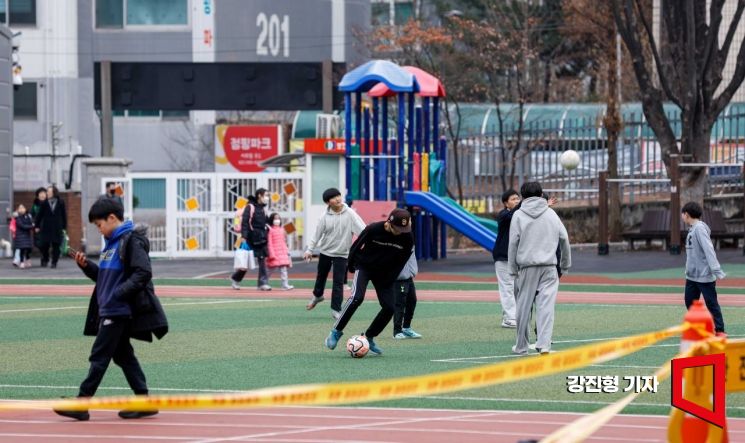 On January 4th, children are exercising at Wonmyeong Elementary School in Seocho-gu, Seoul. Photo by Jinhyung Kang aymsdream@
The number of youths experiencing depression also decreased. In the past year, 21.4% of male youths and 30.9% of female youths experienced depression continuously for two weeks, decreasing by 2.8 and 2.6 percentage points respectively compared to the previous year. The decrease was particularly notable among high school students (male: 25.3% → 21.4%, female: 33.6% → 30.2%). Along with this, the stress recognition rate also declined for both male students (36.0% → 30.8%) and female students (47.0% → 44.2%). The main source of stress for youths was the burden of grades and career paths (36.1%), followed by academics (25.9%), appearance (10.2%), and conflicts with parents (9.4%).
However, the number of students skipping breakfast slightly increased. Students skipping breakfast five or more days a week were 39.7% of males and 42.6% of females, increasing by 2.3 and 1.9 percentage points respectively compared to the previous year.
© The Asia Business Daily(www.asiae.co.kr). All rights reserved.


















