False Manufacturing Date Listed on Bread Distributed at Elementary School
School "Contract Terminated with Vendor... Will Hold Accountable"
A primary school in China has sparked a major controversy after it was revealed that the manufacturing date on the bread distributed to students during an event was incorrectly labeled.
On the 28th, local media including People’s Daily reported that the incident occurred on the 26th at a primary school in Suzhou (蘇州), Jiangsu (江蘇) Province. The school handed out bread as snacks to students during a spring picnic event that day. Surprisingly, the manufacturing date on the bread was marked as the 27th, the day after the picnic. This was discovered by a parent who checked the bread their child had brought home without eating. The parent exposed the issue by posting a video of the bread online, which led to nationwide attention.
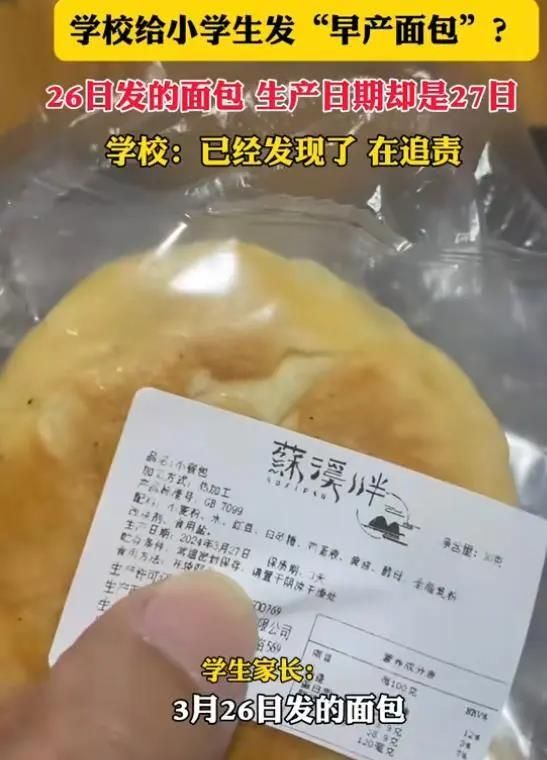 Bread from a Chinese company stamped with a manufacturing date of the 'next day' after receiving the bread [Image source=Captured from Baidu, China, Yonhap News]
Alarmed by the situation, the school belatedly recognized the problem with the bread’s manufacturing date and contacted the catering company to promptly recall the problematic bread. The school also terminated its contract with the company and decided to hold the company legally accountable. Parents of the school expressed outrage, stating, "Food safety is directly linked to the health of all children," and called the incident "absolutely unacceptable." Chinese netizens harshly criticized the company for falsifying the manufacturing date, mocking the bread with nicknames such as "bread from the future," "premature bread," and "time-traveling bread."
However, it has not yet been confirmed whether the incident was simply a mistake in labeling the manufacturing date or a deliberate attempt to extend the very short shelf life of the bread, which lasts only three days. Experts pointed out that "this incident exposes the careless attitude and management loopholes in the food production process," urging the industry to self-regulate and the authorities to enforce strict supervision.
Meanwhile, last year, a dairy company in China was caught after an internal whistleblower exposed its systematic manipulation of expiration dates. The factory in Hangzhou city used a method of wiping off production dates with chemically treated cotton swabs on returned products before their expiration date and then falsifying the dates. Additionally, defective products generated during production were collected for 3 to 7 days, repackaged, and sold as new products. Local media reported that "some of the beverages being filtered at this company developed mold and spoiled." The company had been fined 20 million KRW three years ago for manipulating production dates but reportedly continued the same practices.
© The Asia Business Daily(www.asiae.co.kr). All rights reserved.

















