4.48% Increase + 650,000 KRW Holiday Allowance... 5.6% Total Rise
Immediate Return to Normal Operation... Seoul City Also Lifts Emergency
Seoul City Financial Burden Rises... Around 60 Billion KRW Level
Wage negotiations between the labor and management of Seoul city buses were settled on the 28th, about 11 hours after the union launched a general strike. The agreed increase is 4.48%, the same level as that agreed upon by major city bus labor and management in Busan and Daegu. A new holiday allowance of 650,000 won was established. Considering this, the total increase amounts to 5.6%, and Seoul City will bear an additional annual financial burden of about 60 billion won.
Seoul City announced around 3:20 p.m. that day that the Seoul City Bus Labor Union and the management side, the Seoul City Bus Transportation Business Association, had reached an agreement on wage negotiations. The bus union fully withdrew the general strike that began at 4 a.m. and immediately resumed normal operations, and Seoul City lifted the emergency transportation measures and changed the planned extended operations of the subway, charter buses, and other alternative transportation to regular operations.
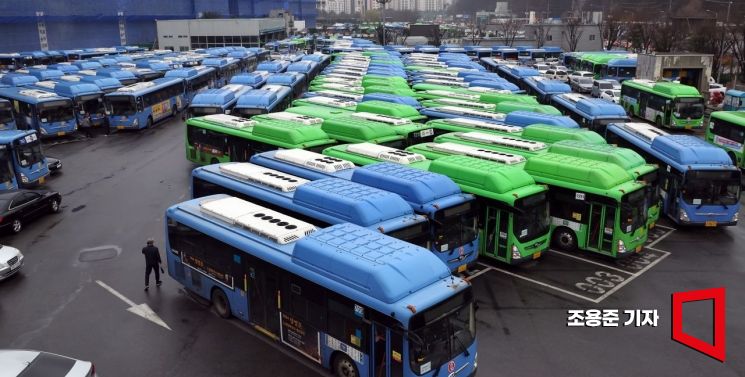 On the 28th, when the Seoul city bus union went on a general strike for the first time in 12 years, buses were parked at a bus garage in Eunpyeong-gu, Seoul. Photo by Jo Yongjun jun21@
Earlier, labor and management held a final adjustment meeting at the Seoul Regional Labor Relations Commission from 2:30 p.m. the previous day and engaged in marathon negotiations for over 11 hours but failed to find a compromise. Around 2 a.m. that day, the breakdown of negotiations was declared, and the union launched the general strike at 4 a.m. It was the first strike by the Seoul Bus Union in 12 years since 2012. The union demanded a 12.7% hourly wage increase to prevent workforce outflow amid worsening personnel losses to the Incheon and Gyeonggi regions, while management maintained that the demand was excessive compared to the inflation rate and wage increase rate over the past five years.
However, after continuous behind-the-scenes negotiations mediated by Seoul City, labor and management agreed around 3:20 p.m. that day on a 4.48% wage increase and a holiday allowance of 650,000 won. Yoon Jong-jang, Director of Seoul City Urban Transportation Office, explained in a briefing, "The wage increase agreement reached this year between labor and management is at the same level as other regions such as Daegu and Busan," adding, "Considering that buses operate even during special occasions like holidays, a holiday allowance was newly established."
However, with this agreement raising bus drivers' wages, Seoul City's financial burden will also increase. Considering that each 1% wage increase results in an additional financial burden of about 11 to 12 billion won, the total reaches approximately 60 billion won. This is also influenced by the quasi-public operation system currently applied to Seoul city buses, where local governments compensate bus companies for deficits in exchange for maintaining vulnerable area routes and preserving public service. Director Yoon added, "We need to strengthen cooperation between labor and management and find solutions through management innovation and generating revenue from subsidiary businesses."
Some predict that this wage increase may lead to higher public transportation fares, but Director Yoon stated, "Since the basic bus fare was increased by 300 won last year, it is unlikely that this will immediately lead to a fare increase."
With the strike over, the evening commute is expected to be less congested than the morning commute. However, the strike during the morning hours caused inconvenience not only in Seoul but also for residents of Gyeonggi Province commuting to Seoul. In particular, the strike coincided with the high school March mock exam day, causing harm to students.
© The Asia Business Daily(www.asiae.co.kr). All rights reserved.
!["The Woman Who Threw Herself into the Water Clutching a Stolen Dior Bag"...A Grotesque Success Story That Shakes the Korean Psyche [Slate]](https://cwcontent.asiae.co.kr/asiaresize/183/2026021902243444107_1771435474.jpg)
















