"Protect Patients Before It's Too Late"
Promoting Reduction of Resident Doctors' Working Hours
Strengthening Cancer Patient Care Cooperation... Expanding Partner Hospitals
On the 28th, the Ministry of Health and Welfare urged resident doctors who have left their training programs to "return to their training hospitals by the end of March." The ministry warned that medical school graduates who passed the internship this year will be unable to train in the first half of the year if they do not register their appointment with the Training Environment Evaluation Committee by the 2nd of next month, and asked them to "return to the medical field and stay by the patients' side before it is too late."
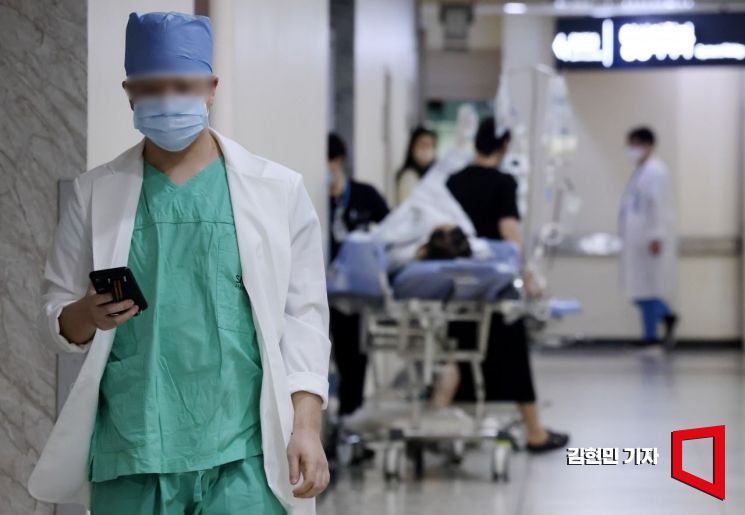 On the 8th, the first day of the implementation of the "Supplementary Guidelines for the Pilot Project on Nurses' Duties," which allows nurses to perform cardiopulmonary resuscitation and administer emergency drugs to emergency patients, medical staff were busy working at a university hospital in Seoul. Photo by Hyunmin Kim kimhyun81@
On the same day, Jeon Byeong-wang, the General Director of the Central Accident Response Headquarters (CARH) and Director of the Health and Medical Policy Office at the Ministry of Health and Welfare, explained at a CARH briefing, "For those who passed the internship this year, we have guided them to register their appointment with the Training Environment Evaluation Committee by the 2nd of next month. If the appointment registration is not completed by this deadline, internship training in the first half of this year will be impossible. In that case, they will have to start internship training in the second half starting in September or in March next year."
The government announced that it will accelerate institutional improvements to enhance the treatment of resident doctors. First, it plans to reduce the working hours of resident doctors.
The total training hours for resident doctors were revised in February under the "Act on the Improvement of Training Environment and Status of Resident Doctors," allowing the Ministry of Health and Welfare to set weekly working hours at 80 hours and continuous working hours at 36 hours by ministerial decree. Although this law will be enforced in February 2026, the ministry plans to conduct a "pilot project to reduce continuous working hours for resident doctors" starting in May this year. Participating hospitals will receive various policy supports for project operation, and incentives will be provided for resident doctor quota allocations in 2025.
Director Jeon said, "Through this, each hospital will deploy additional personnel and alleviate the workload of resident doctors to support their focus on training," adding, "We will evaluate the results of the one-year pilot project and promptly institutionalize the reduction of continuous working hours for resident doctors, expanding it to all training hospitals."
In addition, the government plans to strengthen the policy foundation to enhance the quality of resident training. It intends to expand the participation of resident doctor members in the "Training Environment Evaluation Committee," which deliberates policies and systems related to resident doctors. Currently, there are 2 resident doctor members among the total 13 committee members. To increase this number, the government will pursue amendments to the Enforcement Decree of the Resident Doctor Act and expand resident doctor membership by one in each of the three subcommittees under the Training Environment Evaluation Committee?policy, education, and institutions?so that the field experience and creative ideas of resident doctors can be reflected in policies. Starting in June, a survey will also be conducted to comprehensively assess the training environment of resident doctors.
Meanwhile, the CARH discussed "measures to strengthen the medical cooperation system" to ensure that cancer patients receive timely and appropriate treatment within the emergency medical system.
The government will expand the designated medical cooperation hospitals from 100 to 150 by adding 50 more starting tomorrow (the 29th). Among these, 45 hospitals with grade 1 or 2 in cancer adequacy evaluations and high cancer treatment capacity based on cancer treatment frequency will operate as cancer medical cooperation hospitals. Furthermore, information on cancer treatment capabilities, such as the availability of cancer surgery, chemotherapy, and radiation therapy, will be included in the shared medical capability information between tertiary general hospitals and cancer medical cooperation hospitals for utilization.
Director Jeon stated, "Currently, chemotherapy is still being performed as before at tertiary general hospitals, but there is a need to establish a system where management of side effects after cancer treatment can be received at nearby general hospitals," adding, "To this end, we are strengthening the linkage between tertiary general hospitals and cancer medical cooperation hospitals."
Efforts are underway to establish cancer patient consultation desks within tertiary general hospitals, and additional incentives will be provided to hospitals that complete the installation.
© The Asia Business Daily(www.asiae.co.kr). All rights reserved.

















