Connecting Semiconductor Hubs in Hwaseong, Yongin, and Anseong
Expecting Enhanced Competitiveness through Workforce and Logistics Mobility
Hwaseong, Yongin, and Anseong in southern Gyeonggi Province are cities included in the government's ambitious semiconductor belt project. The so-called 'Semiconductor Highway' project, which connects major semiconductor hubs in this region with a single highway network, is expected to gain momentum. This is because President Yoon Suk-yeol expressed his commitment to constructing the 'Semiconductor Highway' to strengthen semiconductor competitiveness at the 'Livelihood Discussion' held at Yongin City Hall on the 25th.
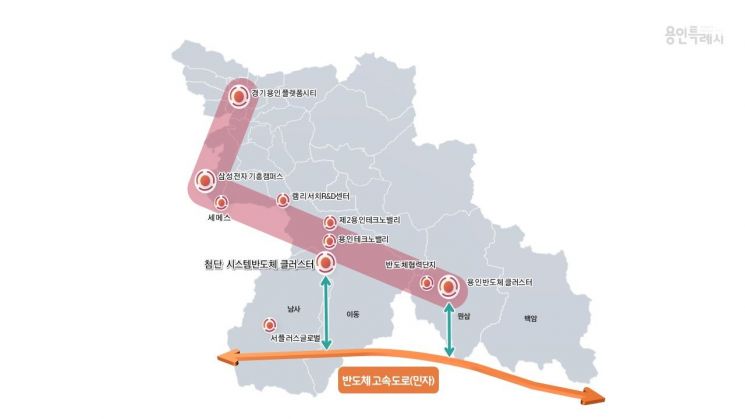
What is the route?
The 'Semiconductor Highway' is a highway network connecting a 45 km section from Yanggam-myeon in Hwaseong through Namsa and Wonsam in Cheoin-gu, Yongin, to Iljuk-myeon in Anseong. It is being promoted as a private investment project.
Although the specific route has not been disclosed as it is not yet finalized, the plan is to branch off from the Pyeongtaek-Hwaseong Expressway (Expressway No. 17), pass through Namsa-eup and Wonsam-myeon in Cheoin-gu, Yongin?where Samsung Electronics' advanced system semiconductor national industrial complex and SK Hynix's 'Yongin Semiconductor Cluster General Industrial Complex' will be located?and connect to Anseong Iljuk, where it meets the Jungbu Expressway.
It is essentially a highway network that horizontally connects the southern metropolitan area between the Seoul Metropolitan Area Second Ring Expressway and the Pyeongtaek-Jecheon Expressway.
How has it been promoted?
The Semiconductor Highway was a campaign pledge made by Lee Sang-il, mayor of Yongin, during the 2022 local elections. At that time, Mayor Lee announced the pledge to establish the 'Yongin Semiconductor Highway and create a semiconductor industrial cluster,' presenting a blueprint for a privately funded highway running east-west through the southern part of Cheoin-gu.
After taking office, Mayor Lee has consistently emphasized the necessity of the Semiconductor Highway to the Presidential Office and the Ministry of Land, Infrastructure and Transport, requesting support for the project. In January last year, during an organizational restructuring, separate teams were established within the New Growth Strategy Division, Semiconductor Divisions 1 and 2, and the 4th Industrial Convergence Division to operate specifically for the construction of the Semiconductor Highway, demonstrating a strong commitment to advancing the project.
Currently, the Semiconductor Highway project is undergoing a feasibility study based on private investment promotion. Yongin City, in consultation with the Ministry of Land, Infrastructure and Transport, determined the route including the highway's start and end points, and applied for the feasibility study to the Korea Development Institute (KDI) Joint Investment Management Center in December last year. The city expects the results of the feasibility study to be announced around July at the earliest.
Expected effects
Yongin City believes that once the Semiconductor Highway is constructed, the conditions for the movement of personnel and logistics between major semiconductor hubs will be greatly improved, which will help enhance competitiveness. The existing Samsung Electronics Hwaseong Campus, the I-dong and Namsa advanced system semiconductor national industrial complexes, the Yongin Semiconductor Cluster general industrial complex, and Anseong Bogae-myeon’s 'Semiconductor Materials, Parts, and Equipment Specialized Complex' will be connected by a single highway, maximizing the agglomeration effect of the semiconductor belt.
Additionally, SK Hynix’s factory in Icheon and Samsung Electronics’ future research complex in Giheung, Yongin, will also be connected via the Gyeongbu and Jungbu Expressways. The city particularly emphasizes the necessity of constructing the Semiconductor Highway for the commute of residents of the 'Idong Public Housing District,' a semiconductor-backed new town spanning approximately 2.28 million square meters with 16,000 households in Idong-eup, Cheoin-gu, and for professionals working in the semiconductor industry.
Mayor Lee said, "We will greatly expand transportation infrastructure to lay a solid foundation for Yongin to leap forward as a global semiconductor hub city."
Expansion of connecting road networks such as national and local roads
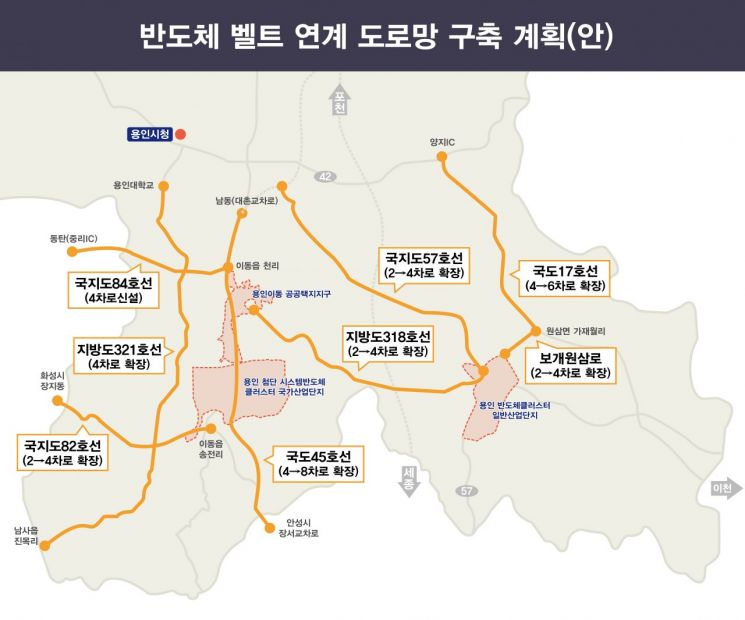
Yongin City plans to significantly expand not only the Semiconductor Highway but also the road networks around the system semiconductor industrial complex and the Yongin Semiconductor Cluster.
A representative route is National Road No. 45. This route connects Yongin City north to south and extends to Anseong City. The road passes through the I-dong and Namsa system semiconductor industrial complexes and the Idong Public Housing District. During the Livelihood Discussion, President Yoon announced plans to expand National Road No. 45 from four lanes to eight lanes alongside the promotion of the Semiconductor Highway construction. At the discussion, Mayor Lee requested, "I hope the government will consider exempting the preliminary feasibility study so that the expansion project can be completed before the first fab of the national industrial complex begins operation."
Earlier, in August last year, Mayor Lee requested the Ministry of Land, Infrastructure and Transport and the Korea Land and Housing Corporation (LH) to reflect the road network connected to the national industrial complex in the national industrial complex survey and design service.
The connecting road networks requested by the city include three routes: ▲ New 4-lane road from Buk-ri, Namsa to Muk-ri, Idong (15 km) ▲ Expansion of National Road No. 45 from Eobi-ri, Idong to Namdong, Cheoin to 8 lanes (12 km) ▲ Expansion of Local Road No. 321 from Bongmyeong, Namsa to Agok, Namsa to 4 lanes (5.2 km).
Meanwhile, the city plans to complete the construction of Local Road No. 84 between Dongtan Jungri IC in Hwaseong City and Cheon-ri, Idong-eup, Cheoin-gu, Yongin by the end of 2026. Additionally, for the six-lane expansion project between Yangji IC Intersection and Pyeongchang Intersection, the city is pursuing a plan to extend it to Bogae Wonsam-ro, the entrance road to the semiconductor cluster.
Bogae Wonsam-ro has already begun construction to expand from two lanes to three lanes in preparation for the groundbreaking of SK Hynix Semiconductor’s first production line scheduled for March next year.
© The Asia Business Daily(www.asiae.co.kr). All rights reserved.
![Clutching a Stolen Dior Bag, Saying "I Hate Being Poor but Real"... The Grotesque Con of a "Human Knockoff" [Slate]](https://cwcontent.asiae.co.kr/asiaresize/183/2026021902243444107_1771435474.jpg)

















