Over 12,000 Lease Transactions in January... 56.2% Lease Contracts
Official Price Drop → Reduced Jeonse Deposit Insurance Limit
More Landlords Demand Monthly Rent, Increasing Tenants' Housing Burden
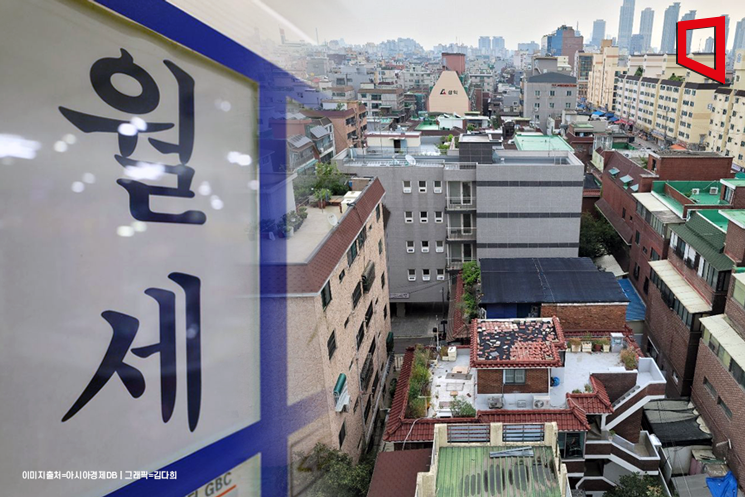
As the publicly announced prices of affordable housing such as villas, multi-family houses, row houses, and officetels decline, landlords are increasingly demanding conversion to monthly rent due to reduced limits on jeonse deposit insurance. Since the insurance limit has dropped, landlords cannot raise the deposit to match the market price, so they are converting the difference into monthly rent. This sudden shift to monthly rent is criticized for undermining the housing stability of low-income tenants by reducing their disposable income.
On the 28th, real estate information company Economy Man Lab reviewed the Ministry of Land, Infrastructure and Transport's actual transaction price disclosure system and found that in January, nationwide villa monthly rent transactions amounted to 11,878 cases, accounting for 56.2% of the total lease transactions (21,146 cases). This was the highest since the government began compiling these statistics in 2011 (January basis). The proportion of villa monthly rent transactions exceeded 50% for the first time last year.
The recent increase in monthly rent is attributed to the decline in publicly announced prices. The maximum subscription limit for the jeonse deposit return guarantee insurance (jeonse deposit insurance) operated by the Korea Housing & Urban Guarantee Corporation (HUG) is based on the publicly announced housing price. Protection is only available up to 126% of the publicly announced price. In this structure, if the publicly announced price falls, the insurance limit also decreases accordingly. For example, for a villa with a market price of 300 million KRW and a publicly announced price of 240 million KRW, the jeonse deposit insurance subscription limit is 302.4 million KRW. If the publicly announced price drops to 230 million KRW, the subscription limit decreases to 289.8 million KRW, a reduction of 12.6 million KRW.
As the insurance limit decreases, landlords are forced to lower the jeonse deposit. This is because tenants now want full insurance coverage of the jeonse deposit following recent jeonse fraud incidents. However, landlords are lowering the jeonse deposit to the insurance limit but are demanding that the unpaid deposit amount be converted into monthly rent by applying the jeonse-to-monthly rent conversion rate (6.01% as of last January). In the above example, the landlord returns 12.6 million KRW from the 300 million KRW deposit to the tenant but notifies the tenant to pay 63,000 KRW monthly rent by applying the conversion rate. From the tenant's perspective, this means paying interest to the landlord at twice the base interest rate.
Yoon Soo-min, a real estate specialist at NH Nonghyup Bank, explained, "Tenants have no choice but to bear monthly rent to secure safety measures for their jeonse deposit," adding, "The villa market originally operated on jeonse, but this is accelerating the shift to monthly rent."
© The Asia Business Daily(www.asiae.co.kr). All rights reserved.


















