Negotiations Continue Among Practitioners Until Morning
Wage Increase Proposal Is Key... Jino Committee
Arbitration Proposal Fails Due to Management Opposition
Seoul City Activates Emergency Transport Measures
The Seoul City Bus Union began a total strike from the first bus on the 28th, and negotiations have been continuing behind the scenes throughout the morning. Since the introduction of the semi-public bus system, this is the first time Seoul buses have stopped operating for such a long period causing inconvenience to citizens, drawing attention to whether a 'dramatic agreement' will be reached.
The Seoul City Bus Labor Union and the Seoul Metropolitan Bus Transport Business Association, the management side, are continuing working-level negotiations at the Seoul Regional Labor Relations Commission (Seoul RLR Commission) this morning. Earlier, after last-minute adjustments that continued until dawn, the union declared the breakdown of negotiations with management.
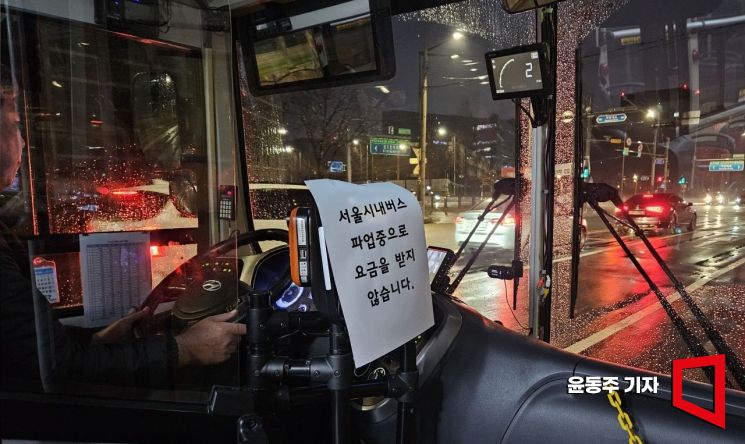 On the 28th, when the Seoul city bus union went on a general strike for the first time in 12 years, a notice saying "Seoul city buses are on strike, fares are not being collected" was attached to the fare tag on buses operating in Seoul. Photo by Dongju Yoon doso7@
The key issue is the wage increase negotiations. The union demands a 12.7% increase, while the Bus Association insists on a 2.5% raise. The Seoul RLR Commission, acting as mediator, proposed a 6.1% increase to both labor and management sides the day before. However, it is reported that the Bus Association opposed this. A representative of the Bus Association said, "In Busan and Daegu, wage increases were settled at 4.48%, so it is difficult to accept the mediation proposal of 6.1%. If the union's demands are reflected amid the increasing deficits of bus companies, Seoul City would have to compensate financially."
The union stated that before discussions with working-level staff could take place, management expressed opposition, preventing a unified stance on the mediation proposal. A Seoul City Bus Union official explained, "The mediation proposal was supposed to be discussed at a meeting of all branch chairpersons, but since management's opposition came out beforehand, the discussion itself did not happen."
If negotiations on the biggest point of disagreement, wages, are reached, the strike is expected to end. Seoul City has left the negotiations to labor and management autonomously but plans to make every effort to resolve the situation as quickly as possible amid this unprecedented bus strike in 12 years. A city official said, "Both sides are continuing discussions, and we have to wait to see when it will end," adding, "We are trying our best to reach an agreement today, as soon as possible."
Seoul City and autonomous districts have activated emergency transportation measures in response to the unprecedented bus strike. To alleviate congestion and inconvenience during commuting hours, subway services have been increased, and late-night operation hours extended by one hour. The 25 autonomous districts have deployed 280 free shuttle buses on 119 routes to connect with the subway.
© The Asia Business Daily(www.asiae.co.kr). All rights reserved.
![Clutching a Stolen Dior Bag, Saying "I Hate Being Poor but Real"... The Grotesque Con of a "Human Knockoff" [Slate]](https://cwcontent.asiae.co.kr/asiaresize/183/2026021902243444107_1771435474.jpg)
















