Low-Cost Cafe Stealing Even 6-Year Regular Customers
Building Recognition with Top Stars Like Son Heung-min and BTS
Individual Cafes Cut Labor Costs to Compete on Price
Lee Ho-jun (45), who has been running a cafe in Jongam-dong, Seongbuk-gu, Seoul for six years, has recently been facing many concerns. This is because a large franchise cafe opened just 600 meters away from his cafe at the end of last year, causing his regular customers to decrease.
Especially as summer approaches, when the demand for iced Americano is high, he finds himself frustrated as he cannot find a way to compete with the large-volume, low-priced coffee sold by the franchise cafe.
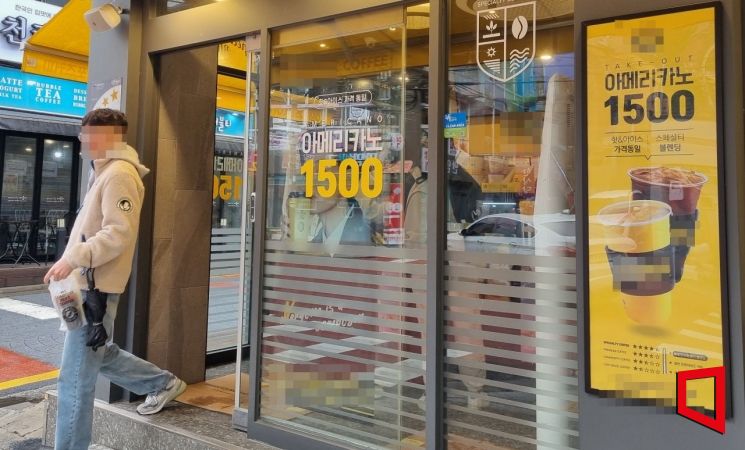 A low-cost franchise cafe near a university in Seongbuk-gu, Seoul. There is a large advertisement stating that an iced Americano is sold for 1,500 won per cup.
 [Photo by Seong-A Shim]
The Invasion of Large-Volume Low-Priced Coffee... Advantage in Cost Competition
Large franchise cafes selling affordable coffee are rapidly increasing their franchise stores. In some areas of Seoul, the same brand stores have opened at every subway stop.
According to the 2022 Franchise Business Disclosure Report released by the Fair Trade Commission, the number of domestic franchise stores selling iced Americano for under 2,000 won ranked as follows: Mega Coffee (2,156 stores), Compose Coffee (1,901 stores), Paik’s Coffee (1,228 stores), and The Venti (993 stores). As of the 27th, the number of Compose Coffee franchise stores increased to 2,512, adding 611 stores in less than two years.
Large franchise cafes have an advantage in cost competition because their headquarters have systems such as in-house roasting factories and can collectively procure large quantities of roasted beans. On the other hand, individual cafes roast and procure relatively small amounts of beans, limiting their ability to lower consumer prices.
No Ha-young (52), owner of a private cafe in Pildong, Jung-gu, Seoul, said, “As the culture of having a cup of coffee after a meal has formed, cheap coffee has become competitive regardless of taste,” adding, “Individual cafes mainly serve customers sensitive to coffee taste, so even if they charge a bit more, they carefully select good beans and prepare coffee with dedication.” Lee Ho-jun also said, “Most individual cafes rely on regular customers,” and added, “It’s not easy to raise prices just because raw material costs have increased.”
Individual Cafes Face Limits in Lowering Prices... Only Labor Costs
The only cost individual cafes can reduce to compete on price is labor costs. Oh Joo-mi (35), who runs a dessert cafe in Anam-dong, Seongbuk-gu, Seoul, works about 12 hours every day managing the cafe. Oh said, “Even raising prices by 100 won causes reactions from customers,” and lamented, “If I hire one part-time worker, considering hourly wages, employment insurance, and severance pay, I would have to raise menu prices by 500 to 600 won, so I can’t even think about it and do everything myself.”
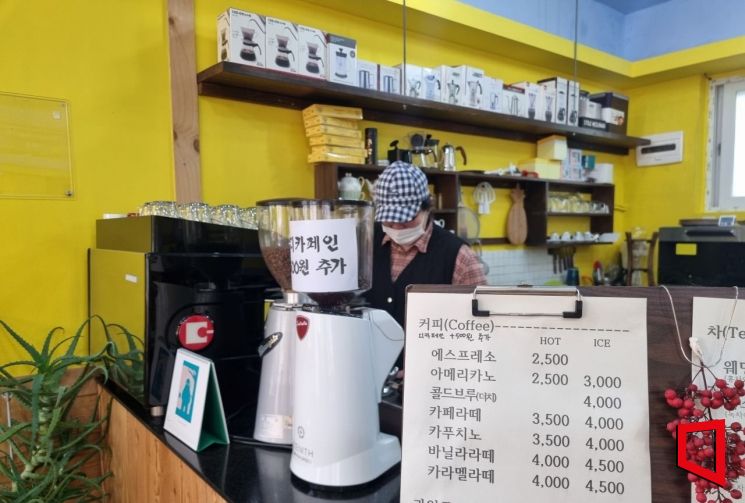 The owner of a private cafe in the university area of Seongbuk-gu, Seoul, is brewing coffee. The menu board shows that an iced Americano costs 3,000 won.
 [Photo by Sim Seong-a]
Large Franchises Spend Billions on Top Star Marketing
Another reason individual cafes find it difficult to compete with large franchise cafes is advertising marketing. Mega Coffee boosted brand awareness by featuring soccer player Son Heung-min, and Compose Coffee used BTS member V as their advertising model.
According to the 2022 advertising expenses by brand released by the Fair Trade Commission, Mega Coffee spent 3.7 billion won, Paik’s Coffee 4.1 billion won, Compose Coffee 2.7 billion won, and The Venti 1.9 billion won. One individual cafe owner lamented, “Franchises have sufficient demand because they already have brand recognition once they open, even without separate promotions,” adding, “Individual cafes take much longer to build recognition in their neighborhoods.”
Experts advise that individual cafes need to find differentiation in this era of intense competition. Lee Young-ae, a professor of Consumer Studies at Incheon National University, said, “Policies such as regulating the distance between cafes are ineffective,” emphasizing, “Small business owners need their own strategies to attract customers.” She added, “Highlighting differentiation through personalized services rather than standardized services is also a good approach.”
© The Asia Business Daily(www.asiae.co.kr). All rights reserved.
![Clutching a Stolen Dior Bag, Saying "I Hate Being Poor but Real"... The Grotesque Con of a "Human Knockoff" [Slate]](https://cwcontent.asiae.co.kr/asiaresize/183/2026021902243444107_1771435474.jpg)












