Interest in Compensation Amount for Yongsunsa Maersk
Likely Application of the 1851 'Limitation of Liability Act'
"Shipowner Liability Minimized Even in the Titanic Incident"
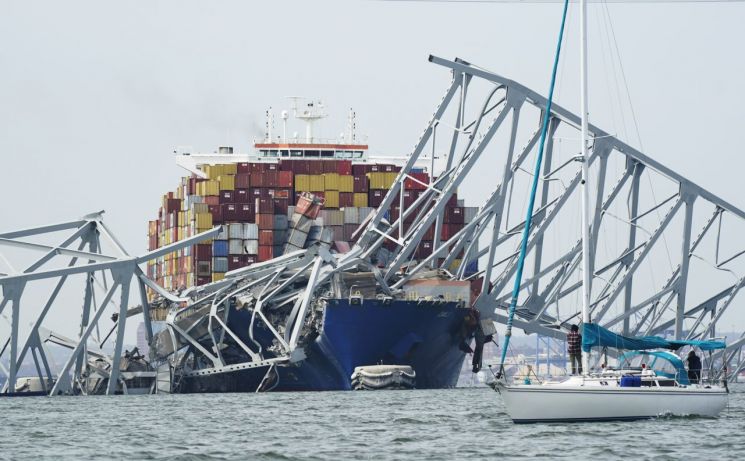
A collision between a bridge and a vessel in Baltimore, USA, has inevitably sparked disputes over liability for damages. The port has been closed, and traffic in the area has been paralyzed for an extended period, resulting in significant losses. In particular, the scale of compensation that Maersk, the large shipping company chartering the accident vessel, must bear is a matter of intense interest.
Legal experts in the United States predict that Maersk, as the charterer who contracted to use the vessel without operating it, will have little or no liability. Furthermore, it is expected that the U.S. 'The Limitation of Liability Act of 1851,' which has significantly reduced shipowner liability in major maritime accidents such as the Titanic incident, will apply, leading to projections that the shipowner will also face much lower compensation amounts than anticipated.
The largest automobile import-export port in the US comes to a halt... Accident compensation could reach hundreds of millions of dollars
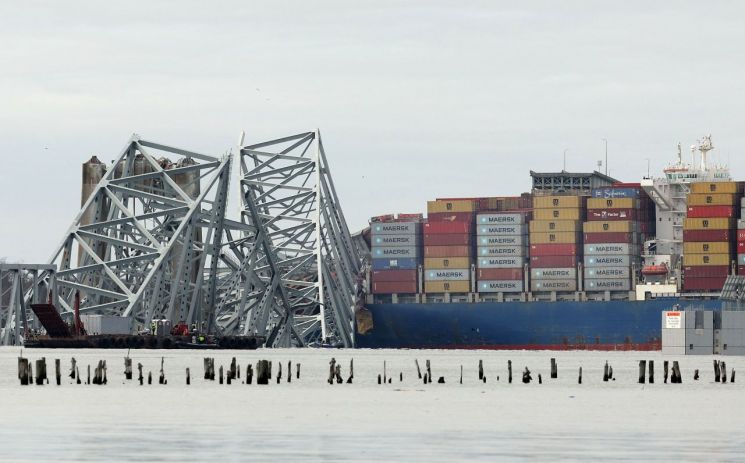
According to AFP on the 26th (local time), Paul Wiedefeld, Maryland's Secretary of Transportation, stated at a press conference, "Ship arrivals and departures at the Port of Baltimore will be suspended until further notice." The debris from the collapsed Francis Scott Key Bridge, caused by the ship collision, is blocking the shipping lanes, making vessel access impossible. On the same day, 13 cargo ships scheduled to depart from the Port of Baltimore were also stuck at the port.
In the early hours of the day, the Singaporean container ship 'Dali' collided with the Francis Scott Key Bridge spanning the Patapsco River shortly after departing Baltimore Port, causing the bridge to collapse instantly. Eight workers who were working on the bridge at the time fell; two were rescued, and six remain missing. None of the 22 crew members aboard the Dali were reported injured.
Fortunately, vehicle traffic on the bridge had been restricted just before the collision, preventing major casualties. However, the closure of Baltimore Port is expected to cause enormous economic losses. According to the Maryland Port Administration, Baltimore Port ranks ninth in the U.S. by cargo volume and is the port that handles the largest number of automobiles in the country, approximately 750,000 vehicles annually. Depending on the duration of the port closure, losses are expected to reach at least hundreds of millions of dollars, and a series of damage compensation lawsuits is anticipated.
Maersk may avoid liability due to no crew onboard... Shipowners likely to see reduced compensation under 'Titanic Law'
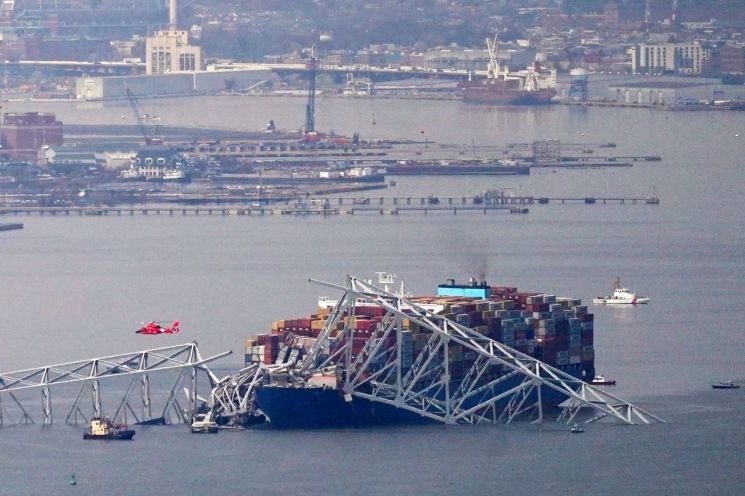
Of particular interest to the market is the scale of compensation that Maersk, the charterer of the Dali and the world's second-largest shipping company, may face. The Dali is a container ship built by Hyundai Heavy Industries in 2015; the shipowner is the Singaporean company Grace Ocean, and the vessel is operated by Synergy Group. Intense legal battles between these companies and insurers over liability and compensation are inevitable.
Experts believe that Maersk, as the charterer, is likely to have very little or no liability. Stefan Kovachev, a credit analyst at Bloomberg Intelligence (BI), a research arm of Bloomberg News, stated, "Maersk is a simple charterer with no crew onboard the vessel, and the ship's operation is the responsibility of a separate operator, so it may have no liability at all." However, he pointed out, "Marine insurance may cover part of the costs, and since the extent of the damage and who will pay how much have not yet been determined, this uncertainty could impose a short-term burden on Maersk."
It is also suggested that if the U.S. Limitation of Liability Act applies to the shipowner and operator, the compensation amount could be much lower than expected. According to Bloomberg News, the Limitation of Liability Act, enacted in 1851, was applied during the 1912 Titanic sinking and is sometimes called the 'Titanic Law' in the U.S. This law limits the shipowner's liability for damages to the value of the vessel and its cargo at the time of the accident.
Martin Davies, director of the Maritime Law Center at Tulane University, told Bloomberg News, "This law was created in 1851 to encourage and protect the shipping industry by significantly limiting shipowners' liability," adding, "If this law applies, even if the total claims amount to hundreds of millions of dollars, the actual compensation liability could be reduced to tens of millions of dollars."
© The Asia Business Daily(www.asiae.co.kr). All rights reserved.



















