Strike if labor negotiations fail late on the 27th
Seoul City emergency transport measures... increased subway trains
The Seoul City Bus Union held a vote on whether to proceed with a general strike scheduled for the 28th, and the proposal passed with approximately 98% approval.
The Seoul City Bus Union of the Korea Federation of Automobile Workers' Unions announced on the 26th that out of 18,133 union members, 16,317 voted in the strike referendum, with a 98.3% approval rate for the strike proposal. There were 239 opposing votes and 32 invalid ballots.
Accordingly, if final negotiations with management fail, Seoul city buses will stop running from 4 a.m., when the first buses start operating on the 28th. The labor and management of Seoul city buses will conduct last-minute mediation procedures at the Seoul Regional Labor Relations Commission on the afternoon of the 27th. The union stated that if no agreement is reached by midnight following the mediation, a legal strike will be possible.
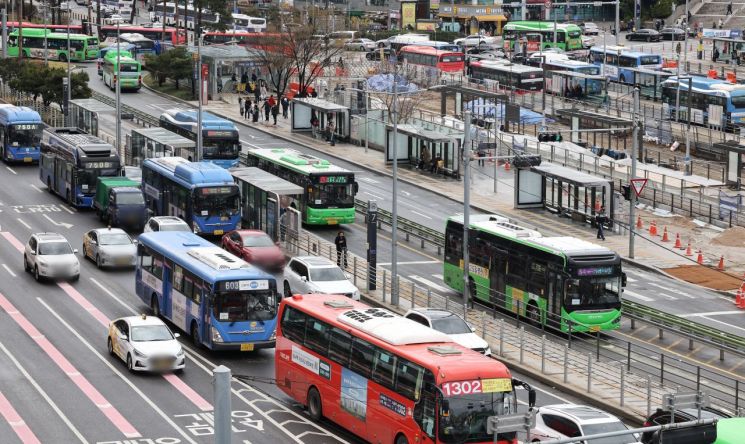
The union is demanding wage improvements that lag behind those in nearby quasi-public bus service areas such as Incheon. In Incheon, the total wage increase rate over the past five years was 27.7%, whereas Seoul's was only 14.9%. Labor and management have been negotiating wages through seven central labor-management negotiations and two preliminary mediation meetings from December 28 last year to the 23rd of this month but have failed to reach an agreement. The union is demanding a 12.7% hourly wage increase, while the management side insists on a wage freeze.
Seoul City has prepared an emergency transportation plan to minimize inconvenience to citizens in case the strike proceeds. First, Seoul City, autonomous districts, and the bus union have formed an emergency transportation headquarters to maintain a 24-hour communication system and have pre-established cooperation systems with transportation operators such as Seoul Metro, Seoul Metro Line 9, and the Ui-Sinseol Light Rail Transit to promptly implement transportation measures.
Accordingly, additional and extended public transportation services will be implemented from the 28th until the union strike ends. The subway will increase the total number of trips by 202 per day to alleviate rush hour congestion and address inconveniences. The main rush hour periods will be extended by one hour compared to the current schedule to increase train deployment, and the last subway trains will be extended until 2 a.m. the following day to support late-night travel.
During the congested hours of 7?8 a.m. and 6?8 p.m., subway operations will increase by a total of 77 trips, and the last train service will be extended until 2 a.m. the next day at terminal stations, increasing total trips by 125. Fourteen emergency standby train sets will be prepared to be deployed immediately in case of train delays or congestion. Order maintenance personnel will be deployed at 17 major stations with high congestion, including Jamsil Station, Sadang Station, Guro Digital Complex Station, Seoul Station, and Gangnam Station.
To facilitate quick transfers during subway rush hours, free shuttle buses will operate in Seoul's 25 autonomous districts. Approximately 400 public and private vehicles will be rapidly deployed to connect major hubs to subway stations, focusing on areas where village buses do not operate among the suspended city bus routes.
To encourage the use of personal transportation, the city will also promote carpooling and the use of Darungi (Seoul's public bike-sharing system) to citizens. Additionally, Seoul City plans to request elementary, middle, and high schools, public institutions, and private companies in the city to adjust school and work start times by one hour during the strike period to disperse the concentrated commuting demand during peak hours.
Meanwhile, the city emphasized that it will make every effort to achieve a smooth labor-management agreement and the prompt normalization of public transportation operations. For transportation companies that quickly return to service and operate temporary routes, the city will focus on improving operation rates by awarding 'extra points for cooperation with city administration.'
Yoon Jong-jang, Director of the Seoul City Urban Transportation Office, stated, "We will mobilize all possible transportation capacity to minimize inconvenience to citizens using public transportation. We hope that an agreement between labor and management will be reached quickly, and we will do our best to support alternative transportation means for citizens and to normalize operations."
© The Asia Business Daily(www.asiae.co.kr). All rights reserved.
![Clutching a Stolen Dior Bag, Saying "I Hate Being Poor but Real"... The Grotesque Con of a "Human Knockoff" [Slate]](https://cwcontent.asiae.co.kr/asiaresize/183/2026021902243444107_1771435474.jpg)
















