Efforts to Exempt Preliminary Feasibility Study for Phase 2 of Gwangju AI Cluster Project Next Year
"Mobilizing All Experience and Capabilities... Supporting Gwangju Mayor to Build AI Hub City"
Lee Nak-yeon, the Saeroun Mirae candidate for Gwangsan-gu (Eul), Gwangju Metropolitan City, announced his first promise to make Gwangju an artificial intelligence (AI) hub city.
On the 26th, Lee held a press conference at the Gwangju City Council and promised to designate the second phase of Gwangju's AI cluster project to be exempt from preliminary feasibility studies, as well as to propose the “tentative AI Industry Promotion Act” as his first bill to create and activate a sustainable AI ecosystem at the national level.
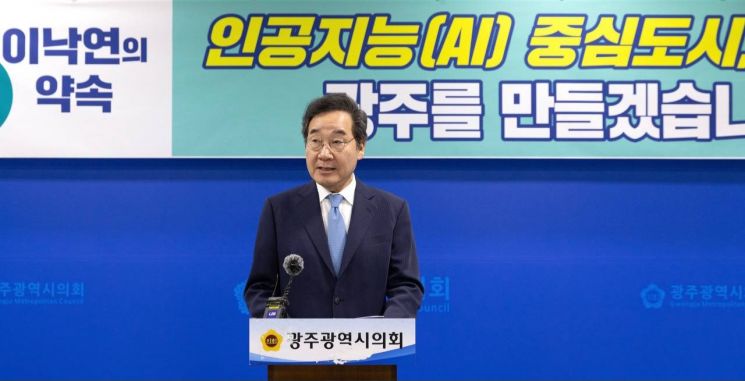
He said, “In 2018, when I was serving as Prime Minister, the Moon Jae-in administration requested metropolitan local governments to apply for projects exempt from preliminary feasibility studies for national balanced development. While other metropolitan local governments applied for large-scale SOC projects such as railroads, roads, and ports, Gwangju was the only one nationwide to apply for an R&D project called the ‘AI Industry Convergence Cluster Development Project.’”
He continued, “As Prime Minister, I helped ensure this application proceeded smoothly, and as a result, in 2019, this project was selected for the preliminary feasibility study exemption, allowing the first phase to be rapidly implemented. I will actively urge the government to ensure that the second phase project (2025?2029, 600 billion KRW), which will start next year, proceeds well,” he emphasized.
Candidate Lee Nak-yeon made three promises.
First, he pledged to work with the Ministry of Economy and Finance and the Ministry of Science and ICT to promptly designate the second phase of Gwangju’s AI cluster project as a preliminary feasibility study exemption project.
He said, “The exemption of the first phase project was possible due to the bold decision of the Moon Jae-in government regarding national balanced development and AI industry promotion. It may be difficult to expect this from the Yoon Suk-yeol government, which is reducing R&D budgets with a shortsighted view of future industries. Based on my experience with the first phase exemption, I will take the lead in persuading the Ministry of Economy and Finance and the Ministry of Science and ICT to exempt the second phase project as well.”
Second, after being elected as a member of the 22nd National Assembly, he promised to propose the “tentative AI Industry Promotion Act” as his first bill to create a sustainable AI industry ecosystem at the national level and support the activation of the national AI cluster. This bill will serve as the institutional foundation necessary to make South Korea a leading AI nation, starting in Gwangju.
Third, he promised to work with Gwangju City to attract more AI-related companies to Gwangju. Plans include expanding the limit of local investment promotion subsidies for companies coming to Gwangju and strengthening incentive support. Through this, he aims to attract 200 innovative companies by 2026 and create more jobs. These details will be included in the tentative AI Industry Promotion Act.
Candidate Lee Nak-yeon added, “With my experience and capabilities, I will assist the mayor of Gwangju to help make Gwangju an AI hub city.”
© The Asia Business Daily(www.asiae.co.kr). All rights reserved.

















