Four of Five Companies Targeted by Shareholder Proposals See Stock Price Decline
14 of 15 Companies Experienced Stock Price Increase in 2022-2023
Expectation of 'Activist Funds = Stock Price Rise' Fades
This year, activist funds have repeatedly suffered defeats against companies at general meetings of shareholders, rendering their efforts a 'storm in a teacup,' while the stock prices of targeted companies have also shown poor performance. Despite the KOSPI being in an uptrend, there were more cases of stock prices moving in the opposite direction. Activist funds are not just simple stock investors; they actively exercise shareholder rights by demanding management improvements in the companies they invest in.
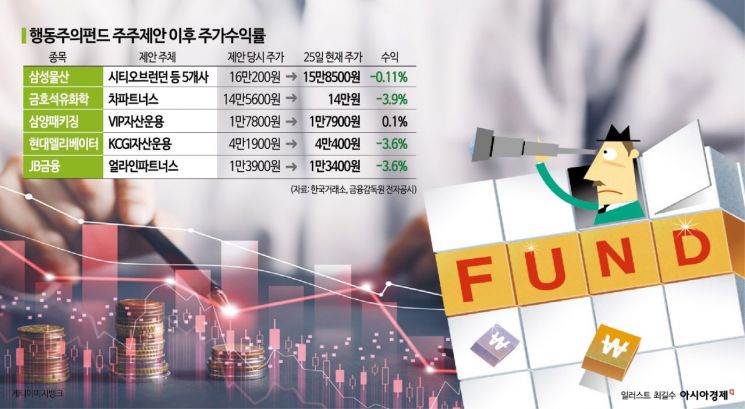
According to the Financial Supervisory Service's electronic disclosure system on the 26th, five companies received shareholder proposals from activist funds this year: Samsung C&T, Kumho Petrochemical, Samyang Packaging, Hyundai Elevator, and JB Financial Group. Among these, only Samyang Packaging saw its stock price rise after the shareholder proposal (from 17,800 KRW to 17,900 KRW as of the 25th), and even then, the increase was only about 0.1%. Samsung C&T (-0.11%), Kumho Petrochemical (-3.9%), Hyundai Elevator (-3.6%), and JB Financial Group (-3.6%) all experienced declines in stock prices following the shareholder proposals. Considering that the KOSPI rose 2.7% this month (as of the 25th), the stock price weakness is even more pronounced.
This trend differs from the past. According to a report published last year by the Korea Capital Market Institute, among 15 companies targeted by activist funds between 2022 and 2023, 14 saw their stock prices rise 20 trading days after shareholder proposals. For example, Ostem Implant, where KCGI Asset Management demanded strengthening board independence, saw a 35.1% increase. More than half of the companies (9) recorded double-digit stock price gains 20 trading days after the proposals. Only one company experienced a decline. This led to a market perception that companies targeted by activist funds tend to see stock price increases.
However, the atmosphere has changed within a year. It appears that the market has learned that if shareholder proposals are rejected, even when targeted by activist funds, there is no fundamental change in the company, and any stock price increase due to media attention is only temporary. The results of shareholder proposals by activist funds this year have been minimal so far. City of London and four other activist funds (Samsung C&T), as well as Cha Partners allied with former Kumho Petrochemical executive Park Cheol-wan (Kumho Petrochemical), suffered consecutive defeats in shareholder proposal votes focused on shareholder returns. The only somewhat visible success for activist funds was at Taekwang Industrial, where Truston Asset Management's three proposed internal and external director candidates were all accepted by the company and submitted as agenda items at the general meeting.
Will Remaining Vote Battles Escape the 'Storm in a Teacup'?
Meanwhile, companies still facing vote battles with activist funds at this year's general meetings include JB Financial and KT&G, both scheduled for the 28th. Align Partners, the second-largest shareholder of JB Financial (14.04% stake), proposed increasing the number of non-executive directors from one to two and recommended a total of five candidates for outside and non-executive director positions. The competition to secure friendly shares is fierce with the largest shareholder, Samyang Corporation (14.61% stake). The Norwegian Government Pension Fund (NBIM) has decided to support Align Partners' shareholder proposal, making the votes of foreign investors, who hold about 35% of shares, a key variable. On the 26th, the court approved an injunction prohibiting mutual voting rights between JB Financial and Finda. As a result, Finda lost voting rights for its 0.75% stake in JB Financial, which is welcome news for Align Partners as JB Financial's friendly shares have decreased.
In the case of KT&G, activist fund Flash Capital Light Partners (FCP) and the largest shareholder, Industrial Bank of Korea, oppose the appointment of candidate President Bang Kyung-man. However, with the National Pension Service, the third-largest shareholder, deciding to vote in favor of Bang, the likelihood of his rejection is considered low. In this general meeting, conducted under a 'cumulative voting system,' two candidates will be appointed based on the highest number of votes among Bang, outside director candidate Lim Min-gyu, and outside director candidate Son Dong-hwan, recommended by the Industrial Bank of Korea. Since only the candidate with the fewest votes is eliminated, Bang's appointment, backed by the National Pension Service's support, is highly likely to pass.
© The Asia Business Daily(www.asiae.co.kr). All rights reserved.
![Clutching a Stolen Dior Bag, Saying "I Hate Being Poor but Real"... The Grotesque Con of a "Human Knockoff" [Slate]](https://cwcontent.asiae.co.kr/asiaresize/183/2026021902243444107_1771435474.jpg)











