Ministry of Economy and Finance Announces '2025 Budget Formulation Guidelines'
Includes 'R&D Reform' in Four Major Investment Priorities
Investing in Basic and Fundamental Research, Next-Generation Leading Technologies
"Policies Emphasized by Government Allow for Budget Expansion"
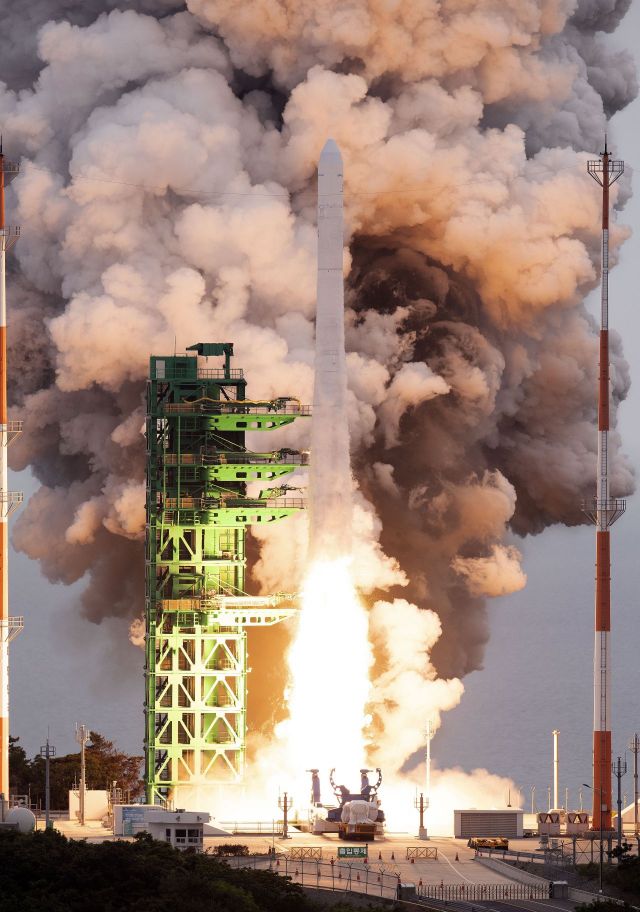 The Korean space launch vehicle Nuri, independently developed by our country, was launched for the third time on May 25 last year. Photo is unrelated to the article content.
In next year's government budget guidelines, research and development (R&D) funding has been included as a key investment area. As a result, the R&D budget, which underwent restructuring for the first time in eight years, is expected to be significantly restored.
According to the '2025 Budget Draft Preparation and Fund Operation Plan Guidelines' announced by the Ministry of Economy and Finance on the 26th, the government identified 'Creating an Economic Innovation Ecosystem' as one of the four major investment priorities for next year, including R&D reform as a detailed task. Last year, when the '2024 Budget Draft Preparation Guidelines' were announced, R&D was excluded from the priority investment targets, but with its reinstatement, the budget size is expected to recover.
The increased budget will be used for basic and fundamental research that the private sector finds difficult to undertake, as well as securing leading technologies in next-generation fields. In particular, intensive investment will be made in future strategic areas including the three major game-changing technologies: artificial intelligence (AI), advanced bio, and quantum. When distributing funds, the financial support system will be radically transformed to encourage bold R&D efforts rather than providing funds as a matter of routine. There are also plans to discover large-scale innovative and challenge-type strategic project initiatives.
Strategies for talent acquisition and improving the research environment were also presented. Outstanding researchers will be involved in leading overseas research, and a global cooperation network will be established by attracting excellent foreign talent to Korea. In connection with the launch of the Space and Aeronautics Agency, cooperation with overseas research institutions such as NASA will be strengthened. Additionally, support will be provided for young researchers to grow through excellence-driven research, and budgets will be allocated to build research infrastructure such as large-scale equipment at universities and research institutes.
How Much Will the R&D Budget, Restructured for the First Time in 8 Years, Be Restored?
Expansion of R&D in the energy sector was also suggested. This is based on the judgment that expanding R&D budgets is necessary to actively support the transition to carbon-free energy and to establish resource security. Budget support will focus on domestic R&D aimed primarily at advancing nuclear power and hydrogen ecosystems and stabilizing supply chains of essential resources.
Funds will also be utilized for R&D investment in line with the budget guidelines. Using the Industrial Technology Promotion and Commercialization Fund, R&D investments will continue in national advanced strategic industries such as semiconductors, displays, and secondary batteries. The Korea Technology Finance Corporation will support private-led R&D investment and the creation of a commercialization environment.
The extent of the R&D budget increase will be determined during the budget formulation process. Last year, following President Yoon Seok-yeol's remarks on "breaking up vested interest cartels," the Ministry of Science and ICT announced a 5.2 trillion KRW (16.6%) cut in the 2024 R&D budget compared to the previous year. This reduction was the first in eight years since 2016. After further discussions, the cut was adjusted to 4.6 trillion KRW (14.7%), but criticism from the scientific community was strong, expressing concerns about the decline in research and development capabilities.
Kim Dong-il, Director of the Budget Office, said, "It is difficult to speak about R&D investment specifics as it is not at a concrete stage," but added, "We view the R&D budget with qualitative changes in mind, and there is room for budget expansion for policies emphasized by the government."
However, expenditure restructuring similar to this year will continue next year. Projects with poor performance or lacking innovation and challenge will be decisively eliminated. The basic, applied, and development research fields will undergo a re-examination of missions between ministries, and restructuring will begin if there are similar or overlapping projects. Consolidation of scattered small-scale projects will also be promoted.
© The Asia Business Daily(www.asiae.co.kr). All rights reserved.

















