The National Election Commission paid 50.8 billion won in election subsidies for the 22nd general election on the 25th. Subsidies were paid not only to the two major parties but also to proportional satellite parties that engaged in seat lending.
The Election Commission paid 18.9 billion won in subsidies to the Democratic Party of Korea based on its current 142 seats, and 17.7 billion won to the People Power Party based on its 101 seats.
Due to circumstances such as ballot numbers, proportional satellite parties that received seats lent by the two major parties also received large subsidies. The Democratic Union (a proportional satellite party of the Democratic Party and other opposition parties), which reported 14 seats, received 2.8 billion won, and the People’s Future (a proportional satellite party of the People Power Party), which reported 13 seats, also received 2.8 billion won in subsidies.
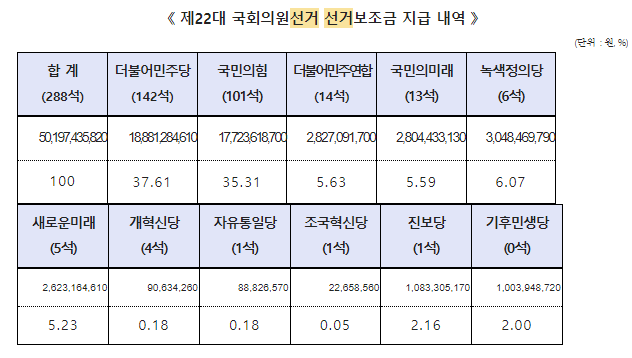
The Green Justice Party, with 6 seats, received 3 billion won, and Saeroun Mirae received 2.6 billion won. However, the Reform New Party, with 4 seats, fell short by one seat and received only 91 million won in subsidies.
Among parties with only one seat, the Progressive Party received the largest subsidy, amounting to 1.1 billion won. The Liberty Unification Party received 888 million won, and the Homeland Innovation Party received 227 million won. The Climate Livelihood Party, despite having zero seats, was able to receive 1 billion won in subsidies based on its recent election vote share.
The Election Commission distributes subsidies based on whether a party forms a negotiation group (20 seats) and whether it has at least 5 seats. For negotiation groups, half of the total amount is distributed equally; for parties with 5 to 20 seats, 5% of the total amount is allocated; and for parties with fewer than 5 seats, 2% of the total amount is distributed based on recent election vote shares and other criteria.
The remaining amount is then divided, with half allocated according to seat proportions and the other half according to vote proportions in the 21st National Assembly election. The total subsidy amount is calculated by multiplying the number of eligible voters in the general election (43.99 million) by this year’s subsidy unit price of 1,141 won.
© The Asia Business Daily(www.asiae.co.kr). All rights reserved.

















