Demanding Apology and Compensation from Japanese Companies
The families of plaintiffs and surviving victims in the forced labor lawsuits during Japanese colonial rule visited the Japanese defendant companies demanding apology and compensation but were turned away at the door. They shouted that they would "fight to the end" against the companies.
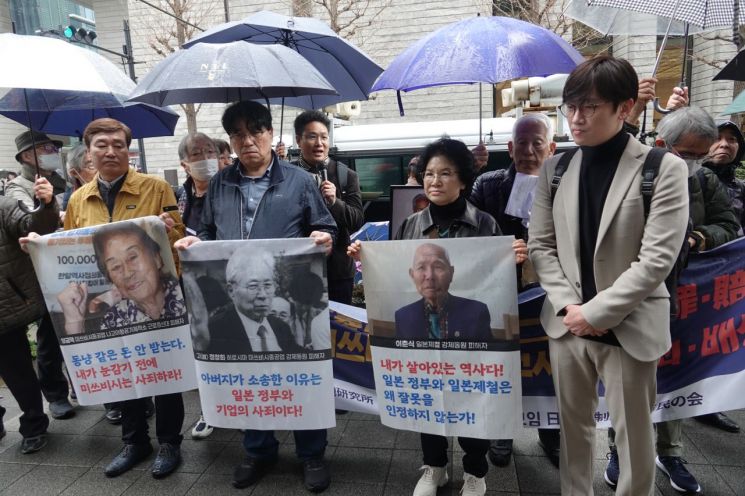 Families of victims of forced labor under Japanese colonial rule are urging the defendant companies to apologize and compensate in front of Nippon Steel in Tokyo on the 25th.
 [Photo by Yonhap News]
On the morning of the 25th, the families of forced labor victims Lee Chunsik, Yang Geumdeok, and Jeong Changhee, accompanied by lawyer Im Jaesung, Kim Younghwan, head of external cooperation at the Institute for Korean Historical Studies, and representatives of Japanese civic groups, visited the headquarters of Nippon Steel in Marunouchi, Chiyoda-ku, Tokyo. They entered the building to urge the defendant company to apologize and compensate but left after 10 minutes without meeting any officials.
Lawyer Im Jaesung said, "We requested a meeting with Nippon Steel in advance, but an employee said, 'There is no appointment, so we cannot have a meeting.' When the victims' families tried to deliver a written request, they asked to accept it, but the employee replied that there was no time." He added, "When we asked if submitting the request at the desk would be officially recognized, we were told it could not be acknowledged."
Regarding Nippon Steel's attitude, Lee Goun, the eldest daughter of forced labor survivor Lee Chunsik, criticized it as "cowardly" with tears in her eyes. She said, "My father was an employee of this company, and his blood and sweat are in this building. We will fight to the end to receive an apology."
After Nippon Steel, the victims' families also visited the defendant companies of the late Jeong Changhee, a victim of Hiroshima Heavy Industries, and grandmother Yang Geumdeok, a forced mobilization victim of Mitsubishi. However, these companies also uniformly turned away the victims' families.
Yang Geumdeok's son, Park Sangwoon, said, "My mother said she would refuse any third-party compensation even if she starved to death. If they offer a sincere apology, she would willingly forgive."
Defendant companies such as Mitsubishi Heavy Industries stated, "We recognize that the Korean forced labor issue was resolved by the 1965 Korea-Japan Claims Agreement," and expressed regret, saying, "The Korean Supreme Court ruling is contrary to the agreement." The Japanese government also claimed that the Korean Supreme Court's compensation ruling against Japanese companies "clearly violates the Korea-Japan Claims Agreement" and insisted that "the Korean government should resolve the issue through a third-party compensation solution."
The third-party compensation proposal is a method where the Korean government and companies pay the judgment amount instead of the Japanese companies, which the Yoon Suk-yeol administration proposed last year as a solution to the forced labor compensation issue.
Four victims, including Lee Chunsik, secured a final Supreme Court ruling in favor of damages for forced labor victims during Japanese colonial rule but refused to accept compensation payments that the Korean government intends to provide under the third-party compensation plan. They are demanding a resolution through the forced sale of the defendant companies' assets.
© The Asia Business Daily(www.asiae.co.kr). All rights reserved.

















