Results of Risk Response Including Localization of Semiconductor Materials in Korea
After the Japanese government strengthened export restrictions on semiconductor materials to South Korea and later lifted them, it has been found that Japanese companies are struggling to regain their market share in South Korea. This is the result of risk responses such as increasing the adoption of domestically produced materials in South Korea following Japan's tightening of regulations.
Asahi Shimbun reported this on the 24th in an article titled "One Year Since the Lifting of Export Restrictions Against South Korea."
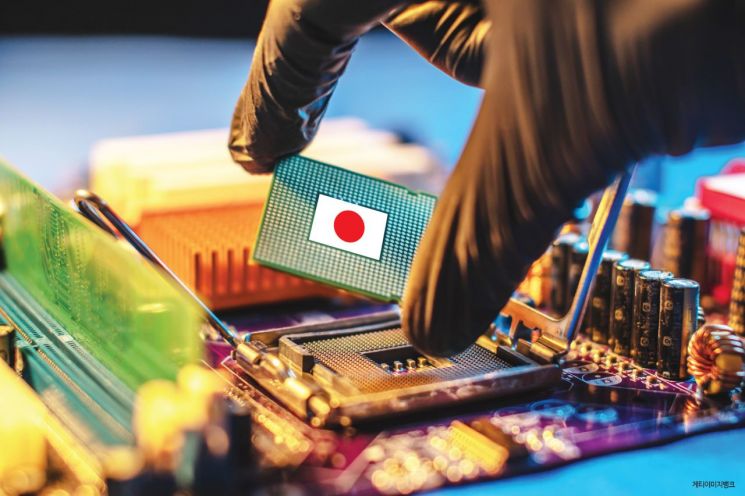
Previously, when the South Korean Supreme Court issued a final ruling in October 2018 ordering Japanese defendant companies to compensate forced labor victims, the Japanese government retaliated by imposing export controls in July 2019 on key semiconductor material items exported to South Korea. The items subject to Japan's export restrictions were three: hydrogen fluoride, fluorinated polyimide, and photoresist.
In response, the South Korean government filed a complaint with the World Trade Organization (WTO) in September of the same year against Japan's export control measures. However, with little progress, Japan lifted the export restrictions after the South Korean government announced a solution for compensating forced labor victims (third-party compensation) in March last year. South Korea then withdrew its WTO complaint.
However, even after the export restrictions were lifted, the market share of Japanese semiconductor materials in South Korea did not increase. Hydrogen fluoride, used in semiconductor cleaning, accounted for more than 40% of South Korea's imports from Japan in 2018, the year before the export restrictions, but after the 2019 restrictions, its share remained around 10% from 2020 to 2022. Although the share rose above 20% last year, it still did not reach pre-restriction levels.
Morita Chemical Industries, which produces hydrogen fluoride, was unable to export the material to South Korea, which accounts for over 90% of its exports, for the first six months after the export restrictions due to the Japanese government's failure to grant export permits. After the export restrictions, the company's annual net profit dropped by 90% compared to the previous year. A Morita Chemical Industries official said that exports to South Korea are unlikely to recover to previous levels and that the company "wants to expand other sales channels such as the United States."
When the export route to South Korea was blocked, some Japanese companies used overseas bases to re-export to South Korea. JSR, a photoresist manufacturer, enabled its Belgian joint venture to export photoresist to South Korea. Additionally, some Japanese companies established manufacturing bases in South Korea, anticipating growth in the South Korean semiconductor industry.
The South Korean government and companies are striving to localize semiconductor materials to reduce dependence on Japan. At the time of the export restrictions, the Moon Jae-in administration promoted localization of materials and parts and diversification of procurement sources. The current Yoon Suk-yeol administration has set a goal to increase the localization rate of materials and parts from 30% in 2022 to 50% by 2030.
Of course, it is not easy to completely replace semiconductor materials. Asahi explained, "It is difficult to replace or localize in the short term in fields where Japanese companies have high competitiveness," and "According to the Korea International Trade Association, even after 2020, Japanese companies maintained a market share of around 90% for fluorinated polyimide and 70-80% for photoresist in South Korea's imports."
Former Japanese Prime Minister Shinzo Abe, who imposed the export restrictions, stated in his memoir published in February last year that "The issue of how to respond to the Moon Jae-in administration, which did not seek any solution after the forced labor compensation ruling was finalized, led to the strengthening of export restrictions."
© The Asia Business Daily(www.asiae.co.kr). All rights reserved.
![Clutching a Stolen Dior Bag, Saying "I Hate Being Poor but Real"... The Grotesque Con of a "Human Knockoff" [Slate]](https://cwcontent.asiae.co.kr/asiaresize/183/2026021902243444107_1771435474.jpg)
















