Hyundai Motor's E-Pit Grows 7 Times in 4 Years
Partnerships with Other Companies' Charging Stations Increase... Expanding to 260,000 Units by Year-End
Hyundai Motor Group announced on the 24th that it will increase its ultra-fast charging service E-pit to 500 units by next year, adding more than 200 units.
Previously, the company began establishing high-speed charging infrastructure in April 2021 with a total of 72 chargers, 6 units each at 12 highway rest stops. Nearly two years after the first installation, the number has increased to 286 units across 54 locations. The company plans to steadily expand this, increasing nearly sevenfold in about four years.
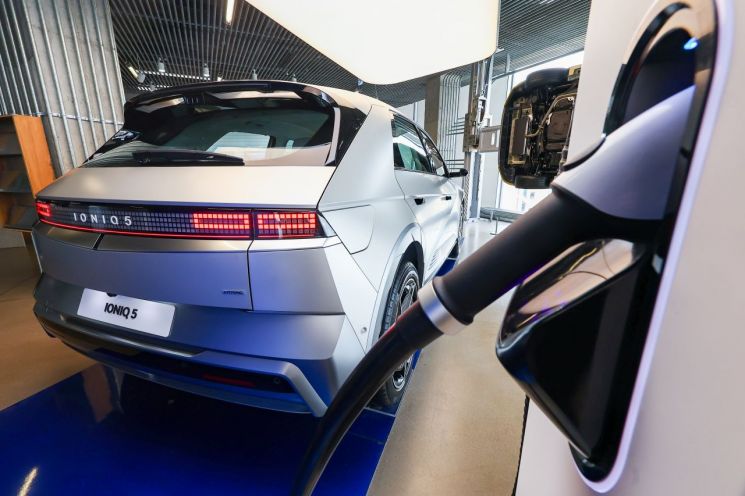
With chargers offering a maximum output of 350 kW and a 400V/800V multi-rapid charging system, the Ioniq 5 can be charged from 10% to 80% battery capacity in about 18 minutes. Outdoor charging stations are equipped with canopies like buildings, making charging convenient even in rain or snow.
By analyzing customer usage patterns, the company found that the average charging time at E-pit is about 18.5 minutes. This indicates that long-distance driving is possible without spending a long time charging.
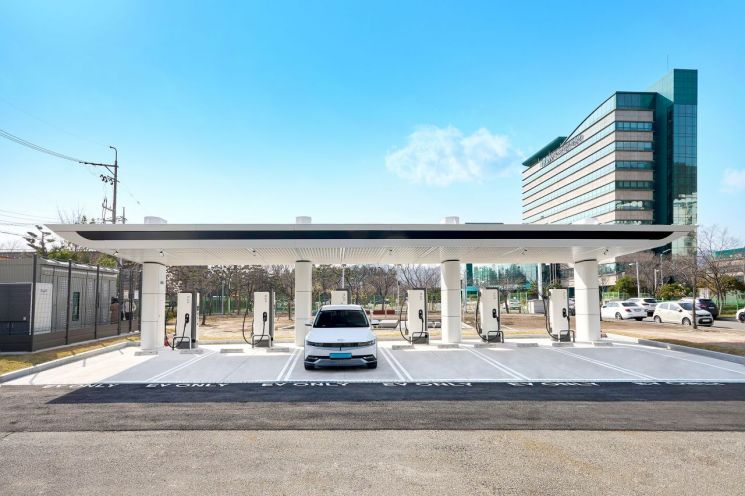 Recently opened in Geumgok-dong, Busan, E-Pit. E-Pit is Hyundai Motor Group's ultra-fast charging service brand.
 [Photo by Hyundai Motor Group]
In addition to E-pit, Hyundai Motor Group’s affiliate Korea Electric Vehicle Charging Service has installed 3,000 ultra-fast chargers, and Hyundai Engineering has added 20,000 slow chargers. This is based on the judgment that the perception of difficulty in charging remains a reason for reluctance to purchase electric vehicles.
Domestic charging infrastructure is considered well-established. As of the end of last year, there were 565,154 registered electric vehicles and 305,309 chargers installed. The ratio of electric vehicles per charger, known as the car-to-charger ratio, is about 1.85, which the company explains is one of the highest levels in the world.
Moreover, the government has steadily increased subsidies for charging facilities to 371.5 billion KRW, more than 40% higher than last year, continuing to expand charging infrastructure. Hyundai Motor Group also focuses on minimizing customer inconvenience by monitoring E-pit 24 hours a day throughout the year. They have established a system that can respond quickly even in case of malfunctions.
The downtime rate (the time during which charging is unavailable due to malfunctions out of the total 24 hours) has been reduced from about 6% in early service in 2022 to the 3% range in about a year and a half. The company also puts effort into developing the electric vehicle market infrastructure by building a quality certification center together with an internationally accredited testing agency.
To enable Hyundai and Kia electric vehicle owners to conveniently charge not only at E-pit but also at other locations, the company is expanding partnerships with charging operators. Launched in December last year, the E-pit Pass allows use at partner charging stations with the membership of the respective companies. The E-pit Pass can be used at a total of 72,000 chargers across five partner companies’ stations. Hyundai Motor Group plans to increase this to 260,000 chargers, equivalent to about 85% of all chargers in South Korea, by the second half of this year.
© The Asia Business Daily(www.asiae.co.kr). All rights reserved.
![User Who Sold Erroneously Deposited Bitcoins to Repay Debt and Fund Entertainment... What Did the Supreme Court Decide in 2021? [Legal Issue Check]](https://cwcontent.asiae.co.kr/asiaresize/183/2026020910431234020_1770601391.png)
















