After Additional Price Stabilization Funds, Shipments Down 13.4%
Wholesale Prices Rising... "Strong Until New Fruit Harvest"
"New Variety Development Needed to Prevent Recurrence"
Retail prices of apples and pears, which had been soaring, have dropped by more than 10% following the government's large-scale financial injection to stabilize grocery prices. However, wholesale prices remain high, and the strong trend is expected to continue until the summer fresh fruit season begins. There are calls for the development of new varieties in response to climate change to prevent recurring price hikes caused by supply and demand instability in agricultural products, such as 'Applelation (Apple + Inflation)'.
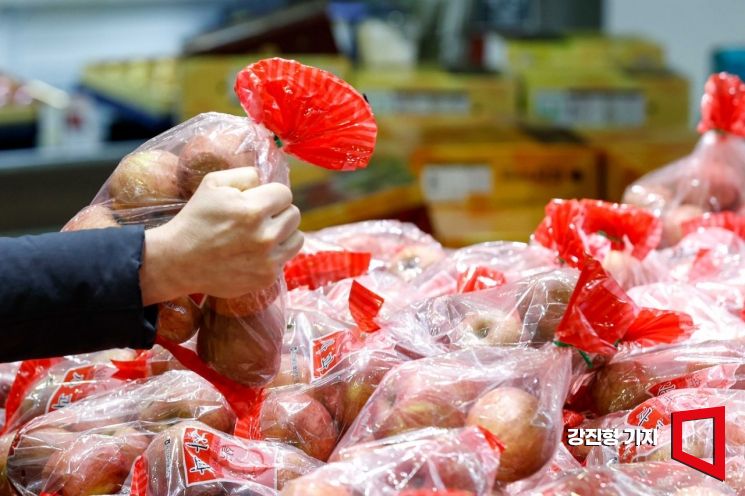 According to the Citrus Shipping Association, the wholesale price of Jeju open-field tangerines has surged by about 50% compared to January last year, averaging 14,000 won per 5kg this month. On the 10th, a customer visiting the Hanaro Mart Yangjae branch in Seocho-gu, Seoul, is purchasing apples. Photo by Jinhyung Kang aymsdream@
Apple retail prices down 11.6% after government discount support... Pears also down 13.4%
According to the Agricultural Products Distribution Information from Korea Agro-Fisheries & Food Trade Corporation (aT) on the 24th, as of the 22nd, the retail price of 10 apples (Fuji, standard grade) was 24,250 KRW, down 11.6% from 15th of the same month.
The retail price of 10 pears (Shingo, standard grade) also fell 13.4% to 39,312 KRW compared to a week earlier. The retail price of tomatoes (standard grade) per 1kg dropped 12.9% to 7,107 KRW, and the retail price of strawberries (standard grade) per 100g decreased 6.1% to 1,303 KRW. The retail price of 10 Korean kiwifruits (standard grade) fell 2.8% to 10,228 KRW.
Prices of imported fruits and vegetables such as bananas and pineapples also declined. The retail price of bananas (imported, standard grade) per 100g dropped 5.4% to 297 KRW, and the retail price of one pineapple (imported, standard grade) fell 5.1% to 6,901 KRW.
On the other hand, the retail price of 10 oranges (Navel, USA, standard grade) rose 3.4% to 16,804 KRW, and the retail price of one mango (imported, standard grade) increased 0.8% to 3,549 KRW.
Retail prices refer to the prices at which consumers purchase products at large supermarkets and traditional markets. The recent downward trend is attributed to the government's large-scale discount support and promotional events by distribution companies. Since the 18th, the government has injected an additional 150 billion KRW in emergency price stabilization funds, including 75.5 billion KRW for supply price support and 45 billion KRW for discount support, to stabilize prices of agricultural and livestock products.
Compared to a year ago, retail prices of mangoes have dropped by 34.7%, bananas by 10.5%, strawberries by 10.0%, and pineapples by 4.9%. However, apple retail prices remain 5.7% higher than a year ago, while pears are up 44.4%, persimmons 78.3%, kiwifruits 17.8%, oranges 8.3%, and tomatoes 7.8% higher.
For apples and pears, wholesale prices, which are not subject to discounts, are still more than double compared to a year ago. The wholesale price of 10kg of apples (Fuji, standard grade) was 91,780 KRW as of the 22nd, up 1.0% from a week earlier, and the wholesale price of 15kg of pears (Shingo, standard grade) rose 7.3% to 108,600 KRW.
Wholesale prices, which are the prices at which wholesalers sell to retailers and consumers, are 121.5% and 147.3% higher than a year ago for apples and pears, respectively.
Considering that the fresh apple and pear harvest season is expected around July to August, prices for apples and pears are likely to remain high for the time being.
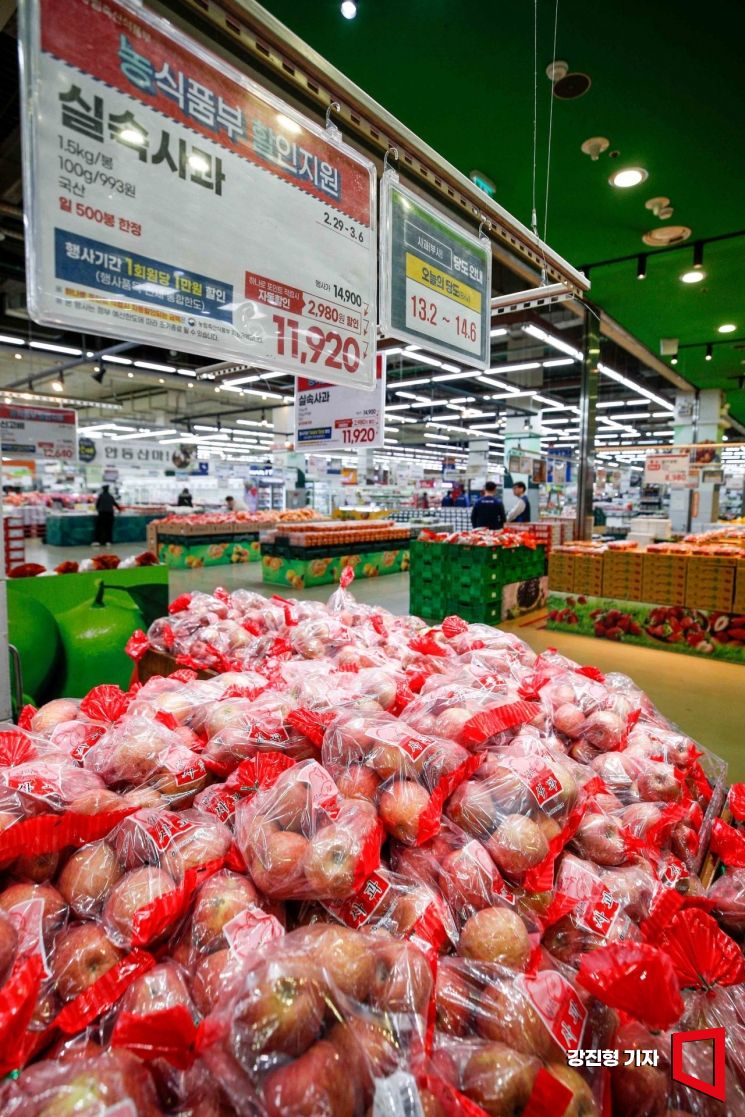 Due to the surge in agricultural product prices, especially fruits, consumer prices, which had stabilized at 2.8% in January, returned to the 3% range within a month. On the 6th, apples were displayed at the fruit stand of Hanaro Mart Yangjae Branch in Seocho-gu, Seoul. Photo by Jinhyung Kang aymsdream@
To prevent recurrence of the 'Golden Apple' phenomenon... "Development of varieties in response to climate change is necessary"
This year's strong prices of agricultural products are largely due to last year's weather disasters. Production of fruits such as apples and pears decreased by 30.3% and 26.8%, respectively, compared to a year earlier, due to spring frost damage and frequent heavy rains in summer last year, and production of irregular-shaped fruits (imperfect fruits) increased.
The government increased market supply of apples and pears during last year's Chuseok and this year's Lunar New Year peak seasons to stabilize prices, which led to somewhat insufficient stored quantities after the Lunar New Year. Additionally, reduced sunlight last month caused decreased production of fruits and vegetables such as Korean melons and tomatoes, limiting the dispersion of fruit demand.
The Ministry of Agriculture, Food and Rural Affairs plans to strengthen support for supply prices and discount events, expecting fruit prices to remain high until the fresh fruit harvest season. In particular, the support amount for apple supply prices has been raised to 4,000 KRW per kilogram.
To diversify fruit demand, the supply of imported fruits such as bananas and oranges will also be expanded. Since the 21st, about 2,000 tons of bananas and oranges directly imported through aT have been supplied to large supermarkets.
The Ministry of Agriculture, Food and Rural Affairs will operate a 'Fruit Growth Management Council' to minimize damage, strengthen monitoring of production areas, and support installation of disaster prevention facilities, as abnormal weather could cause a repeat of last year's agricultural production decline. They also plan to establish a 'Fruit Industry Competitiveness Enhancement Plan' to build a stable fruit production foundation despite climate change.
No Ho-young, head of the Horticulture Observation Office at the Korea Rural Economic Institute, said, "The government needs to play a role in research and development (R&D) for developing varieties in response to climate change, and it would be good to benchmark supply and demand measures mainly used in vegetables, such as expanding contract farming volumes and stockpiling purchases, for the fruit sector as well."
© The Asia Business Daily(www.asiae.co.kr). All rights reserved.
![Clutching a Stolen Dior Bag, Saying "I Hate Being Poor but Real"... The Grotesque Con of a "Human Knockoff" [Slate]](https://cwcontent.asiae.co.kr/asiaresize/183/2026021902243444107_1771435474.jpg)

















