"Government Reduces Pediatric Surgery to 'Dongnyang Clinic'"
"Need to Establish 'Department of Pediatric and Adolescent Medicine' within the Ministry of Health and Welfare"
The Korean Pediatric Hospital Association criticized the government's medical reform, including the expansion of medical school quotas, saying it will accelerate the collapse of pediatrics.
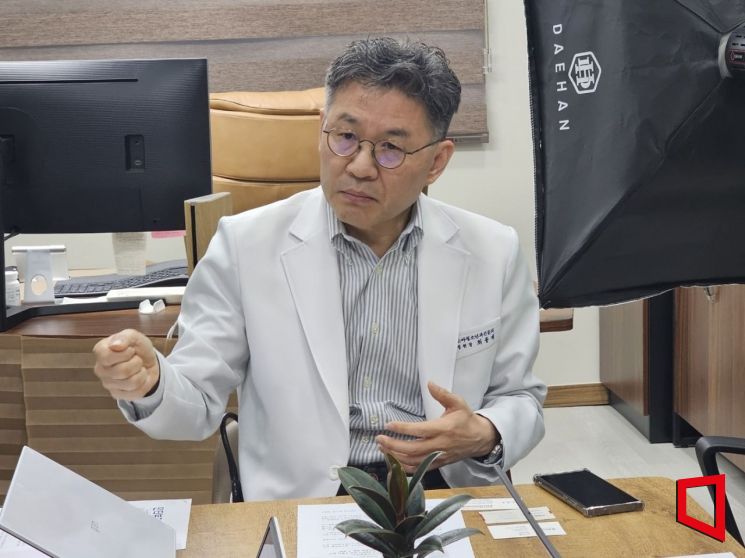 On the 21st, Choi Yong-jae, President of the Korean Pediatric Hospital Association, met with reporters at Ttuntun Children's Hospital in Uijeongbu, Gyeonggi Province, explaining the issues faced by pediatric and adolescent departments. Photo by Choi Tae-won peaceful1@
Choi Yong-jae, president of the Korean Pediatric Hospital Association, stated this in an interview held on the 21st at Ttuntteun Children's Hospital in Uijeongbu, Gyeonggi Province. He said, "The government has reduced pediatrics to a charity care specialty. They said they would expand medical school quotas to revive essential medical care, but it seems this will only accelerate the transformation of pediatrics into a charity care specialty. Avoidance of pediatrics by residents is not a recent issue, yet the government is only offering temporary measures rather than showing a will to solve the problem."
He criticized, "The Ministry of Health and Welfare recently announced a revised training curriculum for residents that extends the minimum mandatory pediatric training period for interns from the current two weeks to over four weeks. This is a typical example of a health policy that assumes the collapse of pediatrics as a given, an irresponsible act by non-expert administrators, and the epitome of patchwork policy."
He continued, "This policy merely aims to formally maintain the pediatrics department signboards at university hospitals under the basic assumption that pediatrics will be completely closed. I want to ask the government whether they expect that increasing the intern period, rather than training pediatric residents, will save pediatric intensive care patients."
He also pointed out problems with a plan allowing specialists assigned exclusively to general intensive care units to care for pediatric intensive care unit patients to fill the gap in pediatric care. President Choi said, "It is very questionable what the government thinks about the role and function of pediatrics to have specialists assigned exclusively to general intensive care units perform duties caring for pediatric intensive care patients."
In the interview, President Choi also argued that the government's misunderstanding of pediatrics is not a recent development. He said, "Due to the government's drug pricing policy, essential pediatric medications are prescribed and administered by subdividing adult medications. Considering the characteristics of children, syrups are the most useful form for medication, but instead, for decades, adult pills have been cut to fit children for prescription and administration."
He also reported that the Korean Pediatric Hospital Association has repeatedly requested the government to supply pediatric formulations, but no improvements have been made.
President Choi insisted that to revive essential medical care in pediatrics, a 'Pediatric Medical Division' should be established within the Ministry of Health and Welfare. He said, "If the government truly intends to revive essential medical care in pediatrics, it should establish a Pediatric Medical Division within the Ministry of Health and Welfare to formulate and implement child policies separately from adults and enact a Basic Children's Health Act."
© The Asia Business Daily(www.asiae.co.kr). All rights reserved.

















