Highest in Gwangju by Region... Lowest in Gyeongnam
38 Parties Applied for Proportional Representation Candidates
Number May Decrease Depending on Review Results
On the afternoon of the 22nd, the deadline for candidate registration for the 22nd general election, the average competition rate across 254 constituencies nationwide was tentatively calculated at 2.7 to 1.
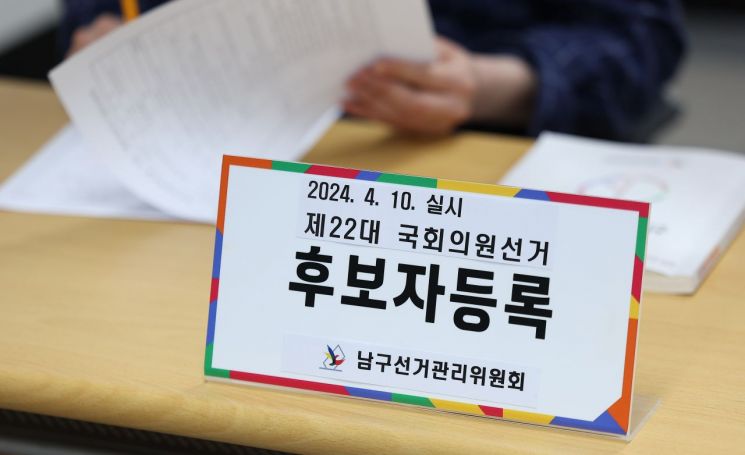 On the 22nd, the last day for candidate registration for the 22nd general election, a candidate registration desk was set up at the Daegu Nam-gu Election Commission.
 [Image source=Yonhap News]
According to the Central Election Commission's tally as of 7 p.m. that day, a total of 686 candidates (tentative) registered in the 254 constituencies. Candidate registration closed at 6 p.m. that day.
On the first day of candidate registration, 610 candidates completed registration, and among the candidates who applied that day, the Election Commission has so far accepted the application documents of 76 candidates.
By party, the People Power Party had the most candidates with 252, followed by the Democratic Party (244), Reform New Party (38), New Future (27), Progressive Party (21), Green Justice Party (17), and Liberty Unification Party (11). There were 56 independent candidates.
The most fiercely contested constituency was Jongno, Seoul, where seven candidates registered, including People Power Party's Choi Jae-hyung, Democratic Party's Kwak Sang-eon, and Reform New Party's Geum Tae-seop. In the 21st general election, Jongno also had the highest competition rate nationwide at 12 to 1.
Among the 17 metropolitan cities and provinces nationwide, Gwangju had the highest competition rate, with an average of 4.5 to 1. In Gwangju, which has eight constituencies, 36 candidates registered. This was followed by Sejong (4 to 1), Jeonnam (3.6 to 1), Jeonbuk (3.3 to 1), Gyeongbuk (3.07 to 1), Daejeon (3 to 1), Ulsan (2.83 to 1), Chungnam (2.82 to 1), and Incheon (2.79 to 1).
Gyeongnam had the lowest competition rate at 2.31 to 1. Jeju (2.33 to 1), Gyeonggi (2.38 to 1), Busan (2.39 to 1), Seoul (2.52 to 1), Gangwon (2.63 to 1), Chungbuk (2.63 to 1), and Daegu (2.67 to 1) were all below the national average.
The youngest candidate nationwide was Woo Seo-young (born 1996), a 28-year-old Democratic Party candidate in Gyeongnam's Miryang·Uiryeong·Haman·Changnyeong district, and the oldest candidate was Kim Il-yoon (born 1938), an 85-year-old independent candidate in Gyeongbuk's Gyeongju district.
Candidates in their 50s numbered 309 (45.04%), making up nearly half of the total, followed by 242 candidates in their 60s (35.28%) and 73 candidates in their 40s (10.64%).
There were 33 candidates in their 30s and 4 candidates in their 20s, with candidates in their 20s and 30s accounting for 5.39%. Candidates in their 70s numbered 22, and those in their 80s numbered 3, meaning there were fewer candidates aged 70 and above than those in their 20s and 30s.
By gender, male candidates numbered 589, accounting for 85.86%, while female candidates numbered 97, making up 14.14%.
Thirty-eight parties applied to register candidates for proportional representation. Depending on the Election Commission's review, the number of parties actually participating in the proportional representation election may decrease.
Voters aged 18 and over can cast their votes through overseas voting (March 27 to April 1), early voting (April 5 to 6), and voting on the day of the general election.
© The Asia Business Daily(www.asiae.co.kr). All rights reserved.

















