In the April 10 general election, voters may receive a proportional representation ballot paper measuring up to 51.7 cm in length.
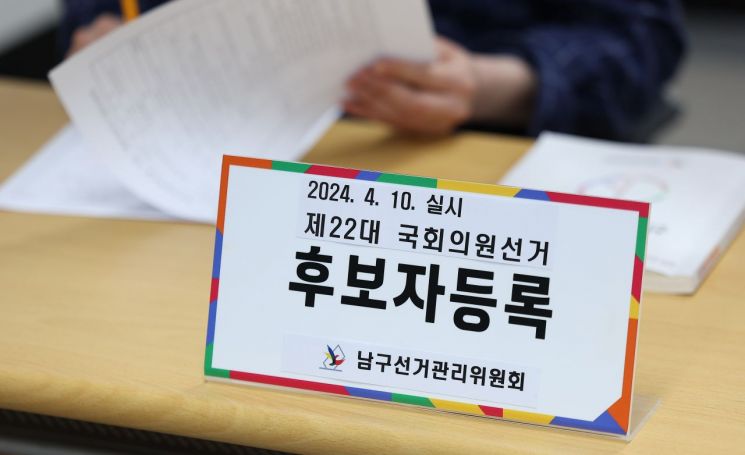 On the 22nd, the last day for candidate registration for the 22nd general election, a candidate registration desk was set up at the Daegu Nam-gu Election Commission.
 [Photo by Yonhap News]
The National Election Commission announced on the 22nd, the deadline for candidate registration, that a total of 38 parties applied to register proportional representation candidates. Currently, 20 parties have completed registration, and 18 are pending review.
If the number of parties is between 18 and 22, the ballot paper will have a marking box height of 1.0 cm and a separation space of 0.3 cm between candidates.
When the number of parties is 23 or more, the marking box height remains the same, but the separation space between candidates is reduced to 0.2 cm to shorten the ballot paper length.
If all 38 parties that applied for proportional representation candidate registration are confirmed to participate in the election after the NEC’s review, the ballot paper will be 51.7 cm long. This 51.7 cm length is the longest ever since the introduction of the party-list 'one person two votes system' in the 17th general election in 2004, where voters mark both a district candidate and a supporting party.
In this case, the NEC will have to conduct 100% manual counting again, as in the 21st general election. This is because the ballot sorting machines owned by the NEC can only process ballot papers up to 46.9 cm long with markings for a maximum of 34 parties.
Conversely, if four or more parties are disqualified during the review process, reducing the number of parties to 34 or fewer, the ballot sorting machines can be used.
In the 21st general election, 35 parties participated in the proportional representation election, and the ballot paper was 48.1 cm long. At that time, the sorting machines could only process ballot papers up to 34.9 cm long for 24 parties, so a 'complete manual count' was conducted.
The NEC introduced new ballot sorting machines at the end of last year capable of processing ballot papers with up to 34 parties, but these became 'useless' for this election.
However, ballot examination counters, which tally sorted ballots like cash counting machines, can still be used. The NEC possesses two types of examination counters capable of processing ballot papers for 39 and 50 parties respectively.
Since the end of last year, the NEC has conducted mock counts at each provincial and district election commission office to prepare not only for the use of new ballot sorting machines but also for the possibility of manual counting.
The large number of parties to the extent that ballot sorting machines cannot be used in the proportional representation election is largely attributed to the influence of the semi-proportional representation system.
The semi-proportional representation system guarantees half of the proportional seats after calculating the total 300 seats based on party vote shares and subtracting the number of seats won in district elections.
Compared to the parallel system, which simply allocates proportional seats based on party vote shares, the semi-proportional system subtracts the number of district winners during seat allocation, making it easier for lesser-known new parties to enter the National Assembly.
The number of parties participating in the proportional representation election was 21 in the 20th general election, but increased to 35 in the 21st general election when the semi-proportional system was first introduced.
Although the number of parties participating in the proportional representation election has increased, not all of them succeed in entering the National Assembly. The Public Official Election Act allocates proportional seats only to parties that receive at least 3% of the proportional vote or win five or more district seats.
In the 21st general election, 30 parties failed to reach the 3% vote threshold and did not obtain any seats.
© The Asia Business Daily(www.asiae.co.kr). All rights reserved.

















