Major foreign media reported on the 22nd (local time) that the United States urged Ukraine to stop airstrikes on Russian oil refining facilities.
There are concerns that if one of the world's largest oil producers, Russia's oil facilities, are hit, global oil prices could become unstable again, and such attacks could trigger retaliation.
According to sources, the U.S. government has repeatedly conveyed this warning to senior officials of the Ukrainian Security Service (SBU) and the Main Directorate of Intelligence (GUR) under the Ministry of Defense.
The Ukrainian military attacked two oil refineries in the Russian border region of Samara on the 16th, and on the 13th destroyed an oil refinery in Ryazan, located 200 km southeast of Moscow. This year alone, there have been at least nine attacks on Russian oil refineries and other oil facilities.
Regarding the bold use of drones by the Ukrainian military to attack oil-related facilities in western Russia, a source said that "the White House is feeling frustrated," according to major foreign media.
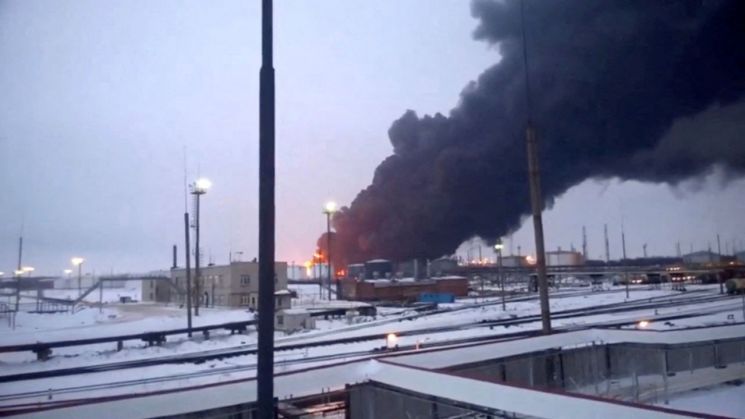 A fire breaks out at an oil refinery in Ryazan, Russia, following a drone attack by Ukraine.
 [Photo by Reuters Yonhap News]
U.S. President Joe Biden is reportedly feeling pressured as international oil prices rise due to attacks on Russian oil facilities at a time when he is about to start campaigning for the year-end election. Rising international oil prices could be a factor in inflation.
On the 18th, the closing price of April delivery West Texas Intermediate (WTI) crude oil futures rose to $82.72, up $1.68 (2.1%) from the previous day's close, marking the highest level in about four months.
Market analysts suggest that Saudi Arabia's production cut policy to maintain high oil prices, combined with the strikes on Russian oil facilities, have had a complex impact.
In addition, major foreign media explained that the U.S. is concerned that if damage to Russian infrastructure continues, Russia could retaliate by targeting energy facilities relied upon by the West.
Particularly, the CPC (Caspian Pipeline Consortium) pipeline, which transports oil from Russia through Kazakhstan to the global market, is a subject of concern. This pipeline, used by Western oil companies such as ExxonMobil and Chevron, was temporarily shut down shortly after Russia's full-scale invasion of Ukraine in 2022.
In this regard, a spokesperson for the U.S. White House National Security Council (NSC) told major foreign media, "We do not encourage attacks inside Russia." The Ukrainian presidential office and the Main Directorate of Intelligence did not respond to requests for comment.
© The Asia Business Daily(www.asiae.co.kr). All rights reserved.

















