Satellite Parties Also Place 'Nationwide Unified Symbols'
Ruling Party Receives No. 4 Through Last-Minute 'Member Lending'
No. 5 Green Justice Party, No. 6 New Future, etc.
In the April 10 general election, the Democratic United Party, a satellite party of the opposition coalition led by the Democratic Party of Korea, is expected to receive candidate number 3, while the People’s Future, a satellite party of the People Power Party, is expected to receive candidate number 4.
According to the National Election Commission on the 22nd, the candidate numbers for major parties and constituency candidates will be determined based on the number of seats as of 6 p.m. on the day candidate registration closes. Unless there are significant changes in the number of seats by party during the afternoon, six parties are expected to receive the “nationwide unified candidate numbers”: the Democratic Party of Korea, People Power Party, Democratic United Party, People’s Future, Green Justice Party, and New Future.
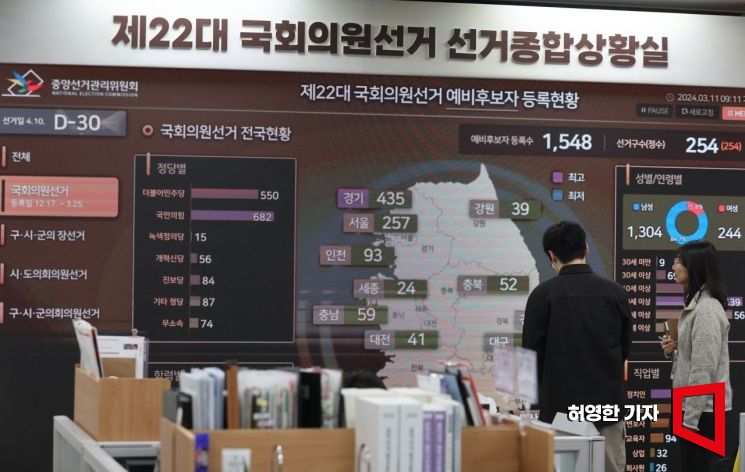 On the 11th, 30 days before the 22nd National Assembly election, the electronic display board at the Comprehensive Election Situation Room for the 22nd National Assembly Election of Gwacheon City Central Election Commission shows the constituencies and the status of preliminary candidate registrations. Photo by Heo Younghan younghan@
The nationwide unified candidate numbers are assigned to parties that have at least five constituency seats or received more than 3% of the proportional vote in the previous general election. These parties can use the unified candidate numbers in all constituency and proportional elections nationwide.
The Democratic Party of Korea, the largest party in the National Assembly with 142 seats, will receive candidate number 1, and the People Power Party, the second-largest party with 101 seats, will receive candidate number 2.
For proportional voting, the Democratic United Party with 14 seats is likely to receive number 3, and People’s Future with 13 seats is likely to receive number 4.
Although People’s Future had only 8 seats as of the previous day, it almost failed to receive a nationwide unified candidate number because it had no constituency lawmakers. However, on the morning of the 22nd, five People Power Party constituency lawmakers (Kim Byung-wook, Kim Young-sik, Kim Yong-pan, Kim Hee-gon, and Lee Joo-hwan) defected to People’s Future, enabling it to receive candidate number 4. ▶Reference article ([Exclusive] Five incumbent constituency lawmakers including Kim Hee-gon and Lee Joo-hwan move from People Power Party to People’s Future)
Since the Democratic Party and People Power Party do not field proportional representation candidates by establishing satellite parties, they are excluded from the proportional ballot, placing the Democratic United Party with candidate number 3 at the top. Accordingly, the Democratic Party and its satellite party will occupy the top positions on both the constituency (number 1) and party (number 3) ballots, while the People Power Party and its satellite party will be positioned second on both the constituency (number 2) and party (number 4) ballots.
Candidate number 5 is expected to be assigned to the Green Justice Party (6 seats). Although the Green Justice Party has only one constituency lawmaker, it qualifies for the nationwide unified candidate number because it received nearly 10% of the proportional vote in the last general election. Candidate number 6 is expected to be assigned to New Future, which has filled five seats solely through constituency lawmakers. Candidates affiliated with parties other than these six or independents in each constituency are expected to receive candidate numbers starting from number 7 onward.
© The Asia Business Daily(www.asiae.co.kr). All rights reserved.
![Clutching a Stolen Dior Bag, Saying "I Hate Being Poor but Real"... The Grotesque Con of a "Human Knockoff" [Slate]](https://cwcontent.asiae.co.kr/asiaresize/183/2026021902243444107_1771435474.jpg)
















