The film 'Pamyo' brings to the surface the Japanese colonial "Danmaek" theory, which most Koreans have at least heard of once. It tells the story that the notorious Government-General of Korea tried to sever the vital energy veins (gimak) of auspicious sites where leaders or talented individuals might be born, fearing rebellion from the Korean people under colonial rule. It is claimed that they drove large iron stakes deep into the ground or deliberately constructed railroads and roads to reverse the feng shui.
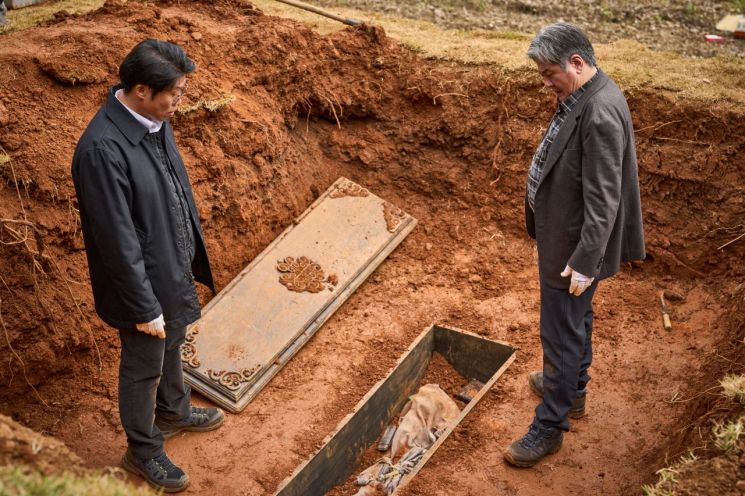
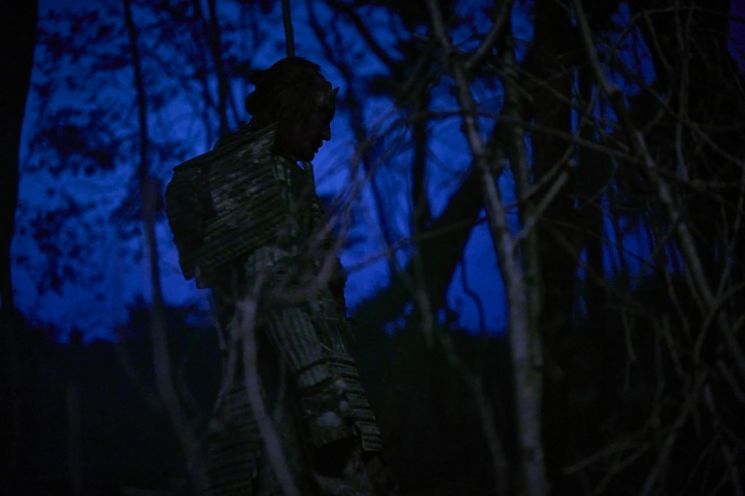
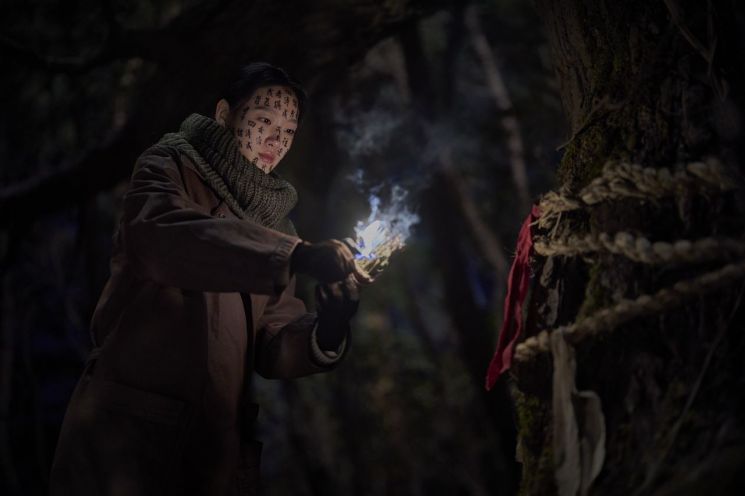
'Pamyo' features a spirit resembling an oni (a Japanese yokai). Originally interred in Daito-gu, it was unearthed during the Japanese colonial period and moved to Goseong, Gangwon Province. Sealed in a coffin with a sword stuck in its spine, it becomes an iron stake. Like the line "A fox cuts the tiger's waist," it suppresses the vital energy veins of the Korean Peninsula.
This provocative setting was the key driver behind the film's explosive success. It closely resembles the process by which the Japanese colonial Danmaek theory drew national attention in the past. Although the evidence is weak, ethnic sentiments flare up. During the Kim Young-sam administration, this was politically leveraged to gain public support. They repatriated the remains of figures from the Shanghai Provisional Government and ordered the demolition of the Government-General building, appealing to nationalism. 'Pamyo' adds occult (mystical and supernatural) elements to a similarly colored fictional imagination, presenting a new way to elevate nationalism.
▲A Plausible Story
At its core, there is a plausible story. Feng shui is one of our traditional customs. It ranges from a way of thinking about land or spatial structures to a belief system. Feng shui practitioners unanimously say that feng shui was completely denied and insulted during the Japanese colonial period. The late Choi Chang-jo, a former Seoul National University professor credited with elevating feng shui to an academic discipline, wrote in his book 'Miscellaneous Essays on Feng Shui' that "the cases of Japanese feng shui invasion are so extensive and diverse that they cannot be covered in a small space."
"From changing the name of Baekdusan's summit, the sacred mountain of our people, to Daijeongbong, one of their era names, to severing the veins of ancestral burial grounds of local aristocratic families, there was nothing they did not do. Even when building railroads or roads, they deliberately designed and constructed them to cut off and suppress the necks, limbs, and bodies of sacred mountains, ancestral mountains, main mountains, guardian mountains, and spiritual mountains that local residents believed to be sacred qi flow sites (地氣流行處). (Omitted) The damage was not limited to Seoul's land but symbolically insulted the entire Korean territory."
The origin of the Danmaek theory is not the Japanese colonial era. Its prototype is found in 'Taekriji' written by Joseon scholar Lee Jung-hwan (1690?1765). It contains content about seeking ideal residential areas, including the following story in the Gyeongsang-do Seonsan section.
"It is said that 'half of Joseon's talents are in Yeongnam, and half of Yeongnam's talents are in Ilseon.' Therefore, there have been many literary scholars since ancient times. In the Imjin War year, when Ming soldiers passed through here, a Ming sorcerer, disliking the abundance of talents in a foreign land, ordered soldiers to cut the mountain range behind the town and light charcoal fires to cauterize it. They also drove large iron nails to suppress the land's vital energy, and since then, no talents have been born."
▲Rise of the Japanese Colonial Danmaek Theory
Traditional geographic thought was regarded as superstition during the Japanese colonial period. Even after liberation, it could not flourish due to the dominance of American-style thinking. It regained attention when the Japanese colonial Danmaek theory was raised. Reports of discovered evidence stirred ethnic emotions. In March 1985, the Ornaerim Hiking Club found and removed twenty-two iron stakes, each 45 cm long and 2 cm in diameter, from the summit of Baegundae on Bukhansan.
Various opinions poured in, such as that they were triangulation markers for surveying or merely simple directional markers. None of the explanations fit the irregular placement of all the iron stakes. However, the scale tipped toward the Japanese colonial Danmaek theory when an eighty-year-old woman testified that she witnessed Japanese people driving iron stakes during the colonial period, and a former police officer who participated in iron stake work in 1943 at Songak, Kaesong, also appeared as a witness.
In fact, the most problematic trace is different. It is the Government-General building. The Japanese initially used the Korean Residency-General located on Namsan but began constructing a new office building as the number of staff grew to 15,113. They built the building blocking the front of Geunjeongjeon, where the king received officials and paid respects. This encroached on Seoul, recognized as the best auspicious site in the world, especially its center. The site was finalized as Gyeongbokgung Palace in 1912. The upper authorities, led by Governor-General Terauchi Masatake, spearheaded the dismantling of Gyeongbokgung.
Gyeongbokgung, founded by King Taejo Yi Seong-gye, suffered greatly, with many buildings burned during the Imjin War (1592?1598). After long neglect, Daewongun rebuilt it to enhance national prestige, restoring it almost to its original form by 1867. The construction caused social unrest due to massive costs and manpower. A satirical song called 'Gyeongbokgung Taryeong' emerged mocking the reckless construction.
Gyeongbokgung, restored at great expense, faced the misfortune of being dismantled again by the Japanese less than half a century later. Most feng shui practitioners regard the Government-General building itself as an act to suppress Joseon's vital energy veins. Another example often mentioned is the Donghae Southern Line (Gyeongju-Pohang), which was almost opened in Yangdong-ri, Gyeongju, Gyeongbuk. Records show that villagers opposed its construction, fearing disaster. The railway crossed between Seolchangsan, the main mountain of Yangdong-ri, and Seongjusan, the guardian mountain, changing the original 'water (勿)' shape into a 'blood (血)' shape. Nearby villages also joined the struggle, opposing the railway passing through the mountain where a seowon (Confucian academy) was located, resulting in a route change.
▲Weak Evidence
It is difficult to see the Donghae Southern Line as evidence of an attempt to sever the vital energy veins. The possibility that the railway was planned for such a purpose is slim. The Japanese even changed the route at the residents' request, incurring additional costs. Most of the evidence for the Japanese colonial Danmaek theory is circumstantial inference. There is no physical evidence or concrete proof to define it as a crime. It is also questionable whether the Japanese had enough knowledge to systematically execute Danmaek.
Geographer Lee Mong-il wrote in his book 'A Study on the History of Korean Feng Shui Thought' that "When Japan occupied this land, they selected thirteen Koreans knowledgeable in geomancy, forming the so-called 13-member committee to identify auspicious sites, such as places where generals or outstanding figures might be born, and severed those veins." However, Professor Nozaki Mitsuhiko of Osaka City University pointed out flaws in his book 'Korean Feng Shui Practitioners.'
"I stayed overnight at Mr. Lee Mong-il's house and discussed various opinions. The 13-member committee claim was based on practical manuals for rites and ceremonies circulating in Korea. Later, I received a copy, but it was disappointing. If it had been written by Government-General officials or Koreans at the time, it would be different, but using content from an unknown origin practical manual for rites and ceremonies (a wedding and funeral encyclopedia) without careful consideration as a basis for a doctoral thesis is hard to excuse as proper research conduct."
The iron stakes found at Baegundae are equally weak evidence. Son Jeong-mok, a former chairman of the Seoul History Compilation Committee and urban administration researcher, said in an interview with Professor Nozaki:
"I am skeptical about the theory that those iron stakes were for severing vital energy veins. If the Government-General had planned large-scale Danmaek activities nationwide, they would have budgeted and executed it systematically, regardless of the official name, but as far as I know, no such records exist. I think those iron stakes were probably for surveying during the land survey project (a land ownership confirmation survey conducted in the early colonial period) or for map-making before that. There are many absurd interpretations about feng shui, many of which I cannot agree with. However, I respect it as an expression of ethnic claims and have no intention of pouring cold water on it."
▲1% Possibility
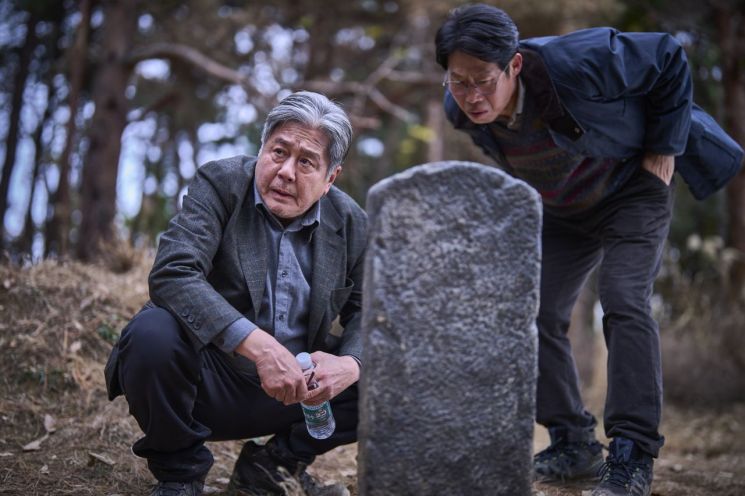
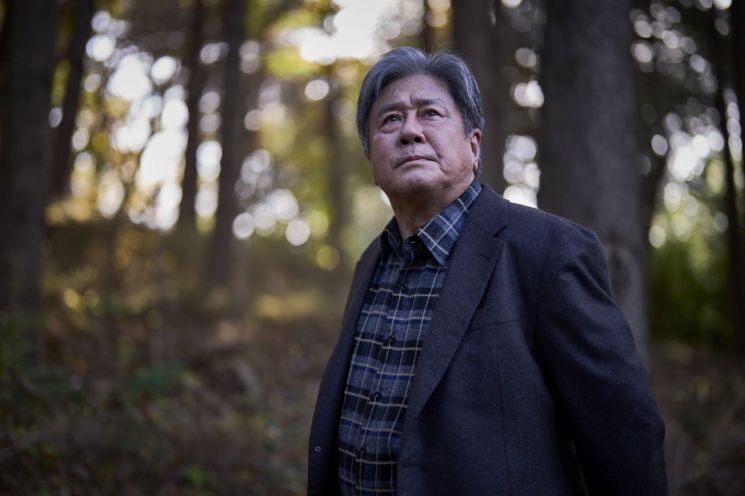
In 'Pamyo,' mortician Ko Young-geun (played by Yoo Hae-jin) and feng shui master Kim Sang-deok (played by Choi Min-sik) debate the Japanese colonial Danmaek theory. "They said (the iron stakes) were for land surveying. 99% is fake." "Then what about the 1%?" Director Jang Jae-hyun explained, "We don't know if the iron stakes exist or not. I put that line in because we don't know if it's true or not." "We didn't include actual iron stakes in the film for that reason. I don't know if they exist or not."
In reality, the Japanese colonial Danmaek theory has mostly been passed down orally. Even the Ornaerim Hiking Club, which pulled out the iron stakes from Baegundae, based their investigation on the testimony of the grandmother who owns Baegunsan Lodge. "She said that when she married at sixteen and came from Suwon, her father-in-law was seen driving iron stakes with Japanese people. Encouraged by her testimony, we climbed the mountain several times from winter to spring that year, pulling out iron stakes, which became a media sensation. After that, a nationwide investigation began, but we did not obtain anything conclusive (Chairman Koo Yun-seo)."
Oral tradition does not mean it is untrue. However, conversely, there is a problem in accepting rumors as actual events. Danmaek was already recorded in old texts like 'Taekriji' and 'Dongguk Yeoji Seungnam' in the form of folklore. Perhaps the Japanese colonial Danmaek theory is merely a temporal transformation of that.
Of course, the Japanese likely wanted to show their power to the people through projects like building the Government-General building. But planned Danmaek is a completely different matter. Professor Nozaki said, "Originally, Gyeongbokgung had been left as it was for 250 years since it burned down during the Imjin War." "Even though Joseon's vital energy veins were left flowing unattended after losing the auspicious site called Gyeongbokgung, no one seems to have raised the issue." "Daewongun, who liked feng shui, promoted the reconstruction of Gyeongbokgung, which seems to have greatly influenced the revival of modern royal capital feng shui theory."
Perhaps 'Pamyo' is also a product inspired by oral tradition. The presumed source is the 1971 'Mountaineering Hiking Series' Bukhansan edition published by Seongmungak. It contains a story that Wada Ichiro, president of Shiksan Bank, and Han Sang-ryong, president of Hanil Bank, hired Chinese workers in 1927 to drive iron stakes. It is said they raised 1,900 won from the business community in support of the assimilation policy to carry out the work.
The latter is roughly a nephew of Lee Wan-yong, known as a representative traitor. Ethnic hatred toward Lee Wan-yong remains strong even today. His descendants cannot reveal their names publicly. One of them even caused controversy by filing an inheritance claim lawsuit. Director Jang triggered unprecedented box office success by sparking the national sentiment of the time with the Japanese colonial Danmaek theory. The medium of feng shui still stirs the blood of Koreans.
© The Asia Business Daily(www.asiae.co.kr). All rights reserved.



















