Biden: "US Supply Chain Share to Reach 20% by 2030"
NYT Examines Production of US Semiconductor Companies
Dependence on East Asia Inevitable... "Cost Competitiveness"
The U.S. administration under Joe Biden has decided to provide approximately 27 trillion won in subsidies to its domestic semiconductor company Intel, raising expectations for a reorganization of the semiconductor supply chain centered in the United States. However, given the strong semiconductor dominance and supply chains in East Asia, including South Korea, Taiwan, and Japan, experts predict that even with massive government funding, it will be difficult to reduce dependence on Asian semiconductors in the short term.
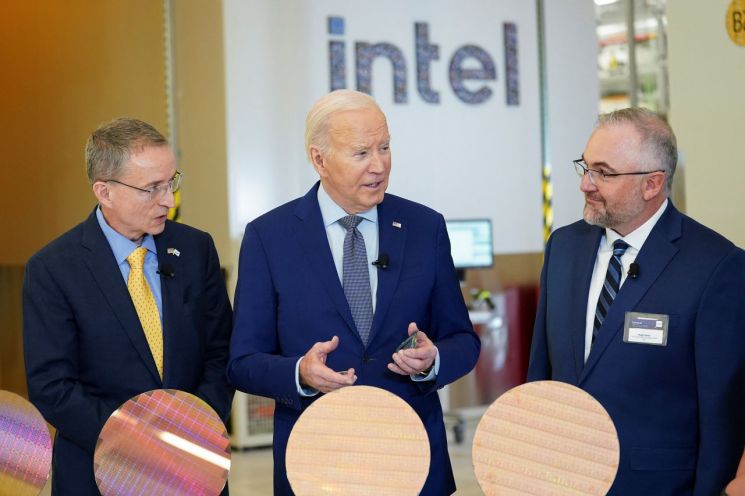 U.S. President Joe Biden (center) is seen conversing at the Intel campus in Arizona, USA, on the 20th (local time).
 [Image source=Reuters Yonhap News]
On the 20th (local time), when the Biden administration announced support for Intel, The New York Times (NYT) reported, "The U.S. government is investing $39 billion (about 52 trillion won) to encourage semiconductor companies to build factories domestically and bring more of the supply chain home, but even if factories are built in the U.S., semiconductor manufacturing will undoubtedly be divided globally."
In its fourth year in power, the Biden administration has been striving since the beginning of its term to reorganize the semiconductor supply chain centered on the United States. The share of the U.S. in the global semiconductor production supply chain has sharply declined from 37% in 1990 to 12% currently. President Biden expressed his determination to raise this share to 20% by 2030 during the announcement of support for Intel.
In the 1960s, when the U.S. was the main pillar of the supply chain, it shifted part of the supply chain overseas to reduce production costs. Through this process, South Korea, Taiwan, and others, following Japan, established themselves as key players in the semiconductor supply chain based on large-scale government support. The U.S. relatively reduced domestic investment in the semiconductor industry. However, despite the massive U.S. investment, major countries such as South Korea, Japan, Taiwan, China, and Europe are simultaneously pouring economic support into the semiconductor industry, making it difficult for the U.S. alone to build a supply chain, which is the prevailing view.
The NYT emphasized the difficulty of creating a U.S.-only supply chain excluding Asia, based on the supply chain of ON Semiconductor, the world's second-largest power semiconductor company for electric vehicles, headquartered in the U.S. According to the report, the production of silicon carbide, ON Semiconductor's core product, begins in the U.S. At ON Semiconductor's New Hampshire plant, primary processing is done using silicon powder sourced from Norway, Germany, and Taiwan. This process uses graphite and gases from the U.S., Germany, and Japan. The resulting crystals are then moved to a plant in the Czech Republic, where secondary processing is carried out to produce thin wafers using machinery from the U.S., Germany, Italy, and Japan.
The produced wafers are sent to a plant in Bucheon, Gyeonggi Province, South Korea, for tertiary processing, and then move to plants in China, Malaysia, and Vietnam for post-processing such as testing and packaging. Some of the semiconductors produced by ON Semiconductor are distributed through centers in China and Singapore to automotive manufacturers in Asia and Europe, including Hyundai Motor and BMW. Others are sold to automotive parts suppliers in Canada, China, and the U.S.
Chance Finley, Vice President of Global Supply Chain at ON Semiconductor, explained that technology companies facing fierce competition tend to outsource work to Asia, where the most technologically advanced manufacturers are located, to reduce costs. NYT reported that ON Semiconductor is considering investments in semiconductor manufacturing facilities in the U.S., but is still contemplating facility expansions worth $2 billion in countries including the Czech Republic and South Korea.
Moody's Analytics, a subsidiary of the global credit rating agency Moody's, also forecasted in a report last month that while China will become isolated, the concentration of semiconductor production in Asia will continue for the time being. Moody's evaluated, "Asia's leadership in the semiconductor industry clearly works to its advantage. The concentration of semiconductor production in a few large companies drives economies of scale and creates regional supply chains necessary for this industry."
© The Asia Business Daily(www.asiae.co.kr). All rights reserved.

















