Eisai 'Senior Welfare Digital Transformation' Symposium
"The digitalization of senior welfare is an unstoppable trend. To achieve this, we must start by bridging the digital information gap."
As Korea approaches a super-aged society, the era of 'digital welfare' has begun, where digital services are increasingly integrated into welfare services for seniors. However, concerns remain about the elderly's lower usability of digital devices, highlighting the urgent need for discussions to address these issues.
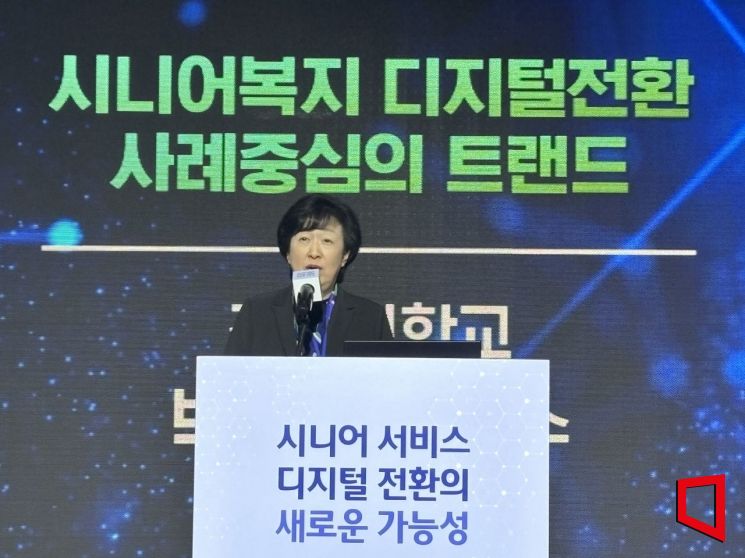 Professor Park Young-ran of the Department of Silver Industry at Gangnam University is presenting at a symposium held on the 21st at The-K Hotel in Seocho-gu, Seoul.
 [Photo by Yeom Da-yeon]
On the afternoon of the 21st, at the 'New Possibilities for the Digital Transformation of Senior Services Symposium' hosted by Korea Eisai at The-K Hotel in Seocho-gu, Seoul, these concerns were further discussed.
Professor Park Young-ran of Gangnam University's Department of Silver Industry, who gave the first presentation at the symposium, examined how welfare for the elderly is transitioning to digital. She stated, "In Korea, the COVID-19 pandemic accelerated digital transformation, and the government is rapidly developing digital care services based on next-generation information systems. While digital devices are being distributed to welfare centers and opportunities for education and hands-on experience are being provided for seniors facing digital information gaps, these efforts are still insufficient and require urgent resolution." Professor Park emphasized, "Elderly individuals do not have the luxury of time to solve many problems, so there is a sense of urgency. Extensive research on the senior consumer group must be conducted quickly."
The digital information gap refers to the phenomenon where disparities in access to and ability to use information lead to broader social and economic inequalities. According to the Korea Intelligent Information Society Education Institute, when the general population is set at 100%, the digital informatization levels of those in their 60s and 70s or older are only 75.6% and 55.6%, respectively. Compared to 20-somethings, who score 127.2%, the gap is severe.
Professor Kim Young-joo of Gachon University's Department of Biomedical Devices presented the need for a new perspective on the digital divide among the elderly. He argued, "Aging is not an inevitable phenomenon but a natural one. We need to reconsider whether the perspective of trying to teach the elderly is appropriate." Professor Kim added, "We should not say there is a gap by first planning digitally and then trying to fit the elderly into it. A new approach is needed where, for example, users may perceive things analogically, but providers deliver services digitally." As an example, he cited Japan's taxi stands, which have public telephones. When a user picks up the phone and states their destination, an AI system automatically dispatches a taxi. Professor Kim explained, "Users do not need to know what digital methods are implemented inside the phone; it is an efficient system for everyone."
In presentations by companies involved in senior welfare services and related businesses that followed, voices emerged expressing intentions to reduce the digital information gap or attempt new approaches from different perspectives.
Kim Hyung-won, Deputy General Manager at Korea Eisai, proposed a smart brain health management solution that seniors can easily use, considering that digital healthcare will become an essential tool for the elderly. He explained, "We are utilizing Cogmate, a brain health assessment tool, to easily assess cognitive decline in seniors. The simple and intuitive interface allows seniors to use it without difficulty." Korea Eisai has been operating the 'Brain Health School' in collaboration with the Korea Association of Senior Welfare Centers since last year, based on brain health projects including Cogmate, and is preparing for the domestic launch of Rekembi, an Alzheimer's disease treatment developed jointly with Biogen.
Yu Ho-young, Deputy Manager at DKI Technology, which is running the Smart Senior Center project, presented on 'Digital Healthcare Transformation of Senior Services through Smart Senior Centers.' He introduced, "Smart Senior Centers are being established to solve digital exclusion and provide better living environments. Through kiosk education experiences and healthcare using video platforms, seniors are empowered to handle digital technology themselves and develop healthy habits."
Additionally, at Smart Senior Centers, seniors can experience health measurements through Internet of Things (IoT) devices, singing classes via smart TVs, and motion recognition-based customized exercise content for the elderly. Deputy Manager Yu stated, "Through these efforts, we aim to ultimately reduce health inequalities and the digital information gap, creating a sustainable future."
© The Asia Business Daily(www.asiae.co.kr). All rights reserved.
![Clutching a Stolen Dior Bag, Saying "I Hate Being Poor but Real"... The Grotesque Con of a "Human Knockoff" [Slate]](https://cwcontent.asiae.co.kr/asiaresize/183/2026021902243444107_1771435474.jpg)











