22nd Public Livelihood Forum Hosted by the President on the 21st
Rapid Aging Approaching 10 Million Elderly Population
Supply Regulation Eased Amid Surge in Elderly Housing Demand
'Silver Stay' to Be Provided for Middle-Class Seniors
 Elderly people gathered in small groups near Tapgol Park in Jongno-gu, Seoul. The photo is unrelated to the article content. Photo by Jinhyung Kang aymsdream@
The legally banned ‘sale-type Silver Towns’ are making a comeback after 10 years. The eligibility criteria have been removed so that anyone aged 60 or older can move in. Additionally, a corporate long-term rental housing called ‘Silver Stay’ will be introduced for middle-class seniors, and opportunities to move into 'Senior Welfare Housing' will also be provided.
On the 21st, the Ministry of Health and Welfare, the Ministry of Land, Infrastructure and Transport, and other related ministries announced these details at the 22nd Public Discussion Forum held at the Health Insurance Review & Assessment Service in Wonju, Gangwon Province, under the theme of ‘Healthy and Happy Old Age.’
‘Era of 10 Million Seniors’... Regulations Must Be Eased to Increase Silver Towns
First, starting next year, sale-type Silver Towns will be allowed in 89 depopulated areas. Currently, only rental-type Silver Towns are permitted. The move-in qualifications have also been relaxed. Previously, only those ‘capable of independent living’ could move in, but this requirement has been abolished. The entrusted operation regulations have been eased to allow various institutions to enter even without prior experience in senior welfare housing projects. At the same time, moving into Silver Towns will be recognized as an exception to ‘actual residence,’ allowing continuous payment of housing pensions.
The deregulation of sale-type Silver Towns is the first in 10 years since 2015. Initially, both rental and sale types were allowed, but illegal sales aimed at development profits became rampant, leading to a legal ban. Yeom Min-seop, Director of Senior Policy at the Ministry of Health and Welfare, explained, “Sale-type Silver Towns offer many benefits to developers, such as acquisition tax and green space provision. As land prices around the area rose significantly, conflicts arose over the ‘60-year age limit for sales’ regulation, which was abolished by the National Assembly.”
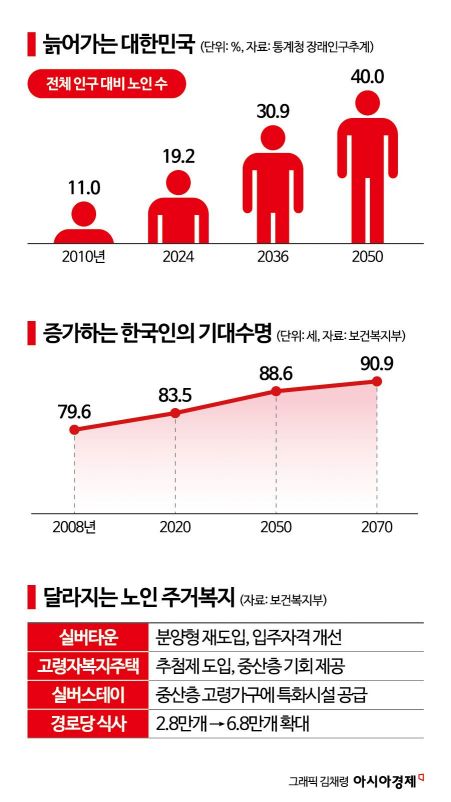
Nevertheless, the reason for reintroducing sale-type Silver Towns is the unprecedentedly rapid aging population. According to Statistics Korea, as of last month, the elderly population was about 9.81 million and is expected to surpass 10 million this year. By next year, Korea will enter a super-aged society where seniors make up more than 20% of the total population, and by 2050, 40% will be elderly. The demand for seniors’ housing, meals, and medical care is expected to increase significantly, and to increase the supply of Silver Towns to meet this demand, allowing sale-type is necessary.
In particular, the government holds the position that sale-type should be allowed in areas with declining populations where profitability is higher. Lee Ki-il, First Vice Minister of Health and Welfare, said, “When I visited Gochang, Jeonbuk, many expressed the need for sale-type. Since it is a depopulated area, only sale-type can circulate funds, which activates senior housing,” adding, “Most of these areas do not include the metropolitan area, but some places like Ganghwa and Ongjin County are included.”
The government explained that since deregulation will occur in depopulated areas, there is little risk of land price surges. However, due to past side effects, a pilot project will be conducted first, followed by additional measures such as drafting standard contracts. Furthermore, supplementary measures will be prepared to prevent illegal activities or poor management related to sale-type Silver Towns.
Improved Housing Welfare for Middle-Class Seniors... Gradual Expansion of Meals at Senior Centers
The housing welfare system for middle-class seniors will also be restructured. Baby boomers living on pensions are entering the senior generation, but there is a shortage of living spaces. Accordingly, the introduction of corporate long-term rental housing called Silver Stay for middle-class elderly households is being promoted. Silver Stay will provide facilities and services specialized for seniors. Housing facilities for vulnerable residents will apply standards such as installing motion detectors and eliminating level differences.
The move-in method for Senior Welfare Housing will be changed. Senior Welfare Housing is rental housing designed with barrier-free features, offering meal and leisure services. Previously, move-in was only sequential based on income level, but from now on, a lottery system will also be used to provide opportunities for the middle class. The supply volume will increase to 3,000 households. Initially, 1,000 households were planned to be newly built in provincial areas, but through remodeling and other methods, an additional 2,000 households will be supplied in urban areas.
On this day, the government also unveiled plans for senior meal welfare. The ‘meal service at senior centers and senior dining halls’ is representative. Currently, about 28,000 senior centers provide meals an average of 3.6 days per week. This will be gradually expanded so that from next year, meals will be provided at all 68,000 senior centers. The necessary workforce will be supplied by increasing related senior jobs by 22,000, and facilities without cooking facilities will begin expanding their infrastructure and equipment starting this year.
A meal welfare system will also be created in apartments and general residential areas outside senior centers. Similar to some apartments operating private breakfast services using common spaces, the government plans to create senior meal hubs using common spaces. For seniors with mobility difficulties, meal delivery services will be promoted. Currently, this service is limited to 12 locations, but it will be expanded nationwide next year.
© The Asia Business Daily(www.asiae.co.kr). All rights reserved.


















