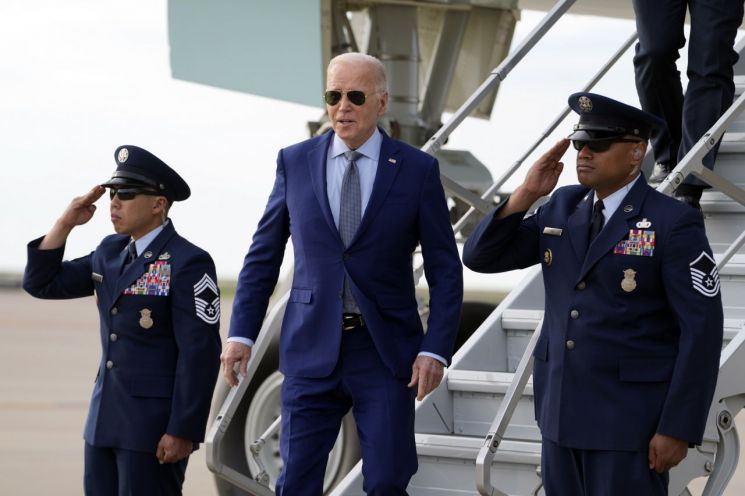
U.S. President Joe Biden, who has emphasized responding to climate change, has finalized regulations to reduce emissions by about half by 2032. Through this, the plan is to increase the share of electric vehicle sales among new cars sold in the U.S. to 56%. However, since this represents a retreat from the original plan, it is pointed out that the administration was mindful of industry backlash ahead of the presidential election. The slowing growth trend of electric vehicles is also interpreted as having influenced the decision.
The new vehicle emissions regulations announced by the U.S. Environmental Protection Agency (EPA) on the 20th (local time) will apply starting with the 2027 model year. The core of the regulations is to gradually reduce allowable emissions of carbon dioxide (CO₂), non-methane organic gases (NMOG), nitrogen oxides (NOx), and particulate matter over six years until 2032.
Accordingly, the current electric vehicle sales share of around 7% will expand to 56% by 2032. The share of plug-in hybrid vehicles is set at 13%. Conversely, the share of internal combustion engine vehicles such as gasoline cars will decrease to 29%. The EPA stated, "The new regulations can help address the climate crisis," adding that "more than 7 billion tons of carbon will be reduced by 2055, with expected benefits amounting to $100 billion annually." These benefits include reduced medical costs, improved air quality, and lower fossil fuel expenses.
Locally, this emissions regulation proposal is being regarded as a de facto victory for the automotive industry. This is because it is a more relaxed outcome compared to the draft released in April last year. The new regulations are phased in to give the automotive industry time to prepare for emissions standards, easing some requirements. The sales share target by 2032 was also lowered from 67% to 56%. The Wall Street Journal (WSJ) described it as "a victory for established automakers," noting that "the Biden administration created the strictest emissions regulations ever, but made significant concessions by giving manufacturers more time."
So far, the automotive industry has argued that meeting the strengthened standards is limited by technological improvements in internal combustion engines and that rapidly expanding electric vehicle sales is not realistically easy. For President Biden, who faces the November presidential election, it was unavoidable to consider industry sentiment separately from his pledge for an electric vehicle transition.
In particular, there have been concerns locally that a rapid shift to electric vehicles would negatively impact internal combustion engine jobs in Michigan, Wisconsin, Pennsylvania, and other states. These states are key battlegrounds in the presidential election. Additionally, the recent noticeable slowdown in electric vehicle growth is also analyzed as having influenced the decision.
A Biden administration official told the WSJ, "We received convincing information," and conveyed that regulators concluded that allowing more time for the electric vehicle transition would result in a more sustainable policy. The New York Times (NYT) pointed out that "electric vehicles are President Biden's core strategy against climate change and have become a flashpoint in the 2024 presidential campaign," indicating the campaign's influence.
John Bozzella, president of the Alliance for Automotive Innovation, a lobbying group representing 42 automakers in the U.S., stated in a press release that the new regulations provide some flexibility. He emphasized, "The future is electric vehicles," but added, "The speed of the electric vehicle transition is important. The market and supply chains must be able to keep up." On the other hand, environmental groups have given mixed evaluations. While some still consider the targets aggressive, there is also criticism for the retreat compared to the draft.
© The Asia Business Daily(www.asiae.co.kr). All rights reserved.

















