SK Bioscience's influenza vaccine Skycellflu is launching its attack on the Southeast Asian and Southern Hemisphere vaccine markets, starting with Thailand. This is the first time SK Bioscience has introduced a vaccine for the Southern Hemisphere in the influenza vaccine market, which is divided into the Northern and Southern Hemispheres.
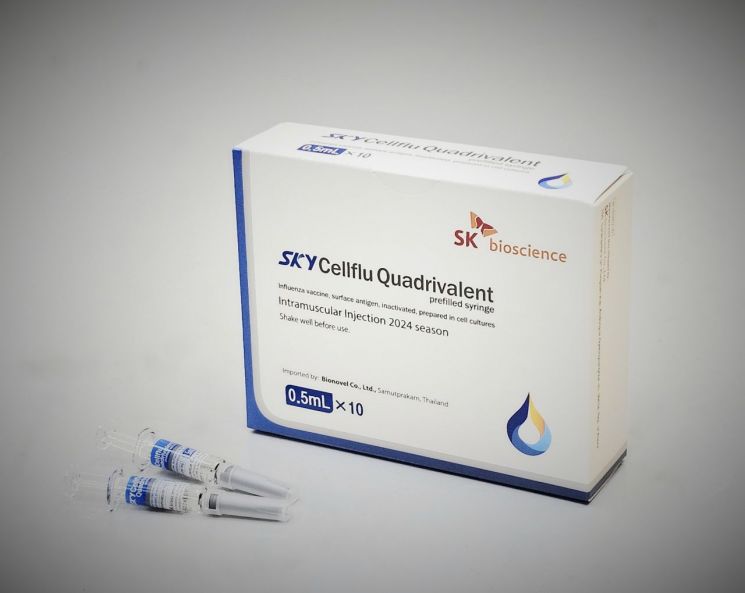
On the 21st, SK Bioscience announced that about 440,000 doses of Skycellflu for supply to its Thai partner BiogenTech were shipped from the Andong L House. This vaccine was developed to prevent the influenza strains expected to circulate in the Southern Hemisphere during the 24th season, as announced by the World Health Organization (WHO).
This is the first time Skycellflu has been launched targeting influenza outbreaks in the Southern Hemisphere. The WHO divides the world into the Southern and Northern Hemispheres and announces about a year in advance which vaccine strains are expected to be predominant in each region. While winter in the Northern Hemisphere, where Korea is located, is from December to February, the Southern Hemisphere, including Australia and New Zealand, experiences winter from June to August, so the main epidemic periods differ and are disclosed separately.
Geographically, Thailand is classified as part of the Northern Hemisphere, located above the equator. However, in terms of influenza outbreaks, the influence of the Southern Hemisphere is actually greater. Because of this, Thailand is classified as a country affected by both Northern and Southern Hemisphere influenza vaccination guidelines from the WHO, requiring continuous vaccine supply throughout the year. SK Bioscience has supplied the bulk substance of Skycellflu to Thailand’s state-owned pharmaceutical company GPO since July last year, providing Northern Hemisphere vaccines to Thailand, but this is the first time it is supplying Southern Hemisphere vaccines as well.
SK Bioscience expects that if the anticipated epidemic strains in the Southern and Northern Hemispheres are the same, it will be able to secure production efficiency and strengthen market competitiveness. Producing vaccines based on the same strains allows for shortened supply times and reduced manufacturing costs due to continuous operation of production facilities. In fact, the influenza strains preventable by the Skycellflu produced this time are the same as those expected to circulate in the Northern Hemisphere in the second half of this year.
Furthermore, this export is expected to serve as a positive case for entry into procurement markets of international organizations such as UNICEF and the Pan American Health Organization (PAHO), as well as individual countries. Skycellflu has received product approval in 12 countries including Malaysia and Singapore, in addition to Thailand.
Ahn Jae-yong, CEO of SK Bioscience, said, “This export of Skycellflu to Thailand is a stepping stone for full-scale global market expansion beyond entry into Southeast Asia and the Southern Hemisphere markets. We will accelerate not only the development of blockbuster new vaccines such as the next-generation pneumococcal vaccine entering phase 3 clinical trials this year but also the diversification of markets for existing products to improve mid- to short-term performance.”
© The Asia Business Daily(www.asiae.co.kr). All rights reserved.
!["The Woman Who Threw Herself into the Water Clutching a Stolen Dior Bag"...A Grotesque Success Story That Shakes the Korean Psyche [Slate]](https://cwcontent.asiae.co.kr/asiaresize/183/2026021902243444107_1771435474.jpg)
















