Glucagon-like peptide-1 (GLP-1) drugs, known as 'miracle obesity treatments' capable of reducing body weight by 20% in a year, are emerging as a hot topic in the global pharmaceutical and biotech industries. However, due to various side effects and high drug costs, interest is growing not only in the administration of these drugs but also in how, how much, and how well they should be used.
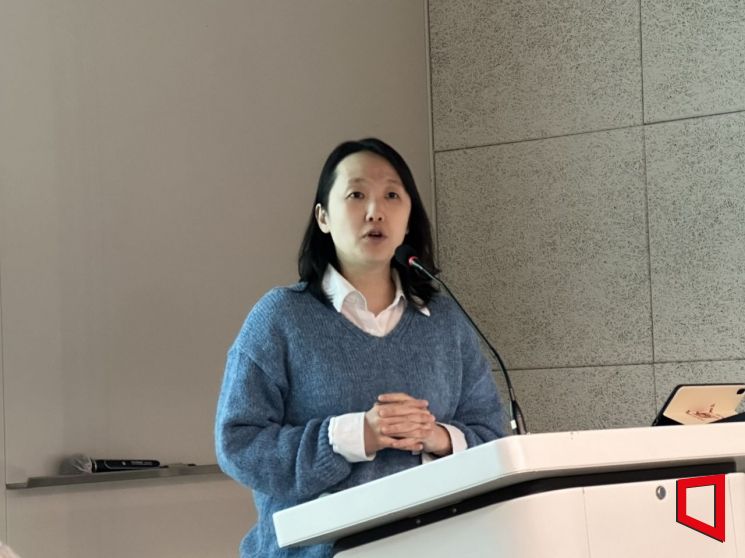 Jung Ju-yeon, a Kakao Ventures evaluator, is giving a lecture at the Kakao Ventures Brown Bag Meeting event held on the morning of the 20th in Gangnam-gu, Seoul.
 [Photo by Lee Chun-hee]
On the 20th, in Gangnam-gu, Seoul, Kakao Ventures held a brown bag meeting event introducing companies that incorporate digital technology for health management, including obesity, reflecting this growing interest among 'Family Companies' invested in by Kakao Ventures.
Joo-yeon Jung, a screening officer at Kakao Ventures who hosted the event, assessed the current situation by saying, "GLP-1 and obesity are big trends in 2023 and will continue to be so," adding, "The stigma around using medication for weight loss is diminishing."
Jung further explained, "People wonder whether they really need to take medication, which drug suits them best, and how to receive cost-effective treatment," emphasizing, "Lowering these hurdles is an area where startups can take on challenges." Specifically, she noted that digital healthcare startups can demonstrate their capabilities in the obesity treatment market by maximizing effectiveness when used alongside existing treatment processes, reducing anxiety and difficulties during weight loss, completing expensive drug treatment courses, and managing maintenance (offboarding) after discontinuation of medication.
 Cheon Yesel, CEO of Vivid Health, is presenting the company introduction at the Kakao Ventures Brown Bag Meeting held on the morning of the 20th in Gangnam-gu, Seoul.
 [Photo by Lee Chunhee]
Both Vivid Health and Gaji Lab, which presented at the event, emphasized that their solutions help manage obesity and other health issues digitally.
Vivid Health, which gave the first presentation, is a startup developing 'Ppiyak,' an obesity treatment management platform scheduled for launch next month. The company was founded in January by CEO Yesul Cheon and Chief Operating Officer (COO) Jaemin Jo, who joined forces after working together at another startup. Jung explained the reason for investing in Vivid Health as, "They have a patient-centered mindset," and "They have a deep understanding of the demand that arises from actually implementing patient communities."
The core content of Ppiyak is 'obesity drug usage reviews.' CEO Cheon said, "We aim to address side effects experienced before and after taking obesity drugs, maintenance after discontinuation, and dosage adjustments," adding, "We developed Ppiyak to discover patients' demand to see how others are managing and to consolidate scattered channels into a single service."
Although various drug usage reviews are already posted on blogs and cafes, these often carry risks of bias. Ppiyak plans to provide well-organized reviews to enable access to factual information rather than exaggerated content, allowing users to understand how people in similar situations manage their treatment and gain more practical experience. CEO Cheon emphasized, "While the positive effects of obesity drugs are often overstated, information about side effects and risks is hard to find and understand," adding, "Users can check how people with similar body mass index (BMI) have taken the medication." Vivid Health has already secured about 200 refined drug usage reviews ahead of Ppiyak's launch.
Additionally, for Saxenda, the GLP-1 obesity drug mainly prescribed in Korea, patients must adjust their own dosage. Vivid Health also provides a drug management solution to assist with dosage adjustment and effect monitoring. Through collaboration with hospitals specializing in obesity treatment, they aim to make treatment information more accessible and plan to generate revenue in the long term through consultation connections with medical institutions and hospital advertising.
 Kim Young-in, CEO of Gajilab, is presenting the company introduction at the Kakao Ventures Brown Bag Meeting held on the morning of the 20th in Gangnam-gu, Seoul.
 [Photo by Kakao Ventures]
Following this, Youngin Kim, CEO of Gaji Lab, introduced their service as a 'personalized wellness curation platform.' Kim, a healthcare expert and former head of the Korean and Japanese branches of the global healthcare service Noom, is a physician by training.
Gaji Lab offers a service that identifies individual wellness tendencies through a brief survey and provides personalized feedback. They have accumulated about 50,000 personalized diagnostic data points so far. Based on this, Kim envisions providing health management services tailored to individual characteristics. They are also developing a 'generative artificial intelligence (AI) health checkup consultation service' tailored to Korea's unique situation, where 15 million health checkups are conducted annually. Kim said, "Although people are advised to visit a hospital if a serious disease is suspected during a checkup, there is often no proper follow-up for conditions requiring management," adding, "We are developing a function that summarizes and explains checkup results more easily using AI."
Kim emphasized the importance of the wellness model in the GLP-1 obesity drug market by leveraging this business model. He stated, "The biggest drawback of GLP-1 is that weight is regained once the medication is stopped," adding, "To manage side effects, a wellness solution is needed that helps correct lifestyle habits during GLP-1 treatment so that even when suppressed appetite returns after stopping the drug, patients can manage effectively."
© The Asia Business Daily(www.asiae.co.kr). All rights reserved.



















