Medical School Quotas Expanded: 1,639 in Non-Capital Areas, 361 in Capital Area
KMA: "Prime Minister to Announce Directly... Premature Discussions Are Inappropriate"
KMA, Daejeon Medical Association, and Jeon Medical Student Association to Hold Online Meeting at 8 PM
The results of the 2025 academic year medical school student quota allocation were announced on the 20th, and the medical community appears to be taking a cautious approach in responding. The medical community held an emergency meeting that evening and stated that they would decide their position after discussions.
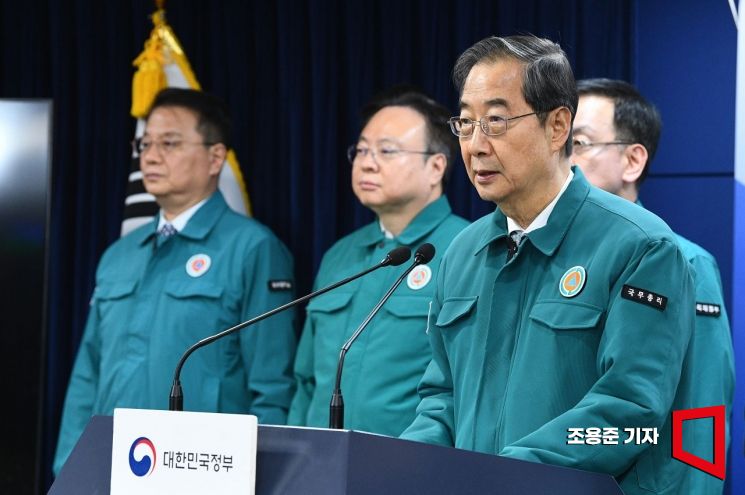 Prime Minister Han Duck-soo is delivering a statement on medical reform and the allocation of 2,000 medical school quotas at the Government Seoul Office in Jongno-gu, Seoul, on the 20th. Present at the announcement were Choi Sang-mok, Deputy Prime Minister and Minister of Economy and Finance; Lee Ju-ho, Deputy Prime Minister and Minister of Education; Lee Sang-min, Minister of the Interior and Safety; Cho Kyu-hong, Minister of Health and Welfare; and Bang Ki-seon, Director of the Office for Government Policy Coordination. Photo by Jo Yong-jun jun21@
On the same day at 2 p.m., the government held a public address at the Government Seoul Office in Jongno-gu, Seoul, announcing the results of the 2025 academic year medical school student quota allocation. The total increase in quota is 2,000 students, with 1,639 additional seats allocated outside the metropolitan area and 361 seats in the metropolitan area.
The medical community expressed a cautious stance toward the government's announcement. Kim Kang-hyun, spokesperson for the Korean Medical Association Emergency Committee (KMA Emergency Committee), said, "Since the Prime Minister announced it personally, we must respond carefully," adding, "It is inappropriate to make premature statements."
The medical community is expected to devise response strategies through an emergency meeting. The KMA Emergency Committee, the Korean Intern Resident Association (KIRA), and the National Medical School Professors' Council (NMSPC) will hold an online meeting at 8 p.m. that day to discuss medical issues, including the medical school quota allocation results. As the government’s announcement of the quota by each medical school effectively confirms the increase of 2,000 students, the medical community, which has opposed this, is expected to consider last-resort measures. Park Dan, chairperson of the KIRA Emergency Committee, also stated on social media the previous day, "I met with local residents and medical students. We are planning a meeting soon in Gyeonggi Province," and added, "Tomorrow, I intend to meet with KMA and NMSPC members in Seoul."
The Korea Hospital Association also expressed a cautious stance. A hospital association official said, "We plan to observe how the situation develops," but added, "We deeply express concern over the current situation, and the government should not only insist on principles and take a hardline stance but also listen to the concerns of the medical community and actively engage in dialogue. This remains our initial position."
Residents appealed that the current educational environment cannot accommodate the increased quota announced by the government. Ryu Ok-ha-da, former representative of interns at the Catholic Central Medical Center, said, "In the case of Chungbuk National University Medical School, the quota increased from 49 to 200. With two grades of medical students doing clinical rotations, it means 400 students are rotating at once," adding, "According to Chungbuk National University residents, the hospital has about 800 beds, and if the bed occupancy rate is 75%, there are 600 patients. Medical students on rotation study patients once every one to two weeks, but two-thirds of all patients have to be interviewed by medical students. I question whether this is reasonable."
She continued, "There seem to be more residents who are giving up training altogether than those trying to return to training," and added, "Upon seeing this announcement, I felt the same emotions as when the 2,000-person increase was first proposed."
Professors at Yonsei University College of Medicine also issued a statement immediately after the government announcement, urging the government to withdraw the quota increase plan. They argued, "Increasing 67% of medical students within one year and deciding the distribution within a few weeks is a hasty policy that will degrade medical education to a developing country level," and "It is merely a political slogan that completely ignores educational conditions."
They added, "Yonsei University College of Medicine professors declare that they absolutely cannot accept the announced quota allocation plan and will devote their utmost efforts to creating proper medical education conditions."
© The Asia Business Daily(www.asiae.co.kr). All rights reserved.

















